

7, 8, and 7 A ˚ resolution, respectively (PDB ID: 5ND4, 5ND2,
5ND7, 5ND3; EMDB: 3622, 3620, 3623, 3621) [22]. Rigidbody restraints were initially defined as SSEs, and flexible fitting
was run with Flex-EM and iMODFIT. To produce a hybrid fit, the
best-fitting SSEs from both programs were combined, and an
all-atom refinement with Flex-EM was run. For each model, an
increase in global CCC was reported and a QMEAN analysis
showed no degradation in model quality.
3.6 Hierarchical
Refinement Approach
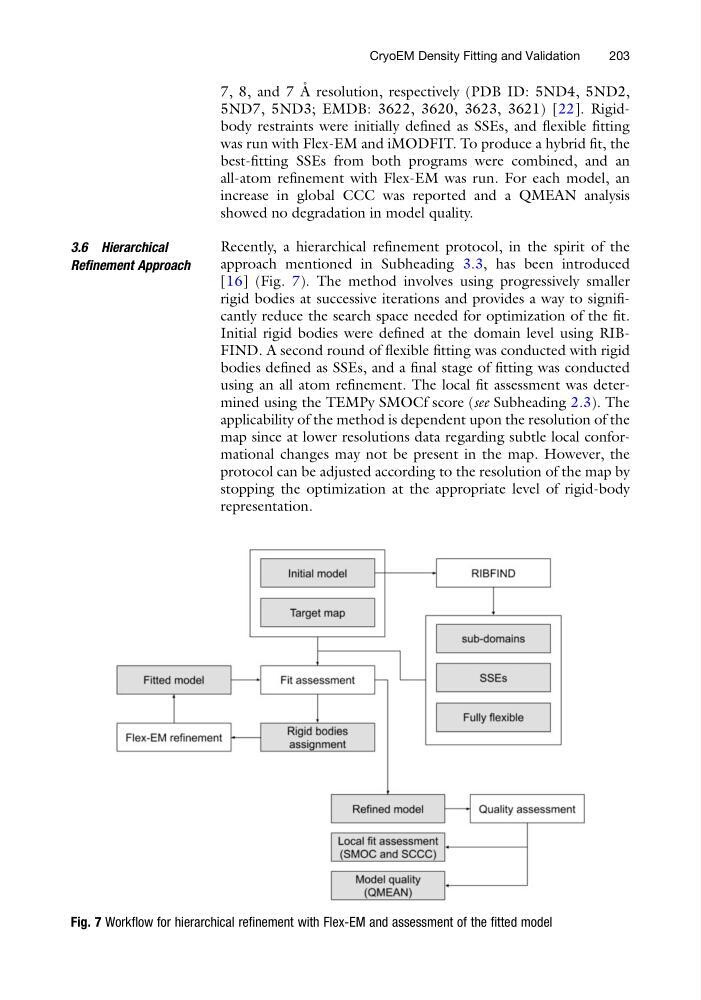
Recently, a hierarchical refinement protocol, in the spirit of the
approach mentioned in Subheading 3.3, has been introduced
[16] (Fig. 7). The method involves using progressively smaller
rigid bodies at successive iterations and provides a way to significantly reduce the search space needed for optimization of the fit.
Initial rigid bodies were defined at the domain level using RIBFIND. A second round of flexible fitting was conducted with rigid
bodies defined as SSEs, and a final stage of fitting was conducted
using an all atom refinement. The local fit assessment was determined using the TEMPy SMOCf score (see Subheading 2.3). The
applicability of the method is dependent upon the resolution of the
map since at lower resolutions data regarding subtle local conformational changes may not be present in the map. However, the
protocol can be adjusted according to the resolution of the map by
stopping the optimization at the appropriate level of rigid-body
representation.
Fig. 7 Workflow for hierarchical refinement with Flex-EM and assessment of the fitted model
CryoEM Density Fitting and Validation
203
5ND7, 5ND3; EMDB: 3622, 3620, 3623, 3621) [22]. Rigidbody restraints were initially defined as SSEs, and flexible fitting
was run with Flex-EM and iMODFIT. To produce a hybrid fit, the
best-fitting SSEs from both programs were combined, and an
all-atom refinement with Flex-EM was run. For each model, an
increase in global CCC was reported and a QMEAN analysis
showed no degradation in model quality.
3.6 Hierarchical
Refinement Approach
Recently, a hierarchical refinement protocol, in the spirit of the
approach mentioned in Subheading 3.3, has been introduced
[16] (Fig. 7). The method involves using progressively smaller
rigid bodies at successive iterations and provides a way to significantly reduce the search space needed for optimization of the fit.
Initial rigid bodies were defined at the domain level using RIBFIND. A second round of flexible fitting was conducted with rigid
bodies defined as SSEs, and a final stage of fitting was conducted
using an all atom refinement. The local fit assessment was determined using the TEMPy SMOCf score (see Subheading 2.3). The
applicability of the method is dependent upon the resolution of the
map since at lower resolutions data regarding subtle local conformational changes may not be present in the map. However, the
protocol can be adjusted according to the resolution of the map by
stopping the optimization at the appropriate level of rigid-body
representation.
Fig. 7 Workflow for hierarchical refinement with Flex-EM and assessment of the fitted model
CryoEM Density Fitting and Validation
203