

and structural homology templates) [1, 2], ab initio models (models built from sequence based on physical principles), or a combinatory approach.
While near-atomic maps allow the use of tools similar to those
developed for X-ray crystallography (and for very high resolutions
may not require an initial model at all), in others, depending on the
resolution and whether the structure suffers from inherent flexibility or experimental limitations, different methods can be applied, to
obtain high-quality, well-fitted atomic model of the macromolecule
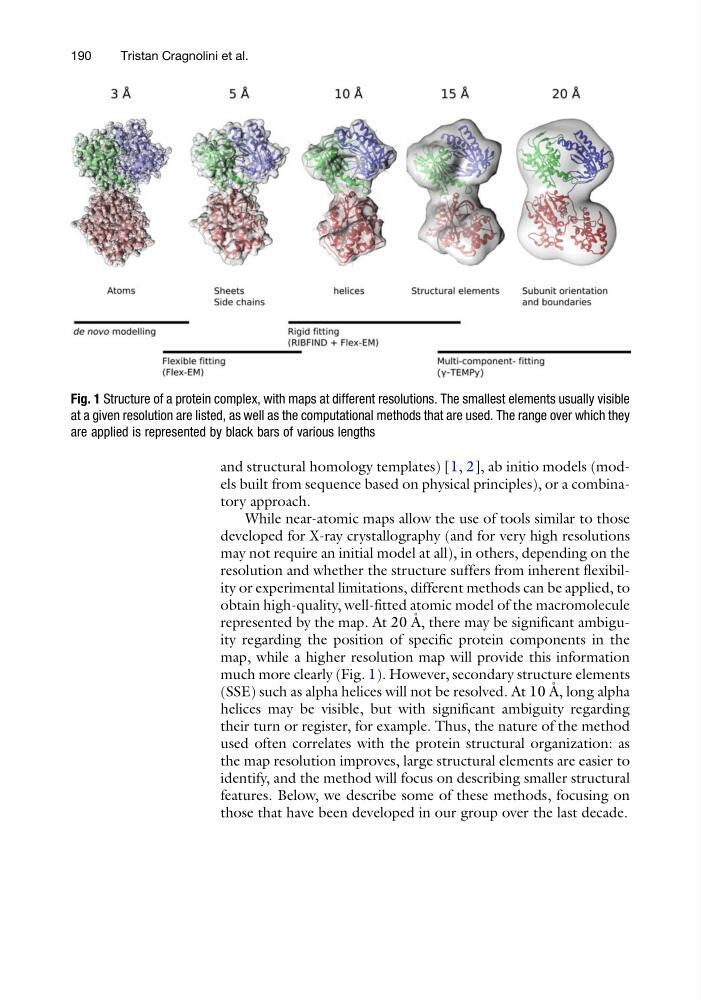
represented by the map. At 20 A ˚ , there may be significant ambiguity regarding the position of specific protein components in the
map, while a higher resolution map will provide this information
much more clearly (Fig. 1). However, secondary structure elements
(SSE) such as alpha helices will not be resolved. At 10 A ˚ , long alpha
helices may be visible, but with significant ambiguity regarding
their turn or register, for example. Thus, the nature of the method
used often correlates with the protein structural organization: as
the map resolution improves, large structural elements are easier to
identify, and the method will focus on describing smaller structural
features. Below, we describe some of these methods, focusing on
those that have been developed in our group over the last decade.
Fig. 1 Structure of a protein complex, with maps at different resolutions. The smallest elements usually visible
at a given resolution are listed, as well as the computational methods that are used. The range over which they
are applied is represented by black bars of various lengths
190
Tristan Cragnolini et al.
While near-atomic maps allow the use of tools similar to those
developed for X-ray crystallography (and for very high resolutions
may not require an initial model at all), in others, depending on the
resolution and whether the structure suffers from inherent flexibility or experimental limitations, different methods can be applied, to
obtain high-quality, well-fitted atomic model of the macromolecule
represented by the map. At 20 A ˚ , there may be significant ambiguity regarding the position of specific protein components in the
map, while a higher resolution map will provide this information
much more clearly (Fig. 1). However, secondary structure elements
(SSE) such as alpha helices will not be resolved. At 10 A ˚ , long alpha
helices may be visible, but with significant ambiguity regarding
their turn or register, for example. Thus, the nature of the method
used often correlates with the protein structural organization: as
the map resolution improves, large structural elements are easier to
identify, and the method will focus on describing smaller structural
features. Below, we describe some of these methods, focusing on
those that have been developed in our group over the last decade.
Fig. 1 Structure of a protein complex, with maps at different resolutions. The smallest elements usually visible
at a given resolution are listed, as well as the computational methods that are used. The range over which they
are applied is represented by black bars of various lengths
190
Tristan Cragnolini et al.