

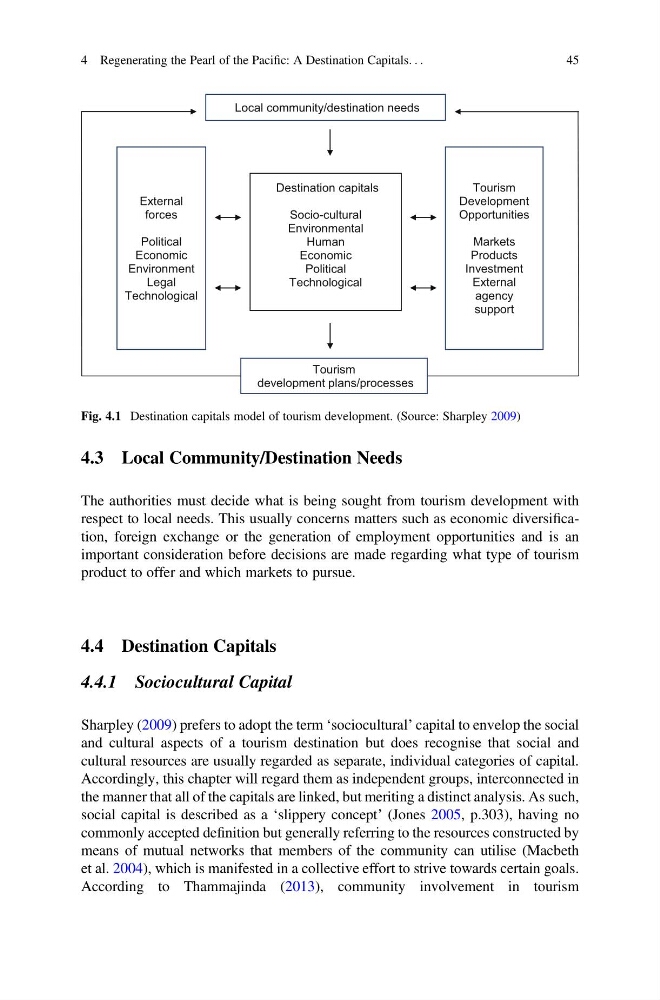
4.3 Local Community/Destination Needs
The authorities must decide what is being sought from tourism development with
respect to local needs. This usually concerns matters such as economic diversification, foreign exchange or the generation of employment opportunities and is an
important consideration before decisions are made regarding what type of tourism
product to offer and which markets to pursue.
4.4 Destination Capitals
4.4.1 Sociocultural Capital
Sharpley (2009) prefers to adopt the term ‘sociocultural’ capital to envelop the social
and cultural aspects of a tourism destination but does recognise that social and
cultural resources are usually regarded as separate, individual categories of capital.
Accordingly, this chapter will regard them as independent groups, interconnected in
the manner that all of the capitals are linked, but meriting a distinct analysis. As such,
social capital is described as a ‘slippery concept’ (Jones 2005, p.303), having no
commonly accepted definition but generally referring to the resources constructed by
means of mutual networks that members of the community can utilise (Macbeth
et al. 2004), which is manifested in a collective effort to strive towards certain goals.
According to Thammajinda (2013), community involvement in tourism
Destination capitals
Socio-cultural
Environmental
Human
Economic
Political
Technological
External
forces
Political
Economic
Environment
Legal
Technological
Tourism
Development
Opportunities
Markets
Products
Investment
External
agency
support
Local community/destination needs
Tourism
development plans/processes
Fig. 4.1 Destination capitals model of tourism development. (Source: Sharpley 2009)
4 Regenerating the Pearl of the Pacific: A Destination Capitals. . .
45
The authorities must decide what is being sought from tourism development with
respect to local needs. This usually concerns matters such as economic diversification, foreign exchange or the generation of employment opportunities and is an
important consideration before decisions are made regarding what type of tourism
product to offer and which markets to pursue.
4.4 Destination Capitals
4.4.1 Sociocultural Capital
Sharpley (2009) prefers to adopt the term ‘sociocultural’ capital to envelop the social
and cultural aspects of a tourism destination but does recognise that social and
cultural resources are usually regarded as separate, individual categories of capital.
Accordingly, this chapter will regard them as independent groups, interconnected in
the manner that all of the capitals are linked, but meriting a distinct analysis. As such,
social capital is described as a ‘slippery concept’ (Jones 2005, p.303), having no
commonly accepted definition but generally referring to the resources constructed by
means of mutual networks that members of the community can utilise (Macbeth
et al. 2004), which is manifested in a collective effort to strive towards certain goals.
According to Thammajinda (2013), community involvement in tourism
Destination capitals
Socio-cultural
Environmental
Human
Economic
Political
Technological
External
forces
Political
Economic
Environment
Legal
Technological
Tourism
Development
Opportunities
Markets
Products
Investment
External
agency
support
Local community/destination needs
Tourism
development plans/processes
Fig. 4.1 Destination capitals model of tourism development. (Source: Sharpley 2009)
4 Regenerating the Pearl of the Pacific: A Destination Capitals. . .
45