

goods of their choice (von Hauff 2015). From the perspective of sustainable development, on the other hand, consumption should be held accountable to the requirements of all three dimensions (environment, economy, and society) if it is to be
sustainable. This stems from the realization that consumption can result in negative
environmental as well as social consequences: Consumption can cause pollution,
and excessive consumption contributes to human suffering. This is why terms such
as consumerism were coined for use in literature. The American economist and
sociologist Thorstein Veblen coined the term conspicuous consumption in his 1899
book titled The Theory of Leisure Class (2000). Demonstrative consumption or
demonstrative waste is a public display of consumption, which is clearly intended
to show what a person can afford. It is not so much about satisfying a need in the
narrower sense but rather about making social status visible and, if necessary,
climbing even higher. In this sense, Jackson, one of the important critics of growth,
added a new twist to the paradigm: Consumption must always increase (Jackson
2017).
1.4 Rationales for Progress in the Various Approaches
to Growth
The proponents clearly classify rising growth as economic progress and, to the extent
growth may bear a relationship to the environment, itis not considered to be a
fundamental contradiction to preserving the environment. In sharp contrast, the
growth opponents see economic growth – at a minimum – as ecological but also
as a social burden, which should be avoided, and they reject the idea of growth as
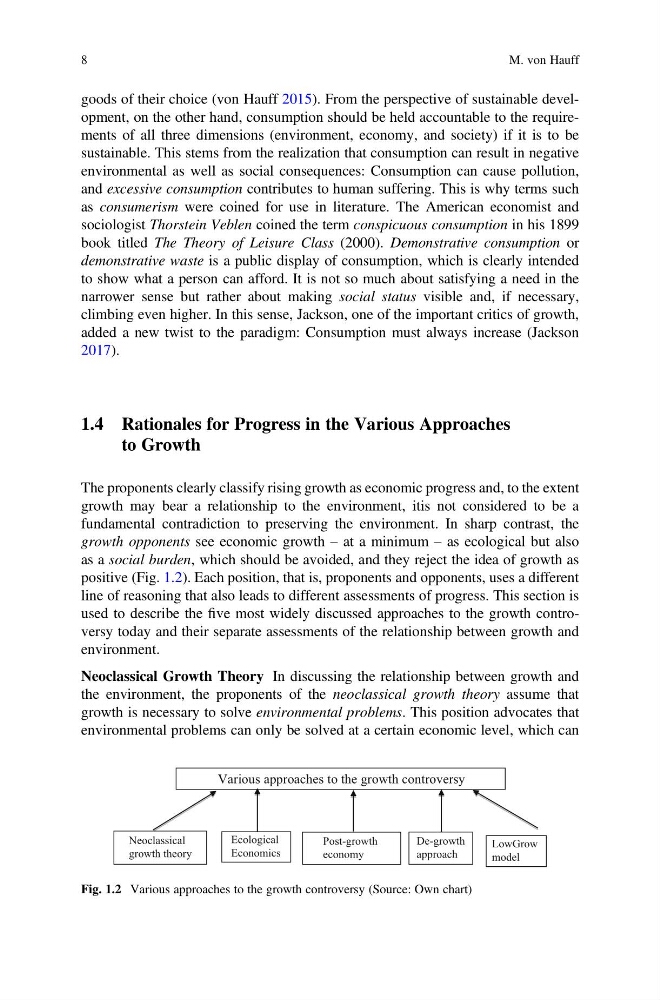
positive (Fig. 1.2). Each position, that is, proponents and opponents, uses a different
line of reasoning that also leads to different assessments of progress. This section is
used to describe the five most widely discussed approaches to the growth controversy today and their separate assessments of the relationship between growth and
environment.
Neoclassical Growth Theory In discussing the relationship between growth and
the environment, the proponents of the neoclassical growth theory assume that
growth is necessary to solve environmental problems. This position advocates that
environmental problems can only be solved at a certain economic level, which can
Ecological
Economics
Post-growth
economy
LowGrow
model
Neoclassical
growth theory
Various approaches to the growth controversy
De-growth
approach
Fig. 1.2 Various approaches to the growth controversy (Source: Own chart)
8
M. von Hauff
sustainable. This stems from the realization that consumption can result in negative
environmental as well as social consequences: Consumption can cause pollution,
and excessive consumption contributes to human suffering. This is why terms such
as consumerism were coined for use in literature. The American economist and
sociologist Thorstein Veblen coined the term conspicuous consumption in his 1899
book titled The Theory of Leisure Class (2000). Demonstrative consumption or
demonstrative waste is a public display of consumption, which is clearly intended
to show what a person can afford. It is not so much about satisfying a need in the
narrower sense but rather about making social status visible and, if necessary,
climbing even higher. In this sense, Jackson, one of the important critics of growth,
added a new twist to the paradigm: Consumption must always increase (Jackson
2017).
1.4 Rationales for Progress in the Various Approaches
to Growth
The proponents clearly classify rising growth as economic progress and, to the extent
growth may bear a relationship to the environment, itis not considered to be a
fundamental contradiction to preserving the environment. In sharp contrast, the
growth opponents see economic growth – at a minimum – as ecological but also
as a social burden, which should be avoided, and they reject the idea of growth as
positive (Fig. 1.2). Each position, that is, proponents and opponents, uses a different
line of reasoning that also leads to different assessments of progress. This section is
used to describe the five most widely discussed approaches to the growth controversy today and their separate assessments of the relationship between growth and
environment.
Neoclassical Growth Theory In discussing the relationship between growth and
the environment, the proponents of the neoclassical growth theory assume that
growth is necessary to solve environmental problems. This position advocates that
environmental problems can only be solved at a certain economic level, which can
Ecological
Economics
Post-growth
economy
LowGrow
model
Neoclassical
growth theory
Various approaches to the growth controversy
De-growth
approach
Fig. 1.2 Various approaches to the growth controversy (Source: Own chart)
8
M. von Hauff