

is beginning to focus on the difference between orthodoxy and heterodoxy (Colander
2004, p. 490; Colander 2015, p. 229). However, it is not just about plurality but also
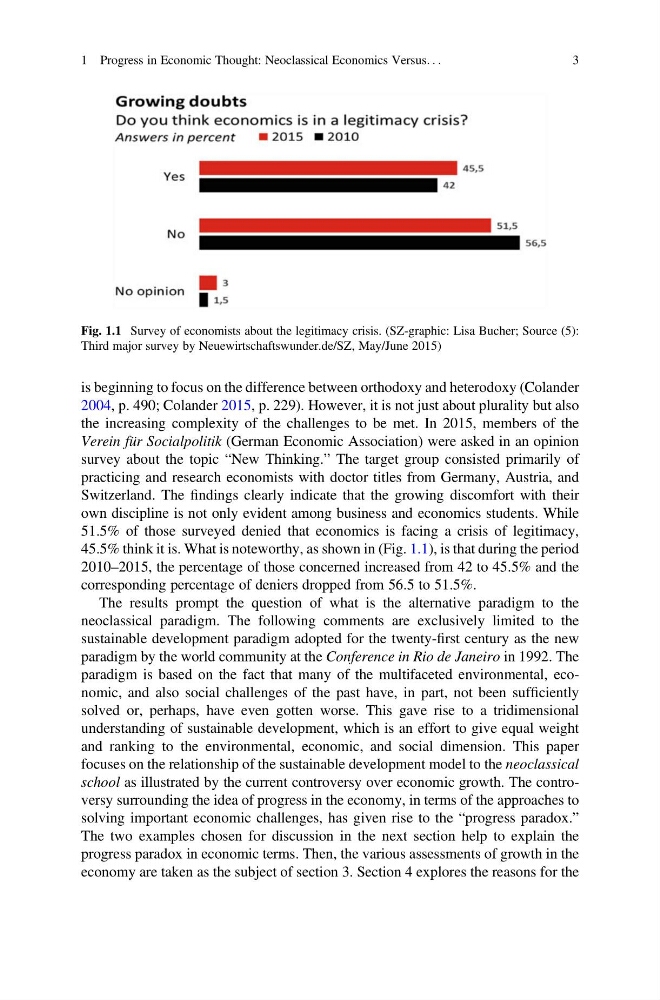
the increasing complexity of the challenges to be met. In 2015, members of the
Verein für Socialpolitik (German Economic Association) were asked in an opinion
survey about the topic “New Thinking.” The target group consisted primarily of
practicing and research economists with doctor titles from Germany, Austria, and
Switzerland. The findings clearly indicate that the growing discomfort with their
own discipline is not only evident among business and economics students. While
51.5% of those surveyed denied that economics is facing a crisis of legitimacy,
45.5% think it is. What is noteworthy, as shown in (Fig. 1.1), is that during the period
2010–2015, the percentage of those concerned increased from 42 to 45.5% and the
corresponding percentage of deniers dropped from 56.5 to 51.5%.
The results prompt the question of what is the alternative paradigm to the
neoclassical paradigm. The following comments are exclusively limited to the
sustainable development paradigm adopted for the twenty-first century as the new
paradigm by the world community at the Conference in Rio de Janeiro in 1992. The
paradigm is based on the fact that many of the multifaceted environmental, economic, and also social challenges of the past have, in part, not been sufficiently
solved or, perhaps, have even gotten worse. This gave rise to a tridimensional
understanding of sustainable development, which is an effort to give equal weight
and ranking to the environmental, economic, and social dimension. This paper
focuses on the relationship of the sustainable development model to the neoclassical
school as illustrated by the current controversy over economic growth. The controversy surrounding the idea of progress in the economy, in terms of the approaches to
solving important economic challenges, has given rise to the “progress paradox.”
The two examples chosen for discussion in the next section help to explain the
progress paradox in economic terms. Then, the various assessments of growth in the
economy are taken as the subject of section 3. Section 4 explores the reasons for the
Fig. 1.1 Survey of economists about the legitimacy crisis. (SZ-graphic: Lisa Bucher; Source (5):
Third major survey by Neuewirtschaftswunder.de/SZ, May/June 2015)
1 Progress in Economic Thought: Neoclassical Economics Versus. . .
3
2004, p. 490; Colander 2015, p. 229). However, it is not just about plurality but also
the increasing complexity of the challenges to be met. In 2015, members of the
Verein für Socialpolitik (German Economic Association) were asked in an opinion
survey about the topic “New Thinking.” The target group consisted primarily of
practicing and research economists with doctor titles from Germany, Austria, and
Switzerland. The findings clearly indicate that the growing discomfort with their
own discipline is not only evident among business and economics students. While
51.5% of those surveyed denied that economics is facing a crisis of legitimacy,
45.5% think it is. What is noteworthy, as shown in (Fig. 1.1), is that during the period
2010–2015, the percentage of those concerned increased from 42 to 45.5% and the
corresponding percentage of deniers dropped from 56.5 to 51.5%.
The results prompt the question of what is the alternative paradigm to the
neoclassical paradigm. The following comments are exclusively limited to the
sustainable development paradigm adopted for the twenty-first century as the new
paradigm by the world community at the Conference in Rio de Janeiro in 1992. The
paradigm is based on the fact that many of the multifaceted environmental, economic, and also social challenges of the past have, in part, not been sufficiently
solved or, perhaps, have even gotten worse. This gave rise to a tridimensional
understanding of sustainable development, which is an effort to give equal weight
and ranking to the environmental, economic, and social dimension. This paper
focuses on the relationship of the sustainable development model to the neoclassical
school as illustrated by the current controversy over economic growth. The controversy surrounding the idea of progress in the economy, in terms of the approaches to
solving important economic challenges, has given rise to the “progress paradox.”
The two examples chosen for discussion in the next section help to explain the
progress paradox in economic terms. Then, the various assessments of growth in the
economy are taken as the subject of section 3. Section 4 explores the reasons for the
Fig. 1.1 Survey of economists about the legitimacy crisis. (SZ-graphic: Lisa Bucher; Source (5):
Third major survey by Neuewirtschaftswunder.de/SZ, May/June 2015)
1 Progress in Economic Thought: Neoclassical Economics Versus. . .
3