

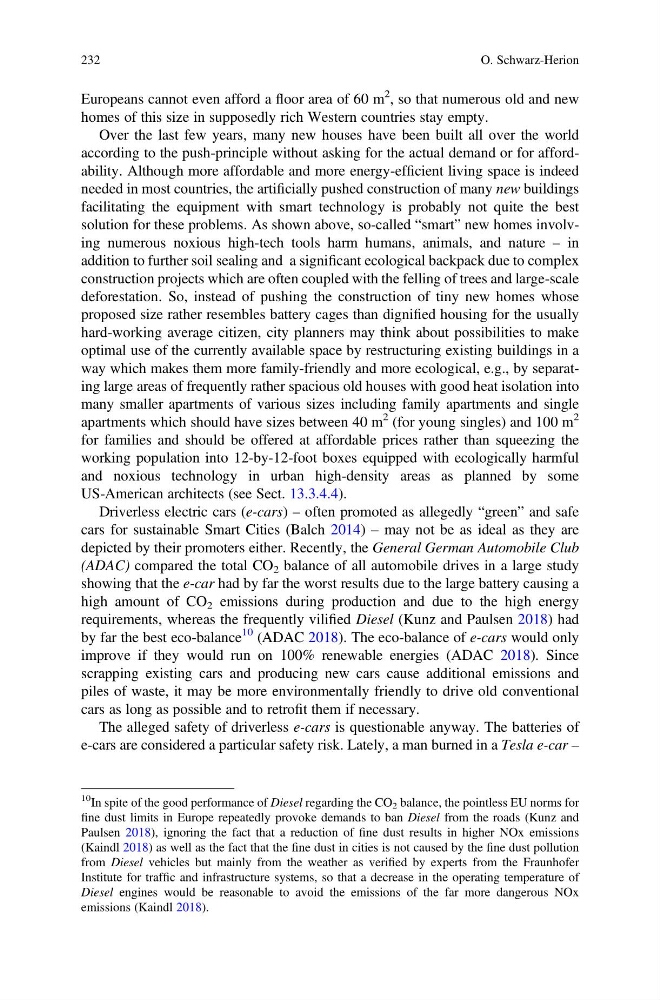
Europeans cannot even afford a floor area of 60 m
2 , so that numerous old and new
homes of this size in supposedly rich Western countries stay empty.
Over the last few years, many new houses have been built all over the world
according to the push-principle without asking for the actual demand or for affordability. Although more affordable and more energy-efficient living space is indeed
needed in most countries, the artificially pushed construction of many new buildings
facilitating the equipment with smart technology is probably not quite the best
solution for these problems. As shown above, so-called “smart” new homes involving numerous noxious high-tech tools harm humans, animals, and nature – in
addition to further soil sealing and a significant ecological backpack due to complex
construction projects which are often coupled with the felling of trees and large-scale
deforestation. So, instead of pushing the construction of tiny new homes whose
proposed size rather resembles battery cages than dignified housing for the usually
hard-working average citizen, city planners may think about possibilities to make
optimal use of the currently available space by restructuring existing buildings in a
way which makes them more family-friendly and more ecological, e.g., by separating large areas of frequently rather spacious old houses with good heat isolation into
many smaller apartments of various sizes including family apartments and single
apartments which should have sizes between 40 m
2 (for young singles) and 100 m
2
for families and should be offered at affordable prices rather than squeezing the
working population into 12-by-12-foot boxes equipped with ecologically harmful
and noxious technology in urban high-density areas as planned by some
US-American architects (see Sect. 13.3.4.4).
Driverless electric cars (e-cars) – often promoted as allegedly “green” and safe
cars for sustainable Smart Cities (Balch 2014) – may not be as ideal as they are
depicted by their promoters either. Recently, the General German Automobile Club
(ADAC) compared the total CO 2 balance of all automobile drives in a large study
showing that the e-car had by far the worst results due to the large battery causing a
high amount of CO 2 emissions during production and due to the high energy
requirements, whereas the frequently vilified Diesel (Kunz and Paulsen 2018) had
by far the best eco-balance
10 (ADAC 2018). The eco-balance of e-cars would only
improve if they would run on 100% renewable energies (ADAC 2018). Since
scrapping existing cars and producing new cars cause additional emissions and
piles of waste, it may be more environmentally friendly to drive old conventional
cars as long as possible and to retrofit them if necessary.
The alleged safety of driverless e-cars is questionable anyway. The batteries of
e-cars are considered a particular safety risk. Lately, a man burned in a Tesla e-car –
10 In spite of the good performance of Diesel regarding the CO 2 balance, the pointless EU norms for
fine dust limits in Europe repeatedly provoke demands to ban Diesel from the roads (Kunz and
Paulsen 2018), ignoring the fact that a reduction of fine dust results in higher NOx emissions
(Kaindl 2018) as well as the fact that the fine dust in cities is not caused by the fine dust pollution
from Diesel vehicles but mainly from the weather as verified by experts from the Fraunhofer
Institute for traffic and infrastructure systems, so that a decrease in the operating temperature of
Diesel engines would be reasonable to avoid the emissions of the far more dangerous NOx
emissions (Kaindl 2018).
232
O. Schwarz-Herion
2 , so that numerous old and new
homes of this size in supposedly rich Western countries stay empty.
Over the last few years, many new houses have been built all over the world
according to the push-principle without asking for the actual demand or for affordability. Although more affordable and more energy-efficient living space is indeed
needed in most countries, the artificially pushed construction of many new buildings
facilitating the equipment with smart technology is probably not quite the best
solution for these problems. As shown above, so-called “smart” new homes involving numerous noxious high-tech tools harm humans, animals, and nature – in
addition to further soil sealing and a significant ecological backpack due to complex
construction projects which are often coupled with the felling of trees and large-scale
deforestation. So, instead of pushing the construction of tiny new homes whose
proposed size rather resembles battery cages than dignified housing for the usually
hard-working average citizen, city planners may think about possibilities to make
optimal use of the currently available space by restructuring existing buildings in a
way which makes them more family-friendly and more ecological, e.g., by separating large areas of frequently rather spacious old houses with good heat isolation into
many smaller apartments of various sizes including family apartments and single
apartments which should have sizes between 40 m
2 (for young singles) and 100 m
2
for families and should be offered at affordable prices rather than squeezing the
working population into 12-by-12-foot boxes equipped with ecologically harmful
and noxious technology in urban high-density areas as planned by some
US-American architects (see Sect. 13.3.4.4).
Driverless electric cars (e-cars) – often promoted as allegedly “green” and safe
cars for sustainable Smart Cities (Balch 2014) – may not be as ideal as they are
depicted by their promoters either. Recently, the General German Automobile Club
(ADAC) compared the total CO 2 balance of all automobile drives in a large study
showing that the e-car had by far the worst results due to the large battery causing a
high amount of CO 2 emissions during production and due to the high energy
requirements, whereas the frequently vilified Diesel (Kunz and Paulsen 2018) had
by far the best eco-balance
10 (ADAC 2018). The eco-balance of e-cars would only
improve if they would run on 100% renewable energies (ADAC 2018). Since
scrapping existing cars and producing new cars cause additional emissions and
piles of waste, it may be more environmentally friendly to drive old conventional
cars as long as possible and to retrofit them if necessary.
The alleged safety of driverless e-cars is questionable anyway. The batteries of
e-cars are considered a particular safety risk. Lately, a man burned in a Tesla e-car –
10 In spite of the good performance of Diesel regarding the CO 2 balance, the pointless EU norms for
fine dust limits in Europe repeatedly provoke demands to ban Diesel from the roads (Kunz and
Paulsen 2018), ignoring the fact that a reduction of fine dust results in higher NOx emissions
(Kaindl 2018) as well as the fact that the fine dust in cities is not caused by the fine dust pollution
from Diesel vehicles but mainly from the weather as verified by experts from the Fraunhofer
Institute for traffic and infrastructure systems, so that a decrease in the operating temperature of
Diesel engines would be reasonable to avoid the emissions of the far more dangerous NOx
emissions (Kaindl 2018).
232
O. Schwarz-Herion