

had two questions, the first being “What is the greatest contributing factor to
deforestation?” and the second, ”What are the negative impacts of deforestation to
the societies and environment?” The second section included seven questions,
including five questions about level of awareness on deforestation, and two questions on respondents’ general knowledge of deforestation in Malaysia. The third
section was to provide or suggest possible recommendations to reduce or eliminate
deforestation in Malaysia. The Likert scale was used in the design of the questionnaire, extending from (1 ¼ strongly disagree) to (5 ¼ strongly agree). A
non-probability sampling technique called convenience sampling was selected to
conduct this study. Seventy-five questionnaires were randomly handed out to
selected residents in different areas in Malaysia including some from outside of
Malaysia. Only 64 questionnaire forms were filled in and returned. Of these, 5 of
them were excluded due to incompleteness. However, 59 questionnaires were
considered and analyzed, yielding a response rate of 78.6%.
11.5 Results Analysis
From the survey we conducted, 95% of respondents are aware of the deforestation
issue in Malaysia. Furthermore, we gathered data on the effects of deforestation in
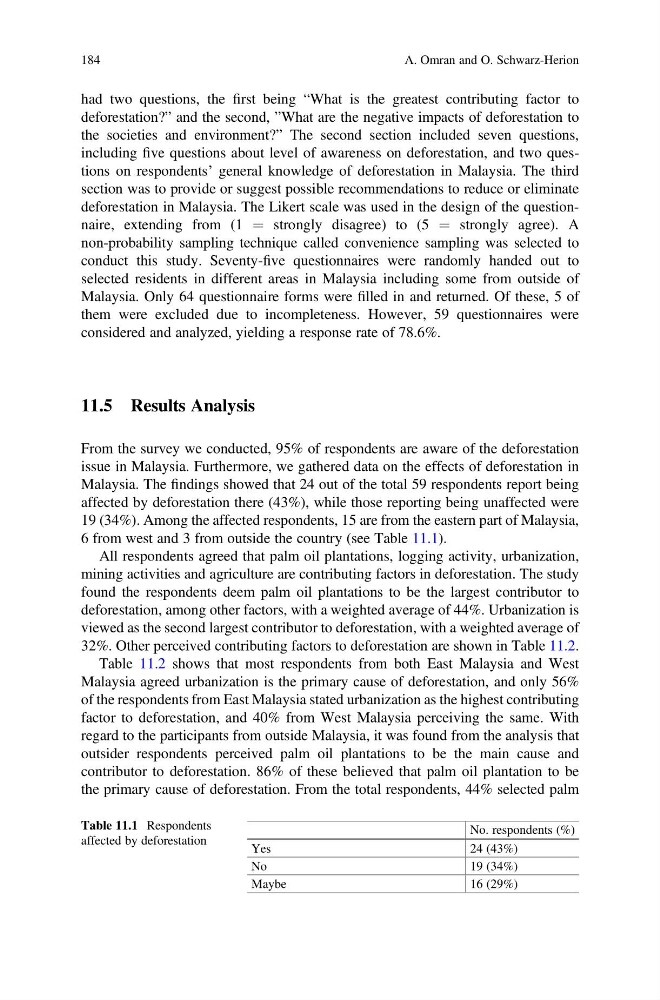
Malaysia. The findings showed that 24 out of the total 59 respondents report being
affected by deforestation there (43%), while those reporting being unaffected were
19 (34%). Among the affected respondents, 15 are from the eastern part of Malaysia,
6 from west and 3 from outside the country (see Table 11.1).
All respondents agreed that palm oil plantations, logging activity, urbanization,
mining activities and agriculture are contributing factors in deforestation. The study
found the respondents deem palm oil plantations to be the largest contributor to
deforestation, among other factors, with a weighted average of 44%. Urbanization is
viewed as the second largest contributor to deforestation, with a weighted average of
32%. Other perceived contributing factors to deforestation are shown in Table 11.2.
Table 11.2 shows that most respondents from both East Malaysia and West
Malaysia agreed urbanization is the primary cause of deforestation, and only 56%
of the respondents from East Malaysia stated urbanization as the highest contributing
factor to deforestation, and 40% from West Malaysia perceiving the same. With
regard to the participants from outside Malaysia, it was found from the analysis that
outsider respondents perceived palm oil plantations to be the main cause and
contributor to deforestation. 86% of these believed that palm oil plantation to be
the primary cause of deforestation. From the total respondents, 44% selected palm
Table 11.1 Respondents
affected by deforestation
No. respondents (%)
Yes
24 (43%)
No
19 (34%)
Maybe
16 (29%)
184
A. Omran and O. Schwarz-Herion
deforestation?” and the second, ”What are the negative impacts of deforestation to
the societies and environment?” The second section included seven questions,
including five questions about level of awareness on deforestation, and two questions on respondents’ general knowledge of deforestation in Malaysia. The third
section was to provide or suggest possible recommendations to reduce or eliminate
deforestation in Malaysia. The Likert scale was used in the design of the questionnaire, extending from (1 ¼ strongly disagree) to (5 ¼ strongly agree). A
non-probability sampling technique called convenience sampling was selected to
conduct this study. Seventy-five questionnaires were randomly handed out to
selected residents in different areas in Malaysia including some from outside of
Malaysia. Only 64 questionnaire forms were filled in and returned. Of these, 5 of
them were excluded due to incompleteness. However, 59 questionnaires were
considered and analyzed, yielding a response rate of 78.6%.
11.5 Results Analysis
From the survey we conducted, 95% of respondents are aware of the deforestation
issue in Malaysia. Furthermore, we gathered data on the effects of deforestation in
Malaysia. The findings showed that 24 out of the total 59 respondents report being
affected by deforestation there (43%), while those reporting being unaffected were
19 (34%). Among the affected respondents, 15 are from the eastern part of Malaysia,
6 from west and 3 from outside the country (see Table 11.1).
All respondents agreed that palm oil plantations, logging activity, urbanization,
mining activities and agriculture are contributing factors in deforestation. The study
found the respondents deem palm oil plantations to be the largest contributor to
deforestation, among other factors, with a weighted average of 44%. Urbanization is
viewed as the second largest contributor to deforestation, with a weighted average of
32%. Other perceived contributing factors to deforestation are shown in Table 11.2.
Table 11.2 shows that most respondents from both East Malaysia and West
Malaysia agreed urbanization is the primary cause of deforestation, and only 56%
of the respondents from East Malaysia stated urbanization as the highest contributing
factor to deforestation, and 40% from West Malaysia perceiving the same. With
regard to the participants from outside Malaysia, it was found from the analysis that
outsider respondents perceived palm oil plantations to be the main cause and
contributor to deforestation. 86% of these believed that palm oil plantation to be
the primary cause of deforestation. From the total respondents, 44% selected palm
Table 11.1 Respondents
affected by deforestation
No. respondents (%)
Yes
24 (43%)
No
19 (34%)
Maybe
16 (29%)
184
A. Omran and O. Schwarz-Herion