

64
It would be a simple matter to argue that every major scientific and technical
breakthrough has, indeed, broken up that fourth wall. Aristotle noted the changes in
visible constellations during the course of even a relatively short journey and rightly
attributed this to a spherical earth. As early as 40,000 BCE in what is Moldovia,
mammoth bones seem to have been utilized as tent poles.
21
These two insights—the
earth is not flat; the protection offered by a tent against a brutal blizzard, though
probably not a large carnivore—are emblematic of circumstances embroidering our
recent cognitive emergence within the vast tapestries of primeval knowledge-based
systems throughout every biome.
Our relatively neonatal surmises gain by the second but are utterly incommensurate with their physical manifestations. Therein lies the colossal mismatch that now
tragically
22
defines what we call the ecological paradox.
21 See Eureka – An Illustrated History of Inventions From the Wheel to The Computer, by Edward
de Bono, Hold, Rinehart and Winston, New York, 1974, p. 132.
22 And, as Angelos Terzakis wrote of such neonatal circumstances that is mankind, “For there exists
an age of tragedy. It is youth.” See Homage To The Tragic Muse, by Angelos Terzakis, Translated
by Athan Anagnostopoulos, Foreword by Cedric H. Whitman, Houghton Mifflin Company,
Boston, 1978, p. 186.
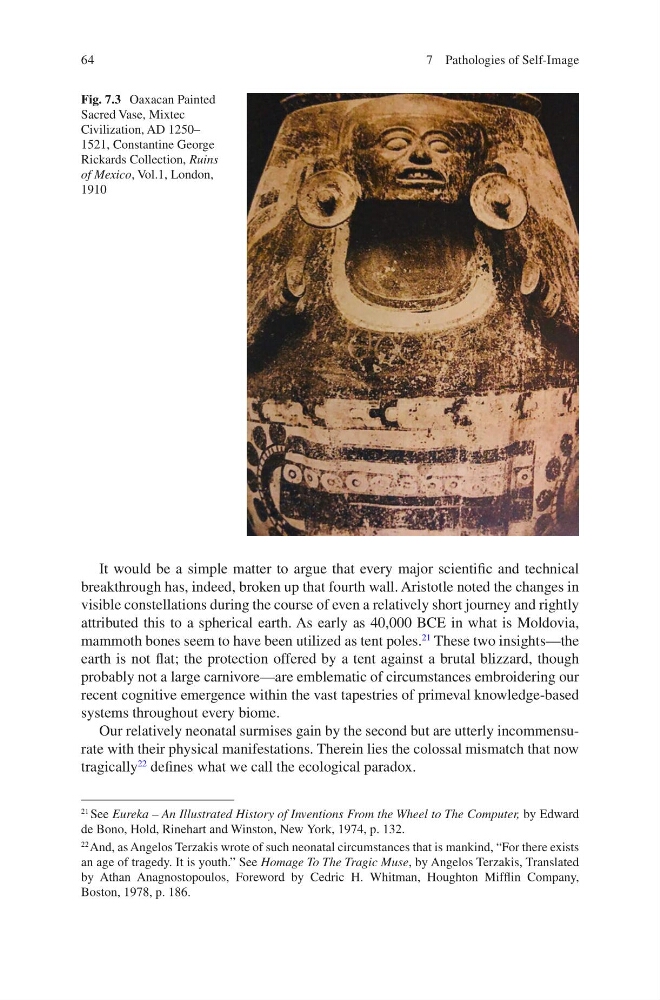
Fig. 7.3 Oaxacan Painted
Sacred Vase, Mixtec
Civilization, AD 1250–
1521, Constantine George
Rickards Collection, Ruins
of Mexico, Vol.1, London,
1910
7 Pathologies of Self-Image
It would be a simple matter to argue that every major scientific and technical
breakthrough has, indeed, broken up that fourth wall. Aristotle noted the changes in
visible constellations during the course of even a relatively short journey and rightly
attributed this to a spherical earth. As early as 40,000 BCE in what is Moldovia,
mammoth bones seem to have been utilized as tent poles.
21
These two insights—the
earth is not flat; the protection offered by a tent against a brutal blizzard, though
probably not a large carnivore—are emblematic of circumstances embroidering our
recent cognitive emergence within the vast tapestries of primeval knowledge-based
systems throughout every biome.
Our relatively neonatal surmises gain by the second but are utterly incommensurate with their physical manifestations. Therein lies the colossal mismatch that now
tragically
22
defines what we call the ecological paradox.
21 See Eureka – An Illustrated History of Inventions From the Wheel to The Computer, by Edward
de Bono, Hold, Rinehart and Winston, New York, 1974, p. 132.
22 And, as Angelos Terzakis wrote of such neonatal circumstances that is mankind, “For there exists
an age of tragedy. It is youth.” See Homage To The Tragic Muse, by Angelos Terzakis, Translated
by Athan Anagnostopoulos, Foreword by Cedric H. Whitman, Houghton Mifflin Company,
Boston, 1978, p. 186.
Fig. 7.3 Oaxacan Painted
Sacred Vase, Mixtec
Civilization, AD 1250–
1521, Constantine George
Rickards Collection, Ruins
of Mexico, Vol.1, London,
1910
7 Pathologies of Self-Image