

818
additional tick species throughout North America, knowing that Bambi is the vector-borne agent within a fiercely competitive predatory environment reeling from
other, zoonotic- borne agents, challenges any earlier referenced politics of peace.
4
Aristotle’s theory of intermediates (somewhere between the physical and the
Platonic Form) implicates the ethical/spiritual conundrum that follows upon every
zoonotic transmission, notably in the case of female mosquitoes of the Anopheles
Genus that are so vulnerable to a single-celled parasite, manifested in at least six
Plasmodium obligate parasites, causing at least 400,000 human deaths annually.
5
We’ve seen such geopolitics and wildlife-human conflicts flare up in every humanoccupied location on earth—from Bhutan to Ladakh, where Buddhism and stray
dogs, for example, have fueled nearly insoluble problems.
6
Gandhi, like Orwell,
misread both Hitler and the crisis for the Jews. And, as with the Jain ethical response
to a potentially lethal snake, Gandhi, while never supporting a first strike mentality,
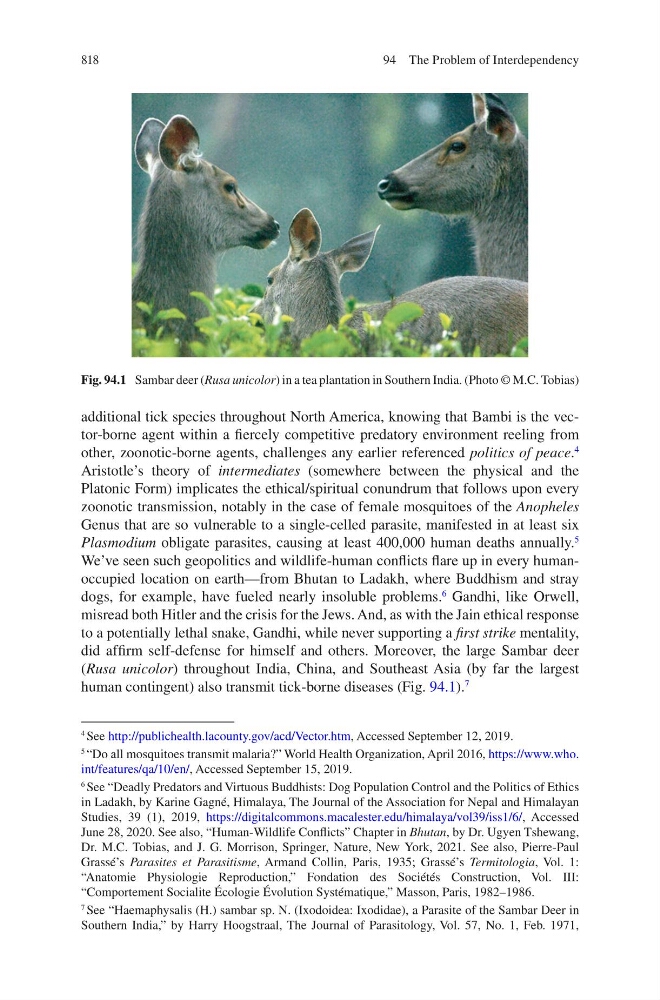
did affirm self-defense for himself and others. Moreover, the large Sambar deer
(Rusa unicolor) throughout India, China, and Southeast Asia (by far the largest
human contingent) also transmit tick-borne diseases (Fig. 94.1).
7
4 See http://publichealth.lacounty.gov/acd/Vector.htm, Accessed September 12, 2019.
5 “Do all mosquitoes transmit malaria?” World Health Organization, April 2016, https://www.who.
int/features/qa/10/en/, Accessed September 15, 2019.
6 See “Deadly Predators and Virtuous Buddhists: Dog Population Control and the Politics of Ethics
in Ladakh, by Karine Gagné, Himalaya, The Journal of the Association for Nepal and Himalayan
Studies, 39 (1), 2019, https://digitalcommons.macalester.edu/himalaya/vol39/iss1/6/, Accessed
June 28, 2020. See also, “Human-Wildlife Conflicts” Chapter in Bhutan, by Dr. Ugyen Tshewang,
Dr. M.C. Tobias, and J. G. Morrison, Springer, Nature, New York, 2021. See also, Pierre-Paul
Grassé’s Parasites et Parasitisme, Armand Collin, Paris, 1935; Grassé’s Termitologia, Vol. 1:
“Anatomie Physiologie Reproduction,” Fondation des Sociétés Construction, Vol. III:
“Comportement Socialite Écologie Évolution Systématique,” Masson, Paris, 1982–1986.
7 See “Haemaphysalis (H.) sambar sp. N. (Ixodoidea: Ixodidae), a Parasite of the Sambar Deer in
Southern India,” by Harry Hoogstraal, The Journal of Parasitology, Vol. 57, No. 1, Feb. 1971,
Fig. 94.1 Sambar deer (Rusa unicolor) in a tea plantation in Southern India. (Photo © M.C. Tobias)
94 The Problem of Interdependency