

806
edge of two worlds at war, without a clue how to resolve the fatal discrepancies. One
may hypothesize some heretofore undefined distribution load of conscious orientation consolidated into a human entity driven solely by ethical considerations. The
Digambara monk? The deceased saint? Other legacies that live on? The idea that
human history can help us fix the future has proved a mathematical non-starter. As
a genetic narrative, it has no more conclusiveness than a theoretical history of all
antibodies. We have no idea how to meaningfully correlate our genes, cells, and
bacteria with environmental conditions over time.
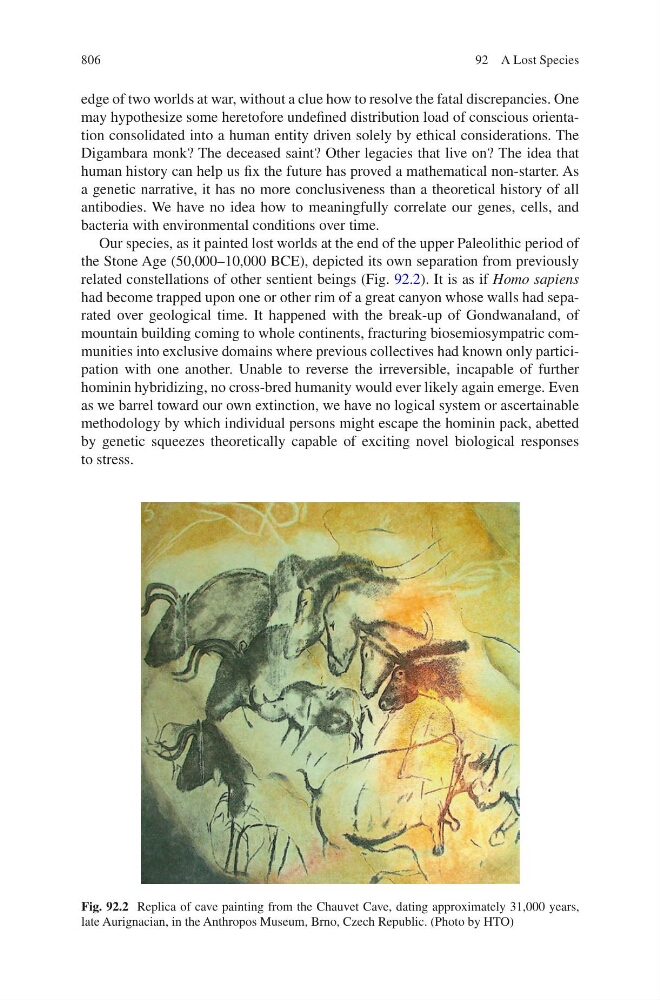
Our species, as it painted lost worlds at the end of the upper Paleolithic period of
the Stone Age (50,000–10,000 BCE), depicted its own separation from previously
related constellations of other sentient beings (Fig. 92.2). It is as if Homo sapiens
had become trapped upon one or other rim of a great canyon whose walls had separated over geological time. It happened with the break-up of Gondwanaland, of
mountain building coming to whole continents, fracturing biosemiosympatric communities into exclusive domains where previous collectives had known only participation with one another. Unable to reverse the irreversible, incapable of further
hominin hybridizing, no cross-bred humanity would ever likely again emerge. Even
as we barrel toward our own extinction, we have no logical system or ascertainable
methodology by which individual persons might escape the hominin pack, abetted
by genetic squeezes theoretically capable of exciting novel biological responses
to stress.
Fig. 92.2 Replica of cave painting from the Chauvet Cave, dating approximately 31,000 years,
late Aurignacian, in the Anthropos Museum, Brno, Czech Republic. (Photo by HTO)
92 A Lost Species