

792
90.3 Levinas and Buber
An atlas of such exiles, those proposed individuals in the front trenches of evolutionary transitions that either die out, shrink by sheer anonymous mutations, or cluster successfully in the build-up of taxa that will survive within a metapopulation,
has a familiar face to it. We see ourselves, at some point within the horizon or circumference. The reflection adds to that speculative fiction which craves an identity,
a circumstance in which to fix its affiliations with other life forms.
We are there prior to our presence, waiting patiently for something to happen.
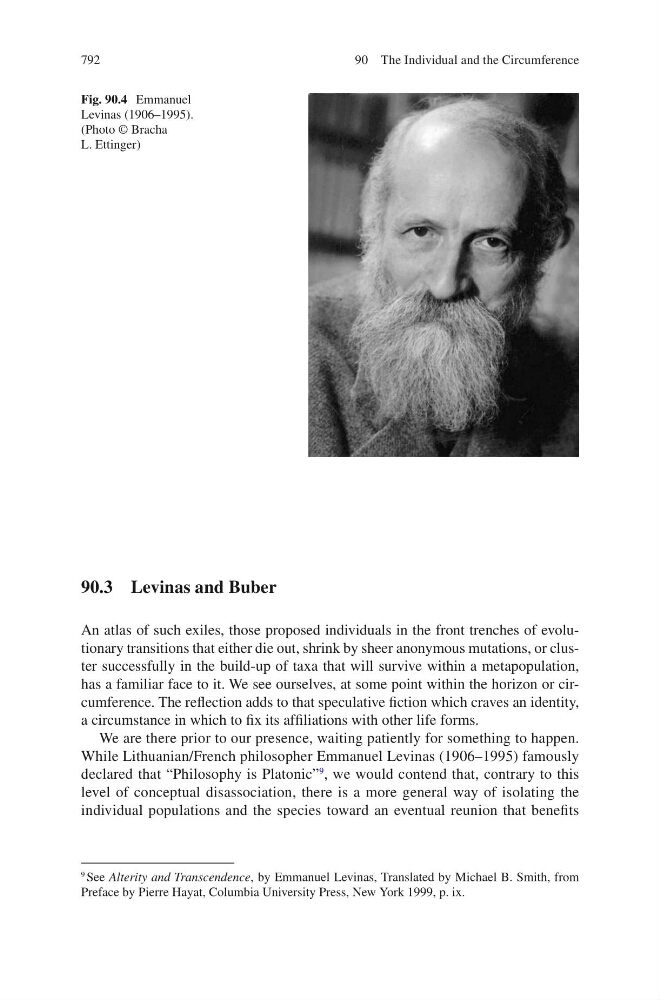
While Lithuanian/French philosopher Emmanuel Levinas (1906–1995) famously
declared that “Philosophy is Platonic”
9
, we would contend that, contrary to this
level of conceptual disassociation, there is a more general way of isolating the
individual populations and the species toward an eventual reunion that benefits
9 See Alterity and Transcendence, by Emmanuel Levinas, Translated by Michael B. Smith, from
Preface by Pierre Hayat, Columbia University Press, New York 1999, p. ix.
Fig. 90.4 Emmanuel
Levinas (1906–1995).
(Photo © Bracha
L. Ettinger)
90 The Individual and the Circumference