

790
Nor are the billions of “introgressive hybridization” occurrences among fungal
pathogens with whom we live
2
. Transgenic fungus manipulated to decimate malaria
parasites
3
, just one among tens of thousands of chemicals, treatments, and other
interventions engineered by humans to sway or eliminate helminths, protozoa, and
other ectoparasitic adversaries. The cumulative efforts are an embassy of transgressions against the otherwise undeflected tides of evolution presaging a deliberately
insular choice of fate for our kind, commensurate with every insult we have ever
handed down. The backfires are initially recorded in the number of antibioticresistant germs. Then it becomes ecologically conceptual.
2 See “The Role of Hybridization in the Evolution and Emergence of New Fungal Plant Pathogens,”
by E. H. Stukenbrock, Phytopathology. 2016 Feb;106(2):104–12. doi: https://doi.org/10.1094/
PHYTO-08-15-0184-RVW. Epub 2016 Jan 29, https://www.ncbi.nlm.nih.gov/pubmed/26824768,
Accessed February 4, 2020.
3 “Development of transgenic fungi that kill human malaria parasites in mosquitoes,” by Fang W
,
Vega-Rodríguez J, Ghosh AK, Jacobs-Lorena M, Kang A, St Leger RJ., Science. 2011 Feb
25;331(6020):1074–7. doi: https://doi.org/10.1126/science.1199115, https://pubmed.ncbi.nlm.
nih.gov/21350178-development-of-transgenic-fungi-that-kill-human-malaria-parasites-in-mosquitoes/, Accessed February 4, 2020.
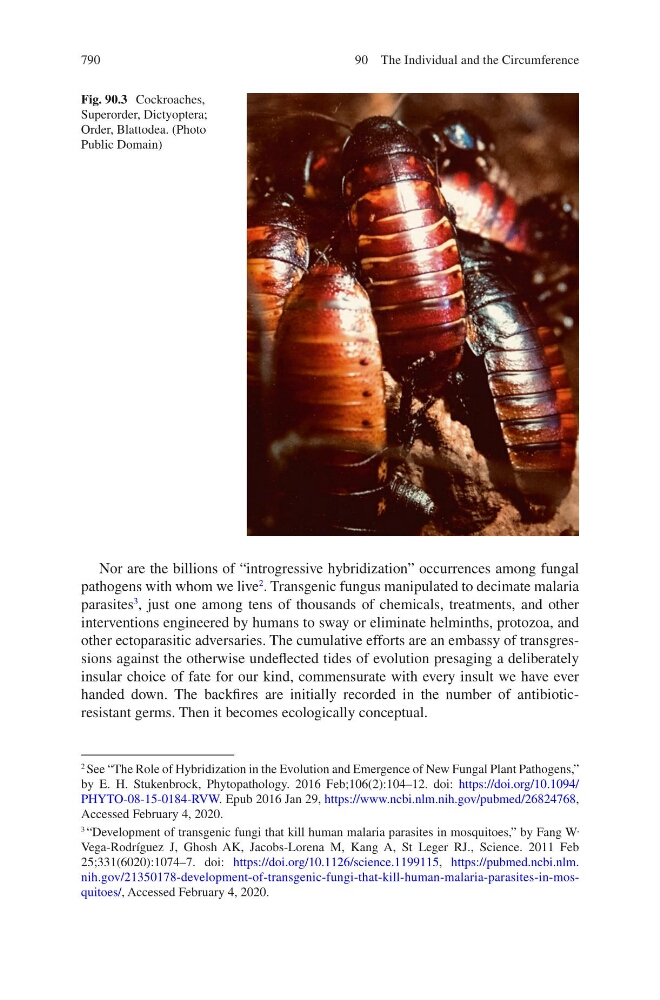
Fig. 90.3 Cockroaches,
Superorder, Dictyoptera;
Order, Blattodea. (Photo
Public Domain)
90 The Individual and the Circumference