

776
solidly open. Other diffusely scattered fragments across every biome of sheered
antennae and brains, exploded thoracic cavities, fallen trees eaten clear through. The
decomposing layers of death are notice boards and magnets for every angle of orientation. Such bundles of clustering death herald a contagion of theories, compressed and as rife as bacteria or worm-like, fluid-replete gastrotricha. Their
seamless proliferation heralds the theory of karma, of passages and outright itineraries, as the teeth fall out, the body turning green, then red, filling with fluids and
gasses. A video of the single-celled Blepharisma disappearing before our eyes: “I
don’t know why this one died but how it dissolves to nothingness just broke my
heart. Big or small, life is fragile,” says microbiologist James Weiss
2
. Some dormant
bacteria may live 250 million years, others, mere minutes, and there is wild speculation that there may well have been some 800 billion bacterial generations prior to
the rapid evolution of this last remaining hominin, us
3
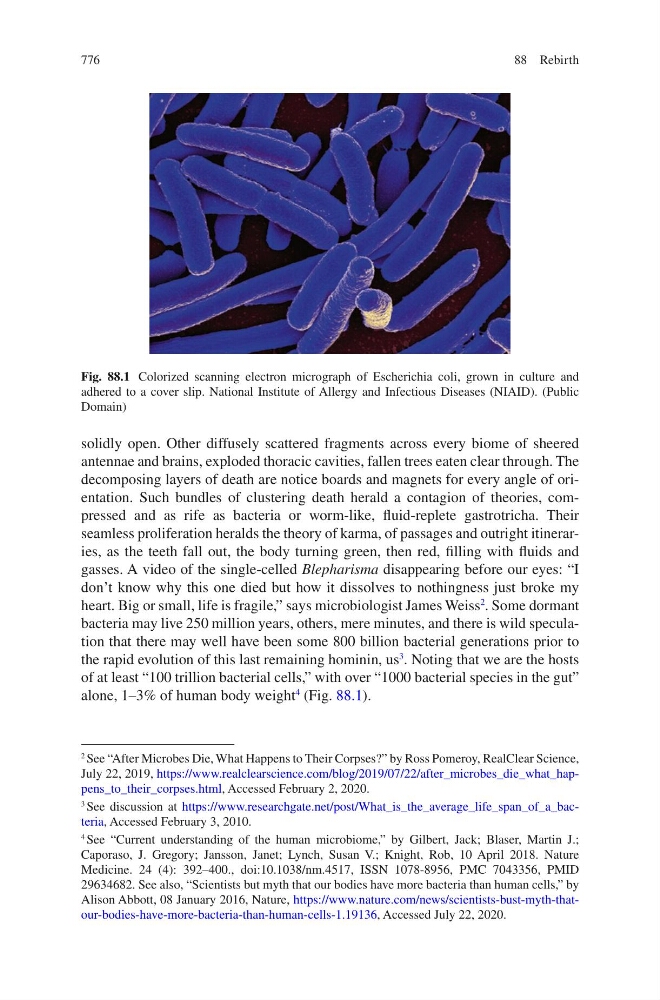
. Noting that we are the hosts
of at least “100 trillion bacterial cells,” with over “1000 bacterial species in the gut”
alone, 1–3% of human body weight
4
(Fig. 88.1).
2 See “After Microbes Die, What Happens to Their Corpses?” by Ross Pomeroy, RealClear Science,
July 22, 2019, https://www.realclearscience.com/blog/2019/07/22/after_microbes_die_what_happens_to_their_corpses.html, Accessed February 2, 2020.
3 See discussion at https://www.researchgate.net/post/What_is_the_average_life_span_of_a_bacteria, Accessed February 3, 2010.
4 See “Current understanding of the human microbiome,” by Gilbert, Jack; Blaser, Martin J.;
Caporaso, J. Gregory; Jansson, Janet; Lynch, Susan V.; Knight, Rob, 10 April 2018. Nature
Medicine. 24 (4): 392–400., doi:10.1038/nm.4517, ISSN 1078-8956, PMC 7043356, PMID
29634682. See also, “Scientists but myth that our bodies have more bacteria than human cells,” by
Alison Abbott, 08 January 2016, Nature, https://www.nature.com/news/scientists-bust-myth-thatour-bodies-have-more-bacteria-than-human-cells-1.19136, Accessed July 22, 2020.
Fig. 88.1 Colorized scanning electron micrograph of Escherichia coli, grown in culture and
adhered to a cover slip. National Institute of Allergy and Infectious Diseases (NIAID). (Public
Domain)
88 Rebirth