

773
Amid a profusion of displaced souls, inaccessible lives, bastions of exile, to forgive is to be attuned at the individual level. We don’t easily forgive, much less whole
populations, systems, civilizations. The freedom any forgiveness tenders is the basis
for beginning a journey anew, in a new land
4
. All of the contradictories are behind
us, at the instant of easily letting go, whether during birth, or life, or death. The act
of forgiveness is an ecological baseline of some certainty. It complements a revolution in aftermath ontologies, finely delineating between individuals and species,
demolishing the notion that the survival of individuals, the genetic pertinacity of
their populations, and the combining effect of numbers into the general conception
of a species, represents a clear picture of what is actually happening within and
between life-forms. In that revised context, prayer, forgiveness, love, and faith take
on stunningly biological definitions that lend to the individual and his/her “neutral
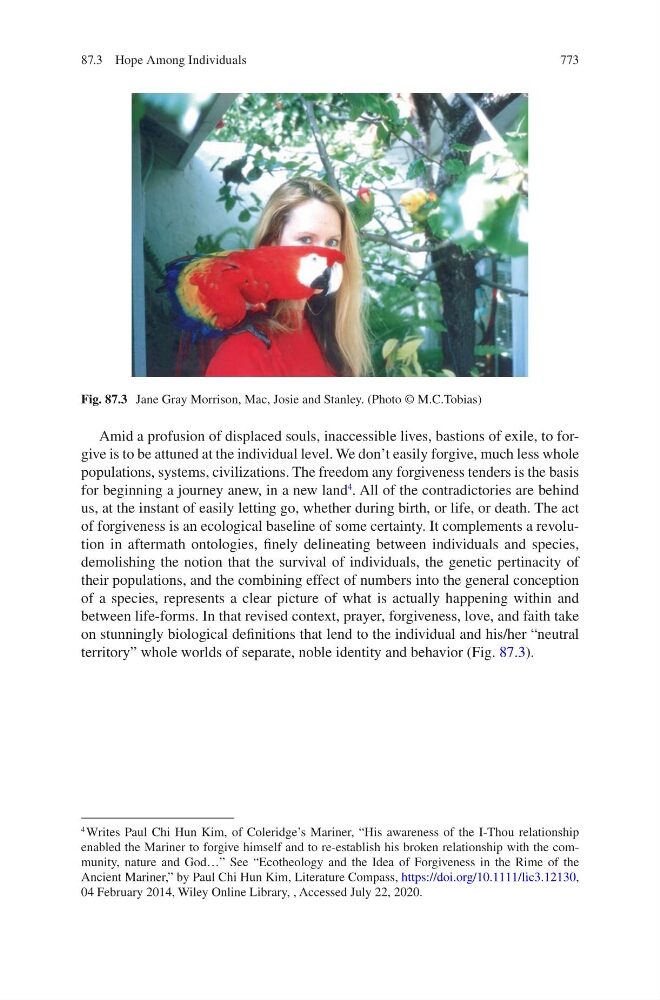
territory” whole worlds of separate, noble identity and behavior (Fig. 87.3).
4 Writes Paul Chi Hun Kim, of Coleridge’s Mariner, “His awareness of the I-Thou relationship
enabled the Mariner to forgive himself and to re-establish his broken relationship with the community, nature and God…” See “Ecotheology and the Idea of Forgiveness in the Rime of the
Ancient Mariner,” by Paul Chi Hun Kim, Literature Compass, https://doi.org/10.1111/lic3.12130,
04 February 2014, Wiley Online Library, , Accessed July 22, 2020.
Fig. 87.3 Jane Gray Morrison, Mac, Josie and Stanley. (Photo © M.C.Tobias)
87.3 Hope Among Individuals