

756
us to understand that we can reject our downfall, affirming life sustaining energy
rather than its entropic collapse.
Many, like Marvin Minsky, have intimated that one of the great unknowns in this
ongoing and death-defying dialectic, has to do with the fact that information may
have nothing to do with meaning, which cannot be measured
3
. In the miniatures of
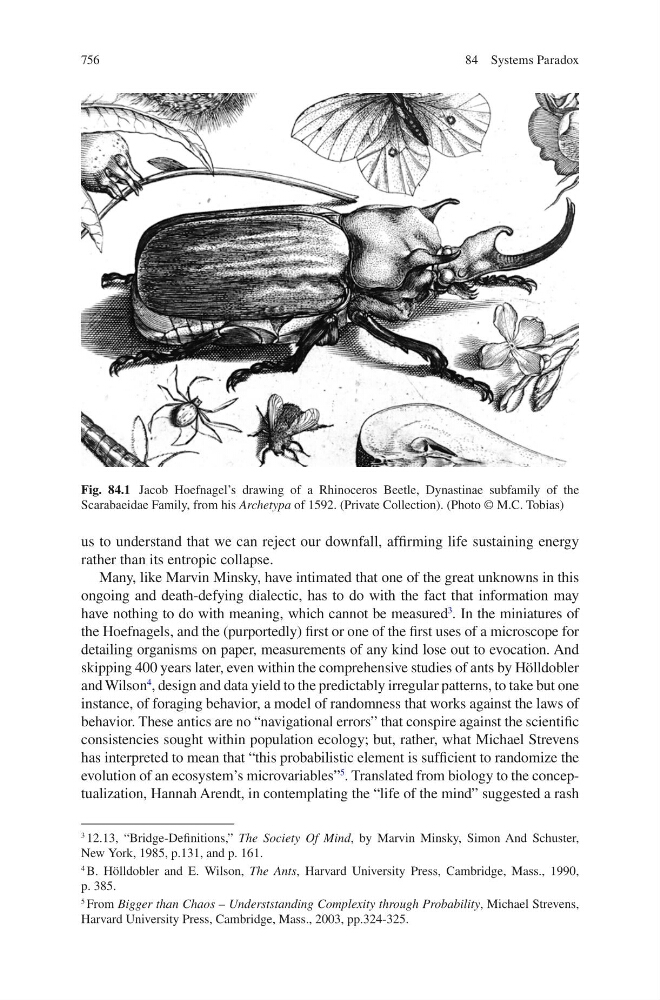
the Hoefnagels, and the (purportedly) first or one of the first uses of a microscope for
detailing organisms on paper, measurements of any kind lose out to evocation. And
skipping 400 years later, even within the comprehensive studies of ants by Hölldobler
and Wilson
4
, design and data yield to the predictably irregular patterns, to take but one
instance, of foraging behavior, a model of randomness that works against the laws of
behavior. These antics are no “navigational errors” that conspire against the scientific
consistencies sought within population ecology; but, rather, what Michael Strevens
has interpreted to mean that “this probabilistic element is sufficient to randomize the
evolution of an ecosystem’s microvariables”
5
. Translated from biology to the conceptualization, Hannah Arendt, in contemplating the “life of the mind” suggested a rash
3 12.13, “Bridge-Definitions,” The Society Of Mind, by Marvin Minsky, Simon And Schuster,
New York, 1985, p.131, and p. 161.
4 B. Hölldobler and E. Wilson, The Ants, Harvard University Press, Cambridge, Mass., 1990,
p. 385.
5 From Bigger than Chaos – Underststanding Complexity through Probability, Michael Strevens,
Harvard University Press, Cambridge, Mass., 2003, pp.324-325.
Fig. 84.1 Jacob Hoefnagel’s drawing of a Rhinoceros Beetle, Dynastinae subfamily of the
Scarabaeidae Family, from his Archetypa of 1592. (Private Collection). (Photo © M.C. Tobias)
84 Systems Paradox