

747
82.2 Hope Begets Faith
Price himself was an extraordinary fellow, close correspondent with Benjamin
Franklin, and expert demographer whose writings in the early 1780s regarding the
population growth in Great Britain would exert significant impact on yet another
Reverend, Thomas Malthus
6
. The three preachers—Bayes, Price, and Malthus—
together can be said to have closed critical gaps between ideas of one and of infinity,
of all things linear and non-linear, populations and species, and the real-time causes
and consequences of number theories within the nascent ecological sciences.
Martyn Hooper cites mathematical historian Sharon Bertsch McGrayne who has
written that Bayes “transformed probability from a gamblers’ measure of frequency
into a measure of informed belief”
7
. This touches the core subjectivity of most probability theories, namely, the incorporation of “belief” into what, then, has become
another version of the Anthropic Principle; the introduction of a central variable into
6 See “Richard Price, Bayes’ theorem, and God,” by Martyn Hooper, in the publication, Significance,
February 2013, pp. 36–39. https://www.york.ac.uk/depts/maths/histstat/price.pdf
7 See McGrayne, S. B. The Theory that Would Not Die: How Bayes’ Rule Cracked the Enigma
Code, Hunted Down Russian Submarines, and Emerged Triumphant from Two Centuries of
Controversy. New Haven, CT: Yale University Press, 2011.
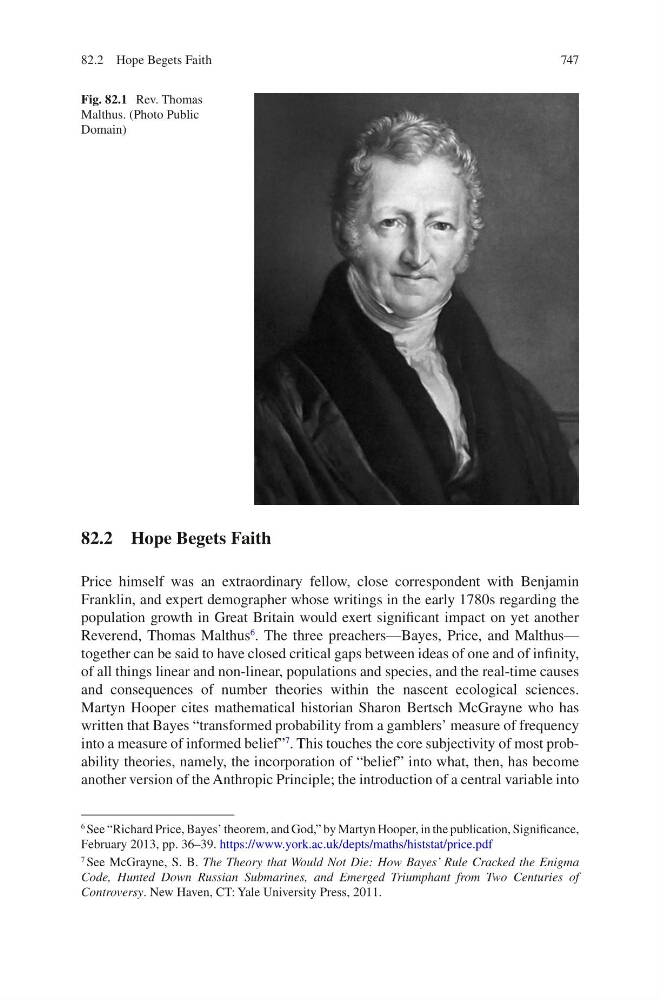
Fig. 82.1 Rev. Thomas
Malthus. (Photo Public
Domain)
82.2 Hope Begets Faith
82.2 Hope Begets Faith
Price himself was an extraordinary fellow, close correspondent with Benjamin
Franklin, and expert demographer whose writings in the early 1780s regarding the
population growth in Great Britain would exert significant impact on yet another
Reverend, Thomas Malthus
6
. The three preachers—Bayes, Price, and Malthus—
together can be said to have closed critical gaps between ideas of one and of infinity,
of all things linear and non-linear, populations and species, and the real-time causes
and consequences of number theories within the nascent ecological sciences.
Martyn Hooper cites mathematical historian Sharon Bertsch McGrayne who has
written that Bayes “transformed probability from a gamblers’ measure of frequency
into a measure of informed belief”
7
. This touches the core subjectivity of most probability theories, namely, the incorporation of “belief” into what, then, has become
another version of the Anthropic Principle; the introduction of a central variable into
6 See “Richard Price, Bayes’ theorem, and God,” by Martyn Hooper, in the publication, Significance,
February 2013, pp. 36–39. https://www.york.ac.uk/depts/maths/histstat/price.pdf
7 See McGrayne, S. B. The Theory that Would Not Die: How Bayes’ Rule Cracked the Enigma
Code, Hunted Down Russian Submarines, and Emerged Triumphant from Two Centuries of
Controversy. New Haven, CT: Yale University Press, 2011.
Fig. 82.1 Rev. Thomas
Malthus. (Photo Public
Domain)
82.2 Hope Begets Faith