

712
ability ignites the most significant intellectual and metaphysical discrepancies separating the history of religions from today’s ecological realities. Religion and reality.
The mind and nature. Is this duality representative of an irreconcilable gulf? Wrote
Nagarjuna, “The moon is the public light/What is the use of (personal) property?”.
20
“Wildness is not to be assuaged by anything”.
21
“The earth, the mighty ocean/And
the mountains are not a burden/But he who is ungrateful/Is indeed a heavy burden”.
22
And by these conjurations, being or no being, existence or non-existence (think
extinct, non-extinct), there still remains a poignant and all-important call to worship. Humanity’s relationship to unexpected, express realities—objects like moonlight, or all those perceptions of things which define for us the environment we
inhabit—is entirely relevant, whether real or not. In the margins, crannies and there,
upon unseen footholds is an activist incantation. It may be a case of the Windmill
Paradox, as lovingly described by a Cervantes, but—giants or no giants—Don
Quixote must act so as to transcend the void. For the charging knight, and his loyal
friend, the observer (Sancho Panza), vagueness explodes beyond itself into both a
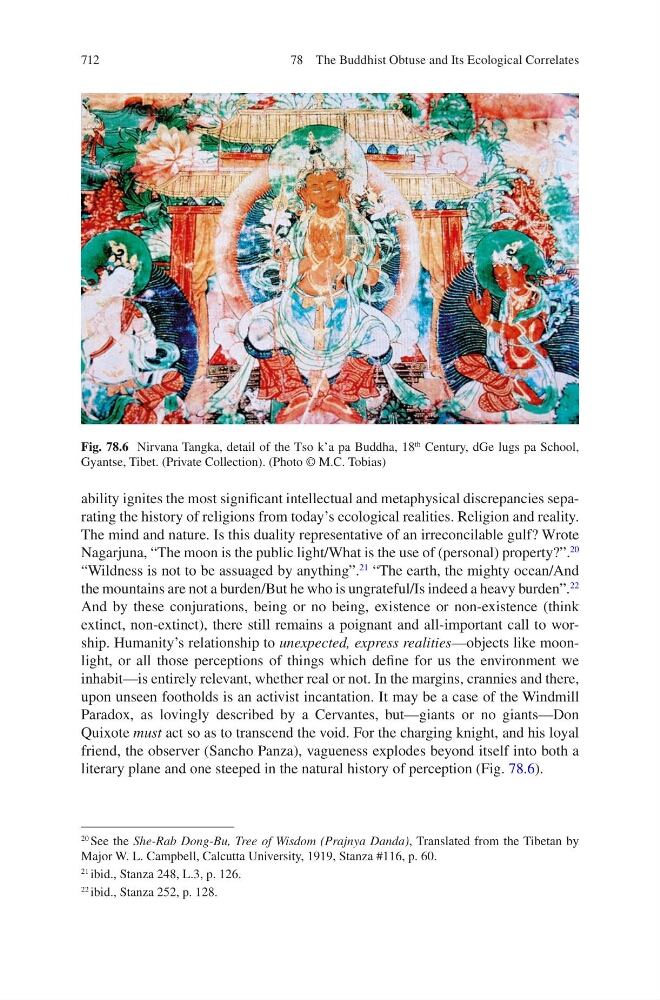
literary plane and one steeped in the natural history of perception (Fig. 78.6).
20 See the She-Rab Dong-Bu, Tree of Wisdom (Prajnya Danda), Translated from the Tibetan by
Major W. L. Campbell, Calcutta University, 1919, Stanza #116, p. 60.
21 ibid., Stanza 248, L.3, p. 126.
22 ibid., Stanza 252, p. 128.
Fig. 78.6 Nirvana Tangka, detail of the Tso k’a pa Buddha, 18
th Century, dGe lugs pa School,
Gyantse, Tibet. (Private Collection). (Photo © M.C. Tobias)
78 The Buddhist Obtuse and Its Ecological Correlates