

694
Teutonic, Gothic, and Anglo-Saxon, frijôn, to love, we have an etymologically
schizophrenic dichotomy from Old English in the fourteenth century, “power of
self-determination, state of free will” to the confused mix of freedom fighters, freedom lovers, and “exemption from arbitrary or despotic control”.
13
And then, its
ultimate desecration, “Arbeit Macht Frei,” Work Makes One Free, the sign at the
entrance to Auschwitz and other Nazi Jewish extermination camps.
Kierkegaard’s dialectical exasperations spanning the mundane as well as his own
tortured theology evince other characteristics endemic to a twenty-first-century ecological conscience, with or without the notion of human freedom, salvation, or a
single atom or god of amelioration. The young poet who declares, “Tout n’est rien,
all is nothing,” and who, in the “Diapsalmata,” informs us, that only in the realization of children, and conversations with them, might we still hold out hope of anything becoming rational, but “-good Lord!” once they have achieved the rational,
what then, he muses?.
14
And years later, writing in “The Essential Expression”
chapter of Kierkegaard’s Concluding Unscientific Postscript (first published in 1846
as Concluding Unscientific Postscript to the Philosophical Fragments by his pseudonymous tell-all, Johannes Climacus), “…that a human being can do absolutely
13 See Online Etymology Dictionary, “freedom,” https://www.etymonline.com/word/freedom,
Accessed July 21, 2020.
14 Søren Kierkegaard, Either/Or, Abridged Edition, Edited by Steven L. Ross, Translated from the
Danish by George L. Stengren, Perennial Library, New York, 1986, p.13.
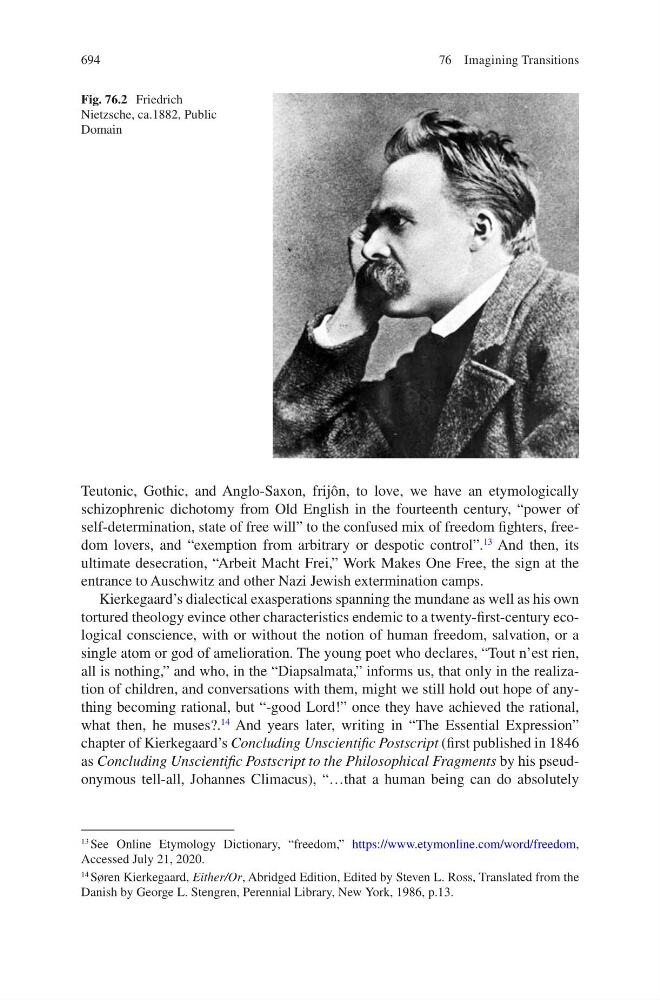
Fig. 76.2 Friedrich
Nietzsche, ca.1882, Public
Domain
76 Imagining Transitions