

692
ethic relevant to human evolution and the power of natural selection favoring a
pragmatic, co-symbiotic ideal. That is, indeed, the very idealism upon which the
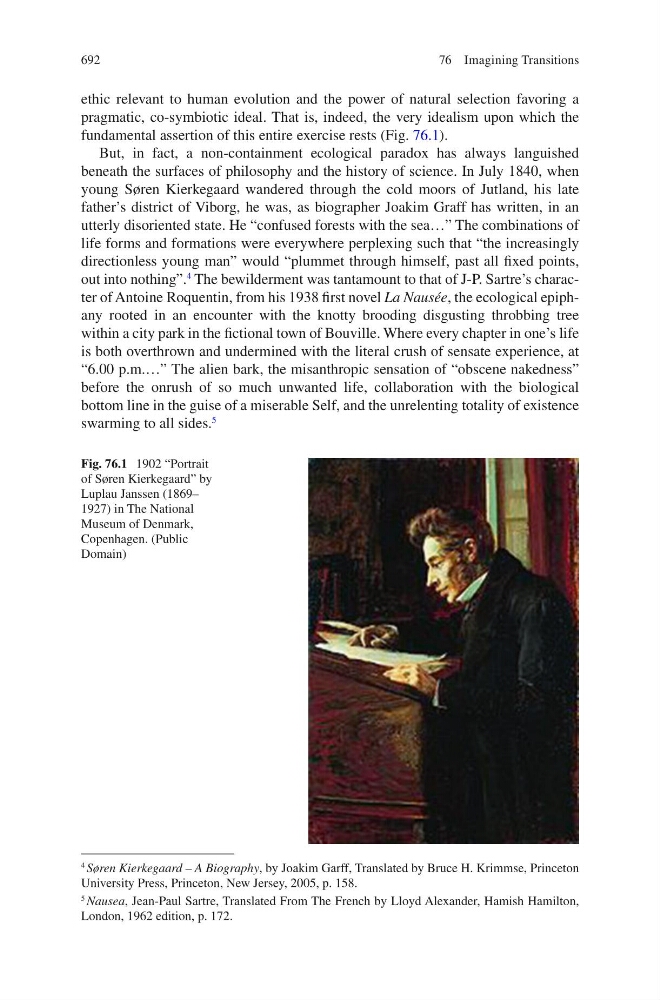
fundamental assertion of this entire exercise rests (Fig. 76.1).
But, in fact, a non-containment ecological paradox has always languished
beneath the surfaces of philosophy and the history of science. In July 1840, when
young Søren Kierkegaard wandered through the cold moors of Jutland, his late
father’s district of Viborg, he was, as biographer Joakim Graff has written, in an
utterly disoriented state. He “confused forests with the sea…” The combinations of
life forms and formations were everywhere perplexing such that “the increasingly
directionless young man” would “plummet through himself, past all fixed points,
out into nothing”.
4
The bewilderment was tantamount to that of J-P. Sartre’s character of Antoine Roquentin, from his 1938 first novel La Nausée, the ecological epiphany rooted in an encounter with the knotty brooding disgusting throbbing tree
within a city park in the fictional town of Bouville. Where every chapter in one’s life
is both overthrown and undermined with the literal crush of sensate experience, at
“6.00 p.m.…” The alien bark, the misanthropic sensation of “obscene nakedness”
before the onrush of so much unwanted life, collaboration with the biological
bottom line in the guise of a miserable Self, and the unrelenting totality of existence
swarming to all sides.
5
4 Søren Kierkegaard – A Biography, by Joakim Garff, Translated by Bruce H. Krimmse, Princeton
University Press, Princeton, New Jersey, 2005, p. 158.
5 Nausea, Jean-Paul Sartre, Translated From The French by Lloyd Alexander, Hamish Hamilton,
London, 1962 edition, p. 172.
Fig. 76.1 1902 “Portrait
of Søren Kierkegaard” by
Luplau Janssen (1869–
1927) in The National
Museum of Denmark,
Copenhagen. (Public
Domain)
76 Imagining Transitions