

682
mere logic. It innately seeks the cover of an exit strategy, the equivalent of a dream
beyond the immediate. It is basic.
There are transitions in nature whose increments defy our conceptual grasp of
the true heap. These vague contours are weaned off palpable grains in the sand,
“traces on the Rhodian Shore,” to cite environmental historian Clarence Glacken’s
work. Robert Kaplan, in his exquisite work, The Nothing That Is – A Natural History
of Zero,
7
meditated at great length upon the history, enigma, and phenomena that
constitute this peculiar function of human logic and longing. Speculating on such
landmarks as Osborne Reynolds’ On an Inversion of Ideas as to the Structure of the
Universe (1903), on the passion to reveal nothingness amid plenty, nihilism as the
font of bounty, the paradoxical “presence” that is, for all that, one’s very “absence”,
8
Kaplan wanders into the world of Jainism, expressly the mathematics at the time of
Mahavira, suggesting that the mysterious convergence of zero, coming ever closer
to other numbers, would invite “an ideal country” comprising new “species,”
“lenses,” an entirely novel realm of landscapes.
9
Such a zero, and all those numbers above, below, to either side, cannot, in themselves define the summit of Mount Fuji or depths of the Mariana Trench, but they do
provide our simplest means of representing Nature to ourselves. Kaplan is reminded
of Winston Churchill describing “a quantity passing through infinity and changing
its sign from plus to minus”.
10
We may pride ourselves on knowing various states of
7 By Robert Kaplan, Illustrations by Ellen Kaplan, Oxford University Press, New York, 2000.
8 ibid., p. 195.
9 ibid., p.195.
10 ibid., p. 142.
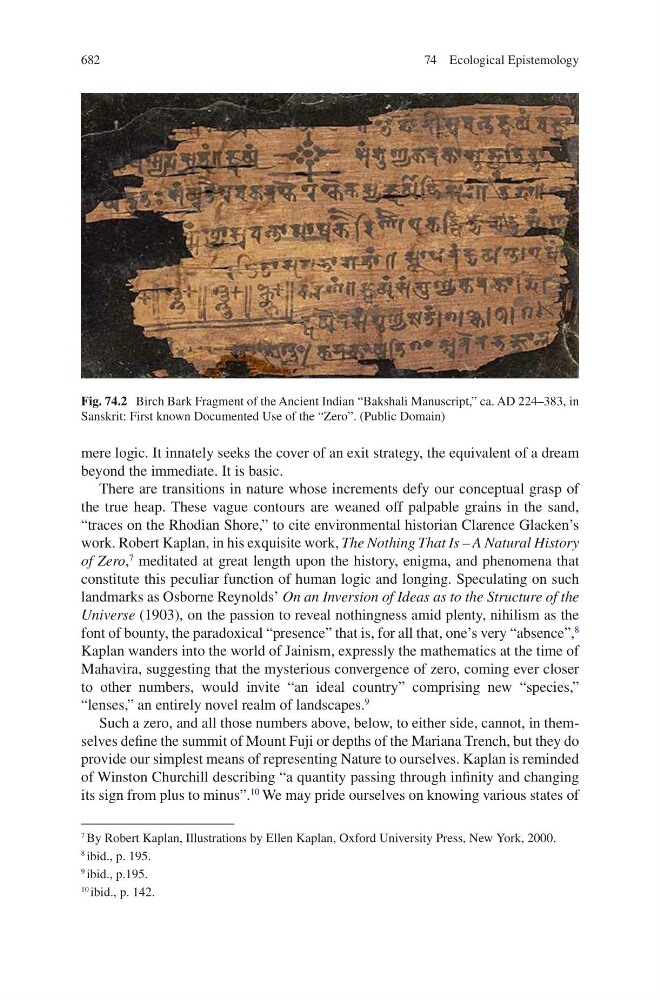
Fig. 74.2 Birch Bark Fragment of the Ancient Indian “Bakshali Manuscript,” ca. AD 224–383, in
Sanskrit: First known Documented Use of the “Zero”. (Public Domain)
74 Ecological Epistemology