

661
that the last of all common hominin ancestors mingled, in a collective numbering
roughly 5 million people worldwide. That figure represented roughly 1% of the
“weight of [all combined] vertebrate animals” who weighed 99%. Today, that ratio
has been thoroughly altered, with humans weighing 32%, domesticated livestock
67%, and wild animals commanding no more than 1%.
4
While such data pertaining
to biomass proportions in the Anthropocene have been suspected for several decades
(as of 2019), what has changed is the inevitable disappearance of most of that
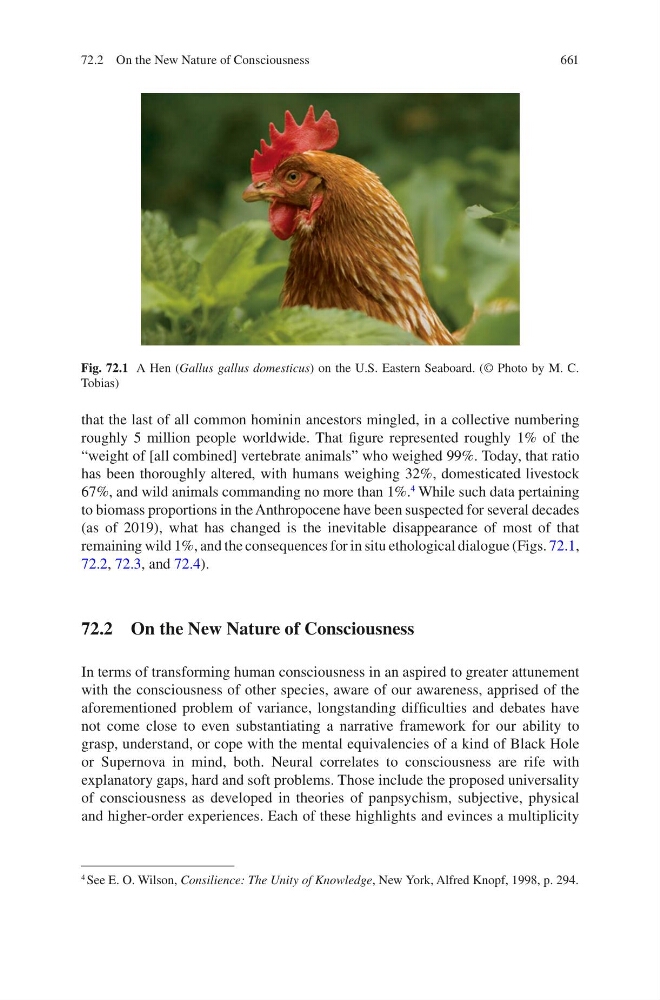
remaining wild 1%, and the consequences for in situ ethological dialogue (Figs. 72.1,
72.2, 72.3, and 72.4).
72.2 On the New Nature of Consciousness
In terms of transforming human consciousness in an aspired to greater attunement
with the consciousness of other species, aware of our awareness, apprised of the
aforementioned problem of variance, longstanding difficulties and debates have
not come close to even substantiating a narrative framework for our ability to
grasp, understand, or cope with the mental equivalencies of a kind of Black Hole
or Supernova in mind, both. Neural correlates to consciousness are rife with
explanatory gaps, hard and soft problems. Those include the proposed universality
of consciousness as developed in theories of panpsychism, subjective, physical
and higher-order experiences. Each of these highlights and evinces a multiplicity
4 See E. O. Wilson, Consilience: The Unity of Knowledge, New York, Alfred Knopf, 1998, p. 294.
Fig. 72.1 A Hen (Gallus gallus domesticus) on the U.S. Eastern Seaboard. (© Photo by M. C.
Tobias)
72.2 On the New Nature of Consciousness