

637
68.3 What Is Beautiful?
But that is not to concede that the beautiful images of a Kuo Hsi or Li Cheng, a
Sultan Muhammad or those imagined dynamics between Gilgamesh and Enkidu do
not herald this idea, further explored in Italo Calvino’s 1957 novel, Il Barone rampante, of a rim of green so ever verdant scattered light in which the semi-wild child
illustriously brachiates and there situates his entire conception of life and of duty to
life. That place so finely elucidated in Edward O. Wilson’s Biophilia, when he
writes, “Nor is there anything foreordained or otherwise trivial in the aesthetic optimum of human beings”
6
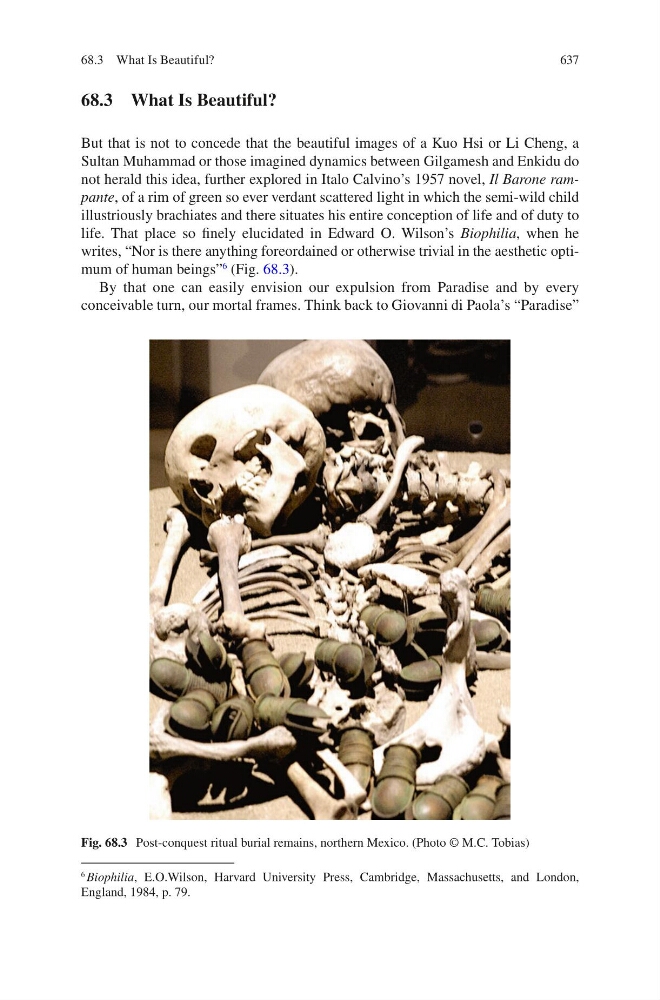
(Fig. 68.3).
By that one can easily envision our expulsion from Paradise and by every
conceivable turn, our mortal frames. Think back to Giovanni di Paola’s “Paradise”
6 Biophilia, E.O.Wilson, Harvard University Press, Cambridge, Massachusetts, and London,
England, 1984, p. 79.
Fig. 68.3 Post-conquest ritual burial remains, northern Mexico. (Photo © M.C. Tobias)
68.3 What Is Beautiful?
68.3 What Is Beautiful?
But that is not to concede that the beautiful images of a Kuo Hsi or Li Cheng, a
Sultan Muhammad or those imagined dynamics between Gilgamesh and Enkidu do
not herald this idea, further explored in Italo Calvino’s 1957 novel, Il Barone rampante, of a rim of green so ever verdant scattered light in which the semi-wild child
illustriously brachiates and there situates his entire conception of life and of duty to
life. That place so finely elucidated in Edward O. Wilson’s Biophilia, when he
writes, “Nor is there anything foreordained or otherwise trivial in the aesthetic optimum of human beings”
6
(Fig. 68.3).
By that one can easily envision our expulsion from Paradise and by every
conceivable turn, our mortal frames. Think back to Giovanni di Paola’s “Paradise”
6 Biophilia, E.O.Wilson, Harvard University Press, Cambridge, Massachusetts, and London,
England, 1984, p. 79.
Fig. 68.3 Post-conquest ritual burial remains, northern Mexico. (Photo © M.C. Tobias)
68.3 What Is Beautiful?