

630
of the world had clearly been self-altered. The catalysts were responsive to—among
others—post-glacial retreats, fairer weather, resulting nutritional opportunism,
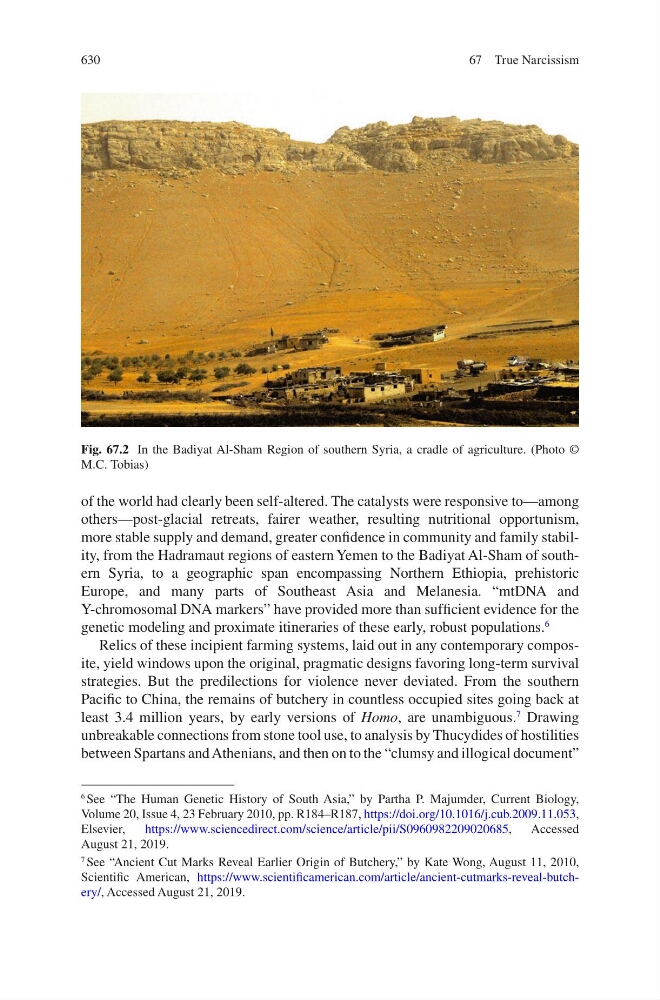
more stable supply and demand, greater confidence in community and family stability, from the Hadramaut regions of eastern Yemen to the Badiyat Al-Sham of southern Syria, to a geographic span encompassing Northern Ethiopia, prehistoric
Europe, and many parts of Southeast Asia and Melanesia. “mtDNA and
Y-chromosomal DNA markers” have provided more than sufficient evidence for the
genetic modeling and proximate itineraries of these early, robust populations.
6
Relics of these incipient farming systems, laid out in any contemporary composite, yield windows upon the original, pragmatic designs favoring long-term survival
strategies. But the predilections for violence never deviated. From the southern
Pacific to China, the remains of butchery in countless occupied sites going back at
least 3.4 million years, by early versions of Homo, are unambiguous.
7
Drawing
unbreakable connections from stone tool use, to analysis by Thucydides of hostilities
between Spartans and Athenians, and then on to the “clumsy and illogical document”
6 See “The Human Genetic History of South Asia,” by Partha P. Majumder, Current Biology,
Volume 20, Issue 4, 23 February 2010, pp. R184–R187, https://doi.org/10.1016/j.cub.2009.11.053,
Elsevier,
https://www.sciencedirect.com/science/article/pii/S0960982209020685, Accessed
August 21, 2019.
7 See “Ancient Cut Marks Reveal Earlier Origin of Butchery,” by Kate Wong, August 11, 2010,
Scientific American, https://www.scientificamerican.com/article/ancient-cutmarks-reveal-butchery/, Accessed August 21, 2019.
Fig. 67.2 In the Badiyat Al-Sham Region of southern Syria, a cradle of agriculture. (Photo ©
M.C. Tobias)
67 True Narcissism