

603
upon fish. But far less clear are the psychological and emotional precursors of such
impacted behavior; let alone how such intangibles might compare and contrast with
those in other species. The very conjectures—at the heart of anthrozoological, ethological and biosemiotic studies—yield virtually nothing that can be asserted with
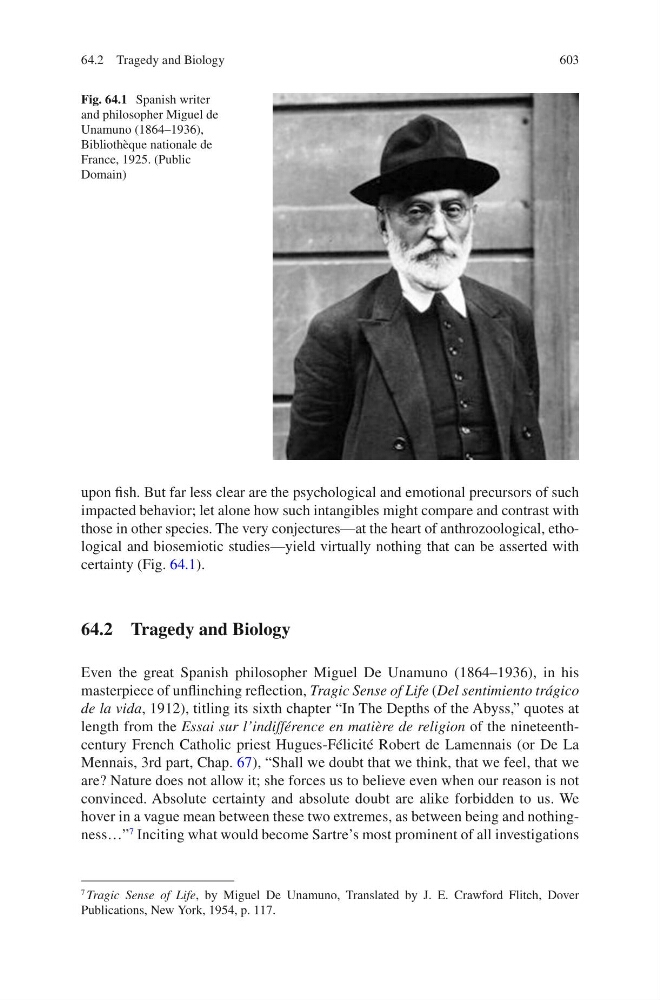
certainty (Fig. 64.1).
64.2 Tragedy and Biology
Even the great Spanish philosopher Miguel De Unamuno (1864–1936), in his
masterpiece of unflinching reflection, Tragic Sense of Life (Del sentimiento trágico
de la vida, 1912), titling its sixth chapter “In The Depths of the Abyss,” quotes at
length from the Essai sur l’indifférence en matière de religion of the nineteenthcentury French Catholic priest Hugues-Félicité Robert de Lamennais (or De La
Mennais, 3rd part, Chap. 67), “Shall we doubt that we think, that we feel, that we
are? Nature does not allow it; she forces us to believe even when our reason is not
convinced. Absolute certainty and absolute doubt are alike forbidden to us. We
hover in a vague mean between these two extremes, as between being and nothingness…”
7
Inciting what would become Sartre’s most prominent of all investigations
7 Tragic Sense of Life, by Miguel De Unamuno, Translated by J. E. Crawford Flitch, Dover
Publications, New York, 1954, p. 117.
Fig. 64.1 Spanish writer
and philosopher Miguel de
Unamuno (1864–1936),
Bibliothèque nationale de
France, 1925. (Public
Domain)
64.2 Tragedy and Biology
upon fish. But far less clear are the psychological and emotional precursors of such
impacted behavior; let alone how such intangibles might compare and contrast with
those in other species. The very conjectures—at the heart of anthrozoological, ethological and biosemiotic studies—yield virtually nothing that can be asserted with
certainty (Fig. 64.1).
64.2 Tragedy and Biology
Even the great Spanish philosopher Miguel De Unamuno (1864–1936), in his
masterpiece of unflinching reflection, Tragic Sense of Life (Del sentimiento trágico
de la vida, 1912), titling its sixth chapter “In The Depths of the Abyss,” quotes at
length from the Essai sur l’indifférence en matière de religion of the nineteenthcentury French Catholic priest Hugues-Félicité Robert de Lamennais (or De La
Mennais, 3rd part, Chap. 67), “Shall we doubt that we think, that we feel, that we
are? Nature does not allow it; she forces us to believe even when our reason is not
convinced. Absolute certainty and absolute doubt are alike forbidden to us. We
hover in a vague mean between these two extremes, as between being and nothingness…”
7
Inciting what would become Sartre’s most prominent of all investigations
7 Tragic Sense of Life, by Miguel De Unamuno, Translated by J. E. Crawford Flitch, Dover
Publications, New York, 1954, p. 117.
Fig. 64.1 Spanish writer
and philosopher Miguel de
Unamuno (1864–1936),
Bibliothèque nationale de
France, 1925. (Public
Domain)
64.2 Tragedy and Biology