

31
habitats larger than 100 square kilometers are seen to be scarce when measured
against smaller protected areas, which are the majority, 60% of them in Europe, and
often extremely small. They account for “less than 10%” of all 46,414,431 square
kilometers protected areas (“14.87% of the land [excluding Antarctica] and 7.27%
of the sea.”)
9
As tiresome as such numbers in array can be, they indisputably excite
volatile emotional realities for the human species on a tightrope. In the United
States (3.797 million square miles= 2.43 billion acres), there are 111 million acres
in 44 states designated as “wilderness.” In total, approximately one-third of all US
public lands—some 235 million acres—are described as “wildlands,” under some
aegis of protection. Including Alaska, that represents less than 5% of America’s land
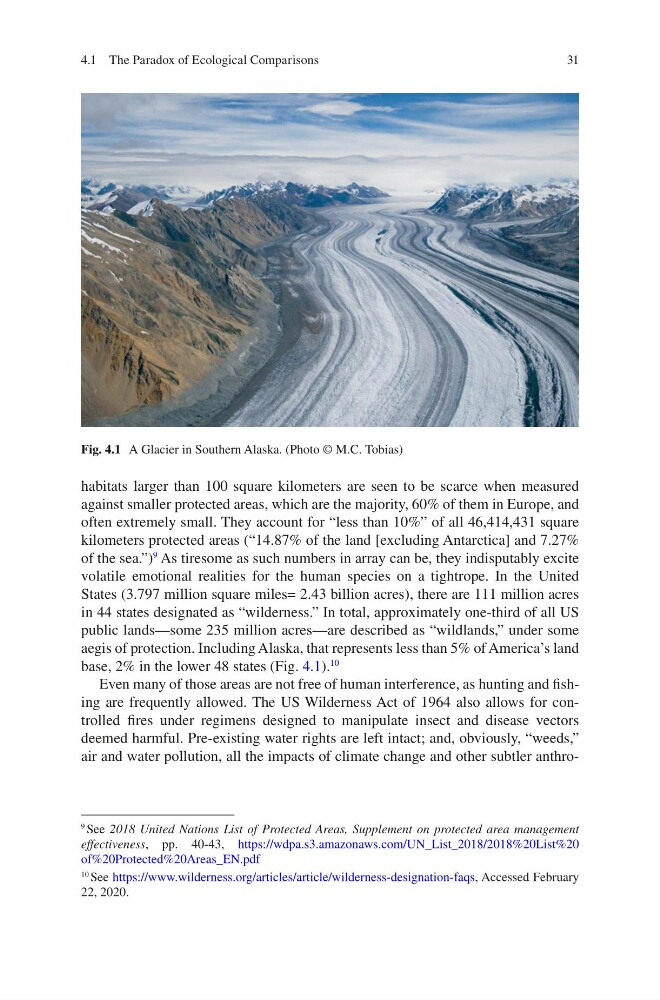
base, 2% in the lower 48 states (Fig. 4.1).
10
Even many of those areas are not free of human interference, as hunting and fishing are frequently allowed. The US Wilderness Act of 1964 also allows for controlled fires under regimens designed to manipulate insect and disease vectors
deemed harmful. Pre-existing water rights are left intact; and, obviously, “weeds,”
air and water pollution, all the impacts of climate change and other subtler anthro9 See 2018 United Nations List of Protected Areas, Supplement on protected area management
effectiveness, pp. 40-43, https://wdpa.s3.amazonaws.com/UN_List_2018/2018%20List%20
of%20Protected%20Areas_EN.pdf
10 See https://www.wilderness.org/articles/article/wilderness-designation-faqs, Accessed February
22, 2020.
Fig. 4.1 A Glacier in Southern Alaska. (Photo © M.C. Tobias)
4.1 The Paradox of Ecological Comparisons
habitats larger than 100 square kilometers are seen to be scarce when measured
against smaller protected areas, which are the majority, 60% of them in Europe, and
often extremely small. They account for “less than 10%” of all 46,414,431 square
kilometers protected areas (“14.87% of the land [excluding Antarctica] and 7.27%
of the sea.”)
9
As tiresome as such numbers in array can be, they indisputably excite
volatile emotional realities for the human species on a tightrope. In the United
States (3.797 million square miles= 2.43 billion acres), there are 111 million acres
in 44 states designated as “wilderness.” In total, approximately one-third of all US
public lands—some 235 million acres—are described as “wildlands,” under some
aegis of protection. Including Alaska, that represents less than 5% of America’s land
base, 2% in the lower 48 states (Fig. 4.1).
10
Even many of those areas are not free of human interference, as hunting and fishing are frequently allowed. The US Wilderness Act of 1964 also allows for controlled fires under regimens designed to manipulate insect and disease vectors
deemed harmful. Pre-existing water rights are left intact; and, obviously, “weeds,”
air and water pollution, all the impacts of climate change and other subtler anthro9 See 2018 United Nations List of Protected Areas, Supplement on protected area management
effectiveness, pp. 40-43, https://wdpa.s3.amazonaws.com/UN_List_2018/2018%20List%20
of%20Protected%20Areas_EN.pdf
10 See https://www.wilderness.org/articles/article/wilderness-designation-faqs, Accessed February
22, 2020.
Fig. 4.1 A Glacier in Southern Alaska. (Photo © M.C. Tobias)
4.1 The Paradox of Ecological Comparisons