

513
our species’ inherent aggression right next door.
35
That debate is further charged by
early Vedic studies by Ananda K. Coomaraswamy (1877–1947) who viewed the
human body itself as a “city of God,” that every “immanent deity” is a “citizen” of
that same community, and the famed saying, “That art thou” actually connotes selfsacrifice (hence, in evolutionary terms, pain) as well as the notion that such pain
also “is to liberate the God within us”.
36
In other words, with human domestication, emerged, first, ethical views, and
then a constellation of godheads, the contest of our consciousness within the fargreater realms of our surrounding and implicit ecological circumstances. To see
through all of these confounding configurations with some mythological pure
vision. To gaze without intervention. That has been the goal of pure vision, beyond
mere faith. But is possible? And, if so, what is it?
And even if, technically, we are blind, deaf, insensate, we still crave a line of
sight, internalize visions, aspire to catch a glimpse, a sensory connection to some
distant place, our own Arcadias, but fail to do so, constantly in the way. All a lucid
prelude to communion with that which is still, silent, at rest. The peace at last which,
at rare moments, an individual—but never a collective or species—discovers. That
is, perhaps, the most difficult of all evolutionary paradoxes to resolve. To finally,
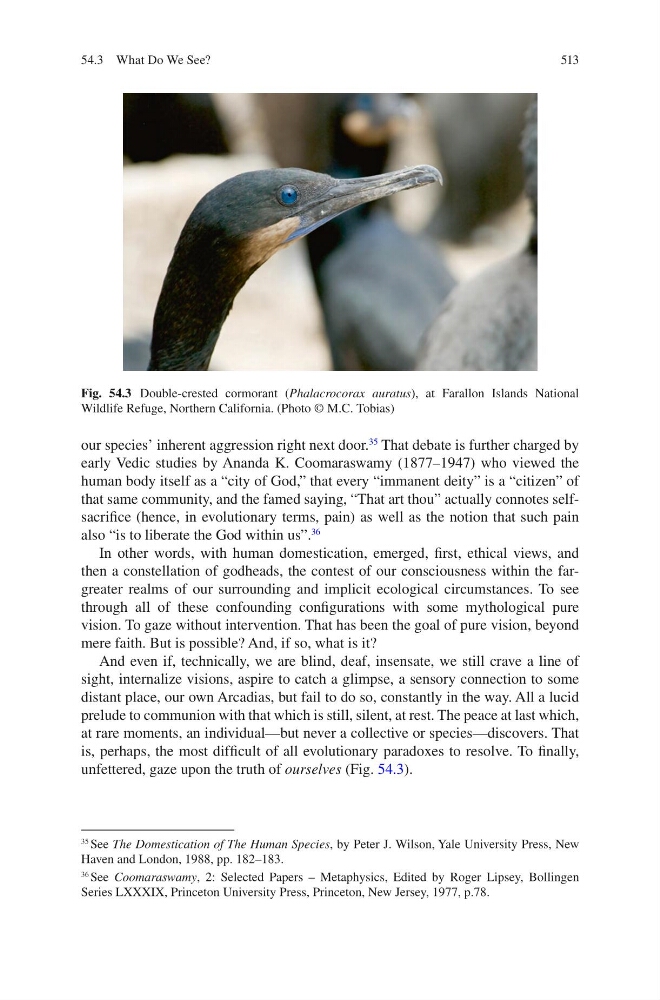
unfettered, gaze upon the truth of ourselves (Fig. 54.3).
35 See The Domestication of The Human Species, by Peter J. Wilson, Yale University Press, New
Haven and London, 1988, pp. 182–183.
36 See Coomaraswamy, 2: Selected Papers – Metaphysics, Edited by Roger Lipsey, Bollingen
Series LXXXIX, Princeton University Press, Princeton, New Jersey, 1977, p.78.
Fig. 54.3 Double-crested cormorant (Phalacrocorax auratus), at Farallon Islands National
Wildlife Refuge, Northern California. (Photo © M.C. Tobias)
54.3 What Do We See?
our species’ inherent aggression right next door.
35
That debate is further charged by
early Vedic studies by Ananda K. Coomaraswamy (1877–1947) who viewed the
human body itself as a “city of God,” that every “immanent deity” is a “citizen” of
that same community, and the famed saying, “That art thou” actually connotes selfsacrifice (hence, in evolutionary terms, pain) as well as the notion that such pain
also “is to liberate the God within us”.
36
In other words, with human domestication, emerged, first, ethical views, and
then a constellation of godheads, the contest of our consciousness within the fargreater realms of our surrounding and implicit ecological circumstances. To see
through all of these confounding configurations with some mythological pure
vision. To gaze without intervention. That has been the goal of pure vision, beyond
mere faith. But is possible? And, if so, what is it?
And even if, technically, we are blind, deaf, insensate, we still crave a line of
sight, internalize visions, aspire to catch a glimpse, a sensory connection to some
distant place, our own Arcadias, but fail to do so, constantly in the way. All a lucid
prelude to communion with that which is still, silent, at rest. The peace at last which,
at rare moments, an individual—but never a collective or species—discovers. That
is, perhaps, the most difficult of all evolutionary paradoxes to resolve. To finally,
unfettered, gaze upon the truth of ourselves (Fig. 54.3).
35 See The Domestication of The Human Species, by Peter J. Wilson, Yale University Press, New
Haven and London, 1988, pp. 182–183.
36 See Coomaraswamy, 2: Selected Papers – Metaphysics, Edited by Roger Lipsey, Bollingen
Series LXXXIX, Princeton University Press, Princeton, New Jersey, 1977, p.78.
Fig. 54.3 Double-crested cormorant (Phalacrocorax auratus), at Farallon Islands National
Wildlife Refuge, Northern California. (Photo © M.C. Tobias)
54.3 What Do We See?