

473
chasms of existing data bases and increments with respect to animal behavior in
general were brought to the fore with the realizations of Imprinting Theory with
Greylag Geese, detected (experienced) by Konrad Lorenz in 1935
15
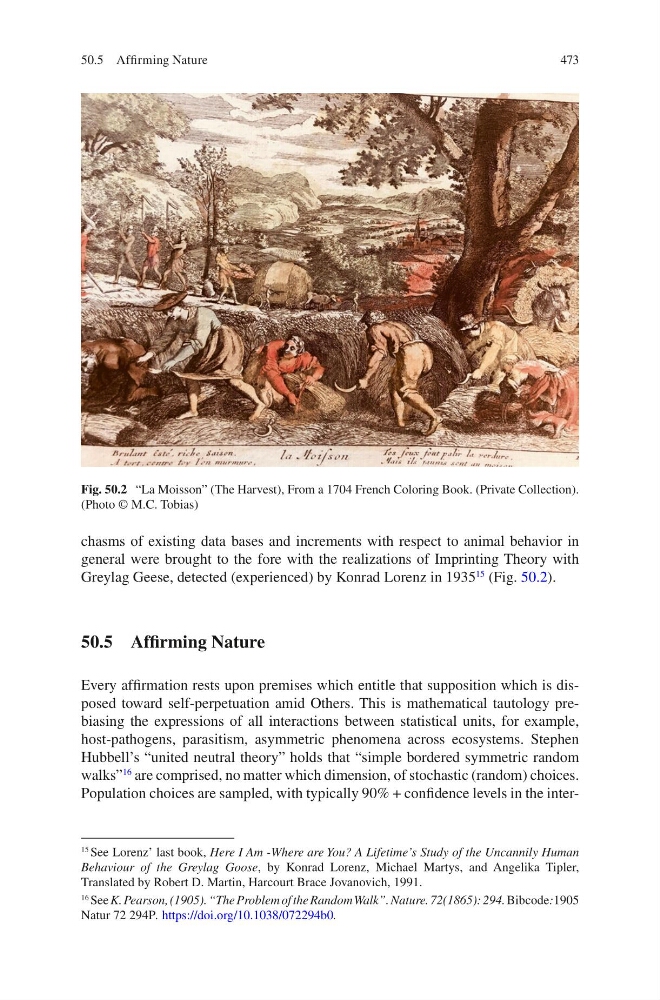
(Fig. 50.2).
50.5 Affirming Nature
Every affirmation rests upon premises which entitle that supposition which is disposed toward self-perpetuation amid Others. This is mathematical tautology prebiasing the expressions of all interactions between statistical units, for example,
host-pathogens, parasitism, asymmetric phenomena across ecosystems. Stephen
Hubbell’s “united neutral theory” holds that “simple bordered symmetric random
walks”
16
are comprised, no matter which dimension, of stochastic (random) choices.
Population choices are sampled, with typically 90% + confidence levels in the inter15 See Lorenz’ last book, Here I Am -Where are You? A Lifetime’s Study of the Uncannily Human
Behaviour of the Greylag Goose, by Konrad Lorenz, Michael Martys, and Angelika Tipler,
Translated by Robert D. Martin, Harcourt Brace Jovanovich, 1991.
16 See K. Pearson, (1905). “The Problem of the Random Walk”. Nature. 72(1865): 294. Bibcode:1905
Natur 72 294P. https://doi.org/10.1038/072294b0.
Fig. 50.2 “La Moisson” (The Harvest), From a 1704 French Coloring Book. (Private Collection).
(Photo © M.C. Tobias)
50.5 Affirming Nature
chasms of existing data bases and increments with respect to animal behavior in
general were brought to the fore with the realizations of Imprinting Theory with
Greylag Geese, detected (experienced) by Konrad Lorenz in 1935
15
(Fig. 50.2).
50.5 Affirming Nature
Every affirmation rests upon premises which entitle that supposition which is disposed toward self-perpetuation amid Others. This is mathematical tautology prebiasing the expressions of all interactions between statistical units, for example,
host-pathogens, parasitism, asymmetric phenomena across ecosystems. Stephen
Hubbell’s “united neutral theory” holds that “simple bordered symmetric random
walks”
16
are comprised, no matter which dimension, of stochastic (random) choices.
Population choices are sampled, with typically 90% + confidence levels in the inter15 See Lorenz’ last book, Here I Am -Where are You? A Lifetime’s Study of the Uncannily Human
Behaviour of the Greylag Goose, by Konrad Lorenz, Michael Martys, and Angelika Tipler,
Translated by Robert D. Martin, Harcourt Brace Jovanovich, 1991.
16 See K. Pearson, (1905). “The Problem of the Random Walk”. Nature. 72(1865): 294. Bibcode:1905
Natur 72 294P. https://doi.org/10.1038/072294b0.
Fig. 50.2 “La Moisson” (The Harvest), From a 1704 French Coloring Book. (Private Collection).
(Photo © M.C. Tobias)
50.5 Affirming Nature