

462
assent, for three days Christ, “the lamb of God” having died, was in paradise prior
to his resurrection (anastasis) and triumphant exaltation, the fuel of visionary succession. A close reading of “Hebrews”
11
focuses our attention upon what might be
described as the core ecological contradiction in the entire New Testament. That he
died for our sins. And who are we? Or, as Alice re-wrote the moment, Who are You?
His “one offering” that eclipses for all time all those other sins, particularly the killing of “bulls” and of the “heifer.” History and pre-history being invoked to remind
all those who believe in this saga that they will take part in “the saving of the soul.”
As crystallized in Hebrews 9:12, “Neither by the blood of goats and calves, but by
his own blood he entered in once into the holy place, having obtained eternal
redemption for us.” And, reiterated, as in John 14:6, “I am the way, and the truth,
and the life”.
12
11 The Holy Bible Containing The Old And New Testaments, Authorized King James Version, The
Christian Science Publishing Society, Boston, Massachusetts, Chapter 10, pp. 1497–1498.
12 See “Compelling Truth – the truth about: Salvation”, CompellingTruth.org Newsletter; https://
www.compellingtruth.org/Jesus-died-for-our-sins.html, Accessed May 7, 2020.
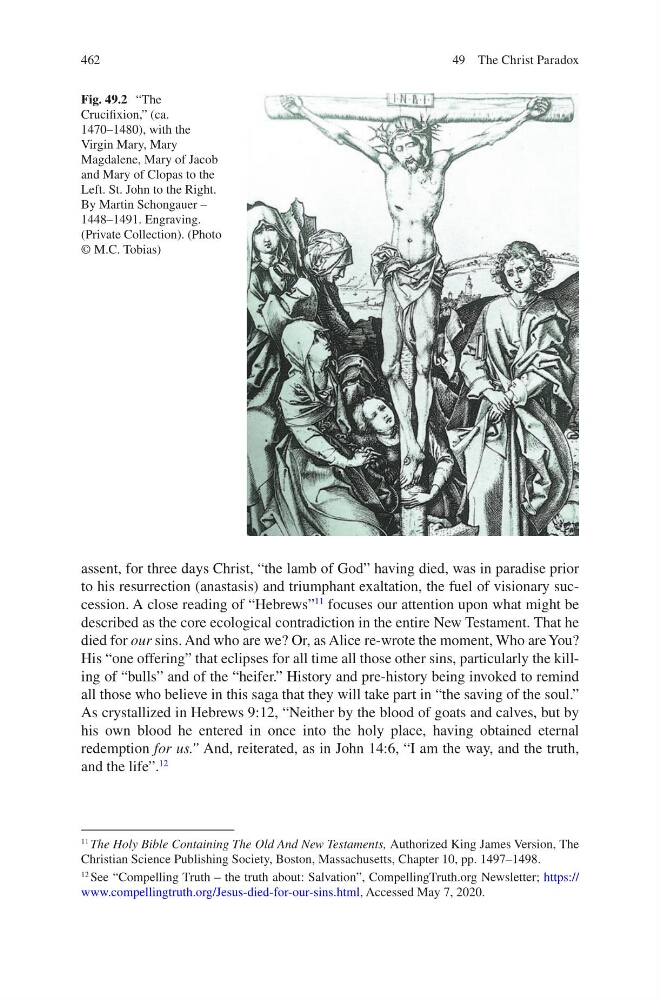
Fig. 49.2 “The
Crucifixion,” (ca.
1470–1480), with the
Virgin Mary, Mary
Magdalene, Mary of Jacob
and Mary of Clopas to the
Left. St. John to the Right.
By Martin Schongauer –
1448–1491. Engraving.
(Private Collection). (Photo
© M.C. Tobias)
49 The Christ Paradox
assent, for three days Christ, “the lamb of God” having died, was in paradise prior
to his resurrection (anastasis) and triumphant exaltation, the fuel of visionary succession. A close reading of “Hebrews”
11
focuses our attention upon what might be
described as the core ecological contradiction in the entire New Testament. That he
died for our sins. And who are we? Or, as Alice re-wrote the moment, Who are You?
His “one offering” that eclipses for all time all those other sins, particularly the killing of “bulls” and of the “heifer.” History and pre-history being invoked to remind
all those who believe in this saga that they will take part in “the saving of the soul.”
As crystallized in Hebrews 9:12, “Neither by the blood of goats and calves, but by
his own blood he entered in once into the holy place, having obtained eternal
redemption for us.” And, reiterated, as in John 14:6, “I am the way, and the truth,
and the life”.
12
11 The Holy Bible Containing The Old And New Testaments, Authorized King James Version, The
Christian Science Publishing Society, Boston, Massachusetts, Chapter 10, pp. 1497–1498.
12 See “Compelling Truth – the truth about: Salvation”, CompellingTruth.org Newsletter; https://
www.compellingtruth.org/Jesus-died-for-our-sins.html, Accessed May 7, 2020.
Fig. 49.2 “The
Crucifixion,” (ca.
1470–1480), with the
Virgin Mary, Mary
Magdalene, Mary of Jacob
and Mary of Clopas to the
Left. St. John to the Right.
By Martin Schongauer –
1448–1491. Engraving.
(Private Collection). (Photo
© M.C. Tobias)
49 The Christ Paradox