

22
between the canine hero, Buck, of his wildly popular Call of the Wild, and the
author’s proposed reversal in a new novel to be named White Fang, whereby “Instead
of devolution of decivilization ... I’m going to give the evolution, the civilization of
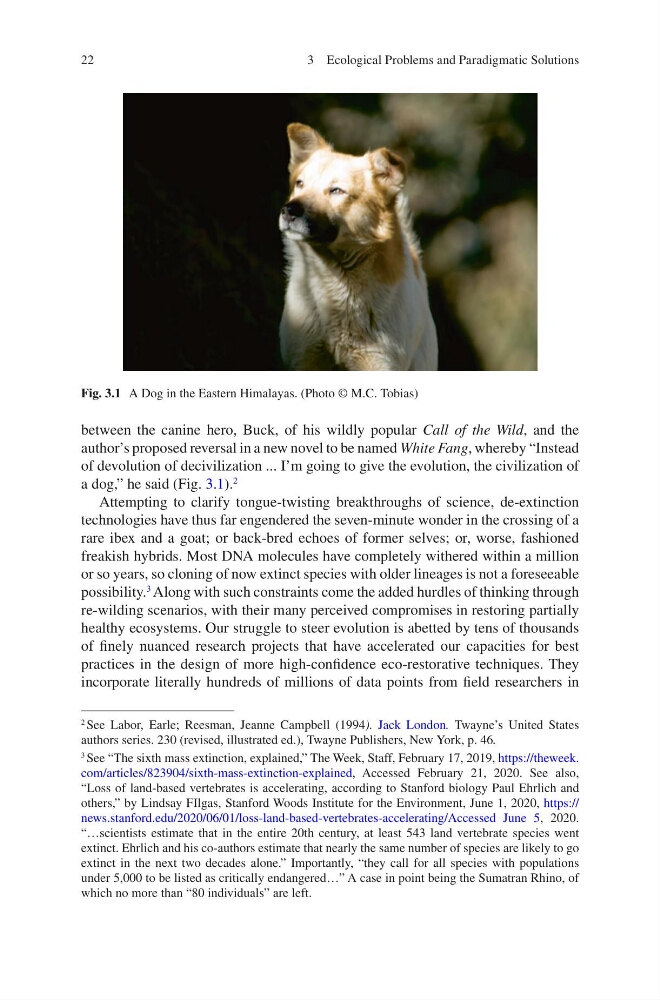
a dog,” he said (Fig. 3.1).
2
Attempting to clarify tongue-twisting breakthroughs of science, de-extinction
technologies have thus far engendered the seven-minute wonder in the crossing of a
rare ibex and a goat; or back-bred echoes of former selves; or, worse, fashioned
freakish hybrids. Most DNA molecules have completely withered within a million
or so years, so cloning of now extinct species with older lineages is not a foreseeable
possibility.
3
Along with such constraints come the added hurdles of thinking through
re-wilding scenarios, with their many perceived compromises in restoring partially
healthy ecosystems. Our struggle to steer evolution is abetted by tens of thousands
of finely nuanced research projects that have accelerated our capacities for best
practices in the design of more high-confidence eco-restorative techniques. They
incorporate literally hundreds of millions of data points from field researchers in
2 See Labor, Earle; Reesman, Jeanne Campbell (1994). Jack London. Twayne’s United States
authors series. 230 (revised, illustrated ed.), Twayne Publishers, New York, p. 46.
3 See “The sixth mass extinction, explained,” The Week, Staff, February 17, 2019, https://theweek.
com/articles/823904/sixth-mass-extinction-explained, Accessed February 21, 2020. See also,
“Loss of land-based vertebrates is accelerating, according to Stanford biology Paul Ehrlich and
others,” by Lindsay FIlgas, Stanford Woods Institute for the Environment, June 1, 2020, https://
news.stanford.edu/2020/06/01/loss-land-based-vertebrates-accelerating/Accessed June 5, 2020.
“…scientists estimate that in the entire 20th century, at least 543 land vertebrate species went
extinct. Ehrlich and his co-authors estimate that nearly the same number of species are likely to go
extinct in the next two decades alone.” Importantly, “they call for all species with populations
under 5,000 to be listed as critically endangered…” A case in point being the Sumatran Rhino, of
which no more than “80 individuals” are left.
Fig. 3.1 A Dog in the Eastern Himalayas. (Photo © M.C. Tobias)
3 Ecological Problems and Paradigmatic Solutions
between the canine hero, Buck, of his wildly popular Call of the Wild, and the
author’s proposed reversal in a new novel to be named White Fang, whereby “Instead
of devolution of decivilization ... I’m going to give the evolution, the civilization of
a dog,” he said (Fig. 3.1).
2
Attempting to clarify tongue-twisting breakthroughs of science, de-extinction
technologies have thus far engendered the seven-minute wonder in the crossing of a
rare ibex and a goat; or back-bred echoes of former selves; or, worse, fashioned
freakish hybrids. Most DNA molecules have completely withered within a million
or so years, so cloning of now extinct species with older lineages is not a foreseeable
possibility.
3
Along with such constraints come the added hurdles of thinking through
re-wilding scenarios, with their many perceived compromises in restoring partially
healthy ecosystems. Our struggle to steer evolution is abetted by tens of thousands
of finely nuanced research projects that have accelerated our capacities for best
practices in the design of more high-confidence eco-restorative techniques. They
incorporate literally hundreds of millions of data points from field researchers in
2 See Labor, Earle; Reesman, Jeanne Campbell (1994). Jack London. Twayne’s United States
authors series. 230 (revised, illustrated ed.), Twayne Publishers, New York, p. 46.
3 See “The sixth mass extinction, explained,” The Week, Staff, February 17, 2019, https://theweek.
com/articles/823904/sixth-mass-extinction-explained, Accessed February 21, 2020. See also,
“Loss of land-based vertebrates is accelerating, according to Stanford biology Paul Ehrlich and
others,” by Lindsay FIlgas, Stanford Woods Institute for the Environment, June 1, 2020, https://
news.stanford.edu/2020/06/01/loss-land-based-vertebrates-accelerating/Accessed June 5, 2020.
“…scientists estimate that in the entire 20th century, at least 543 land vertebrate species went
extinct. Ehrlich and his co-authors estimate that nearly the same number of species are likely to go
extinct in the next two decades alone.” Importantly, “they call for all species with populations
under 5,000 to be listed as critically endangered…” A case in point being the Sumatran Rhino, of
which no more than “80 individuals” are left.
Fig. 3.1 A Dog in the Eastern Himalayas. (Photo © M.C. Tobias)
3 Ecological Problems and Paradigmatic Solutions