

437
confounding every premise, cause, and consequence, and (3) the value, to begin
with, of psychoanalysis, when the end result is a pragmatism that is either imagined
or irrelevant. Jean-Paul Sartre’s critical works stand out in this (relatively) recent
wave of questioning. L’Imagination, 1936; La Nausée 1938 (in which he cynically
propounded one of his most lauded witticisms, “Three o’clock is always too late or
too early for anything you want to do”; Esquisse d’une Théorie des Émotions, 1939;
Le Mur, 1939; L’Imaginaire. Psychologie—Phénoménologique de l’Imagination,
1940; L’être et le néant. Essai d’ontologie phénoménologique, 1943. And his famed
war-time lecture “Existentialism is a Humanism,” in which he declared, “l’existence
précède l’essence.”
We read all of these (and countless other) Eastern and Western struggles to
achieve the precipitation and abandonment of identity in an ocean of riptides that
cares nothing about us, or our philosophies, as perpetually frustrated, grand epics
that may seem entirely pointless. They contain passing beauty that only mocks
itself, conscious of the ephemerality that persists within and without. A koan—typically defined as a “paradoxical anecdote or riddle used in Zen Buddhism to demonstrate the inadequacy of logical reasoning and to provoke enlightenment”
25
—however
25 https://www.google.com/search?client=firefox-b-1-d&q=koan.
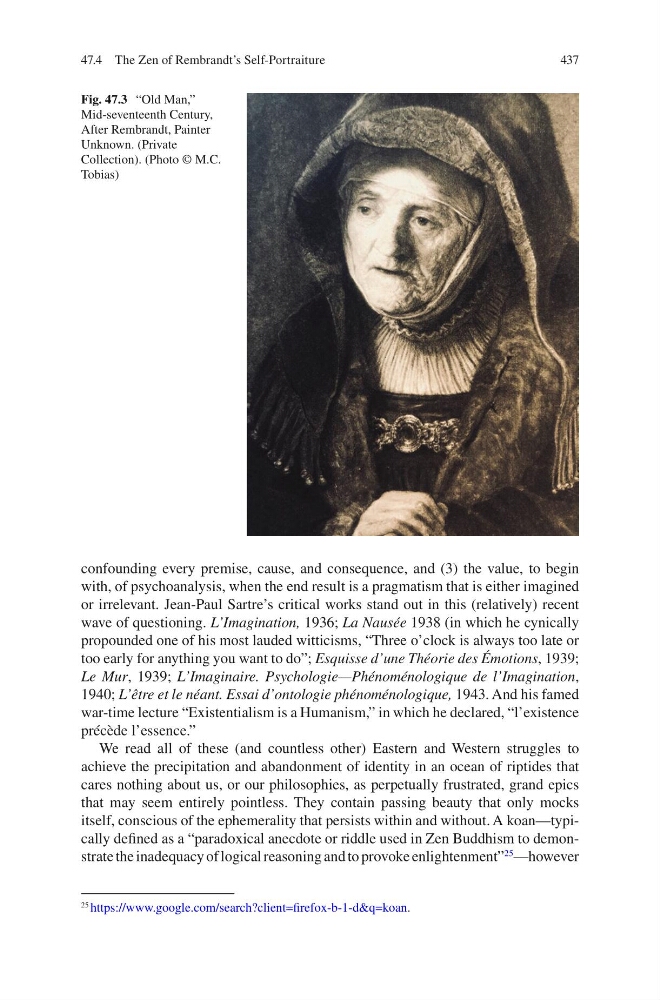
Fig. 47.3 “Old Man,”
Mid-seventeenth Century,
After Rembrandt, Painter
Unknown. (Private
Collection). (Photo © M.C.
Tobias)
47.4 The Zen of Rembrandt’s Self-Portraiture
confounding every premise, cause, and consequence, and (3) the value, to begin
with, of psychoanalysis, when the end result is a pragmatism that is either imagined
or irrelevant. Jean-Paul Sartre’s critical works stand out in this (relatively) recent
wave of questioning. L’Imagination, 1936; La Nausée 1938 (in which he cynically
propounded one of his most lauded witticisms, “Three o’clock is always too late or
too early for anything you want to do”; Esquisse d’une Théorie des Émotions, 1939;
Le Mur, 1939; L’Imaginaire. Psychologie—Phénoménologique de l’Imagination,
1940; L’être et le néant. Essai d’ontologie phénoménologique, 1943. And his famed
war-time lecture “Existentialism is a Humanism,” in which he declared, “l’existence
précède l’essence.”
We read all of these (and countless other) Eastern and Western struggles to
achieve the precipitation and abandonment of identity in an ocean of riptides that
cares nothing about us, or our philosophies, as perpetually frustrated, grand epics
that may seem entirely pointless. They contain passing beauty that only mocks
itself, conscious of the ephemerality that persists within and without. A koan—typically defined as a “paradoxical anecdote or riddle used in Zen Buddhism to demonstrate the inadequacy of logical reasoning and to provoke enlightenment”
25
—however
25 https://www.google.com/search?client=firefox-b-1-d&q=koan.
Fig. 47.3 “Old Man,”
Mid-seventeenth Century,
After Rembrandt, Painter
Unknown. (Private
Collection). (Photo © M.C.
Tobias)
47.4 The Zen of Rembrandt’s Self-Portraiture