

429
document is an early biography (the first) of the Buddha, known as Buddhacharita
(“Acts of the Buddha”) and written by the famed poet Asvaghosa (c. 80–150 CE). It
is there that reference is made to what would be termed Shussan Shaka (Japanese:
shussan shaka; Chinese: chūshān shìjiā).
4
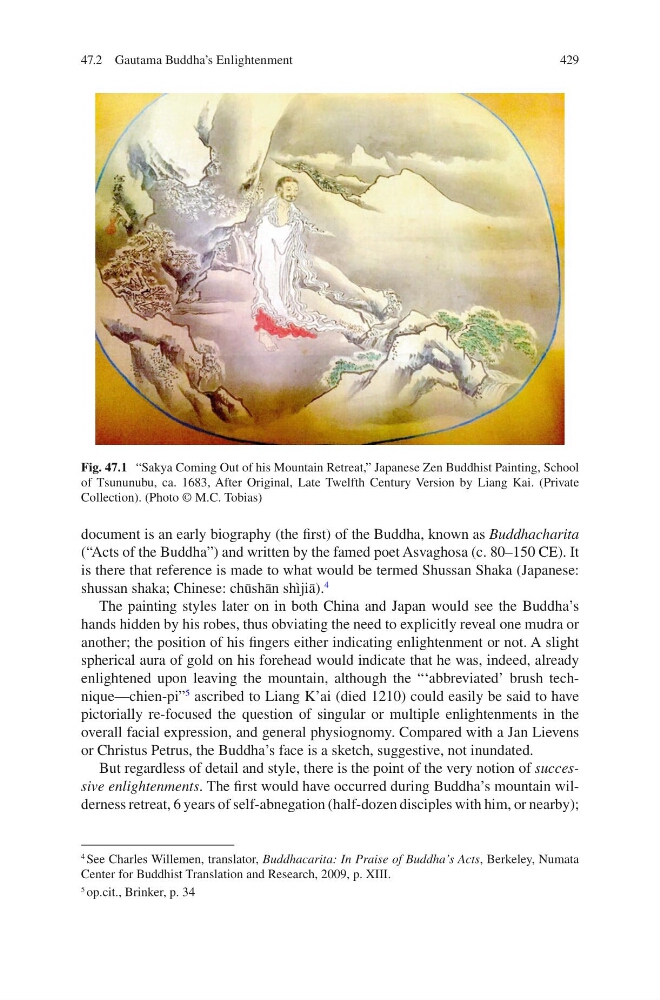
The painting styles later on in both China and Japan would see the Buddha’s
hands hidden by his robes, thus obviating the need to explicitly reveal one mudra or
another; the position of his fingers either indicating enlightenment or not. A slight
spherical aura of gold on his forehead would indicate that he was, indeed, already
enlightened upon leaving the mountain, although the “‘abbreviated’ brush technique—chien-pi”
5
ascribed to Liang K’ai (died 1210) could easily be said to have
pictorially re-focused the question of singular or multiple enlightenments in the
overall facial expression, and general physiognomy. Compared with a Jan Lievens
or Christus Petrus, the Buddha’s face is a sketch, suggestive, not inundated.
But regardless of detail and style, there is the point of the very notion of successive enlightenments. The first would have occurred during Buddha’s mountain wilderness retreat, 6 years of self-abnegation (half-dozen disciples with him, or nearby);
4 See Charles Willemen, translator, Buddhacarita: In Praise of Buddha’s Acts, Berkeley, Numata
Center for Buddhist Translation and Research, 2009, p. XIII.
5 op.cit., Brinker, p. 34
Fig. 47.1 “Sakya Coming Out of his Mountain Retreat,” Japanese Zen Buddhist Painting, School
of Tsununubu, ca. 1683, After Original, Late Twelfth Century Version by Liang Kai. (Private
Collection). (Photo © M.C. Tobias)
47.2 Gautama Buddha’s Enlightenment
document is an early biography (the first) of the Buddha, known as Buddhacharita
(“Acts of the Buddha”) and written by the famed poet Asvaghosa (c. 80–150 CE). It
is there that reference is made to what would be termed Shussan Shaka (Japanese:
shussan shaka; Chinese: chūshān shìjiā).
4
The painting styles later on in both China and Japan would see the Buddha’s
hands hidden by his robes, thus obviating the need to explicitly reveal one mudra or
another; the position of his fingers either indicating enlightenment or not. A slight
spherical aura of gold on his forehead would indicate that he was, indeed, already
enlightened upon leaving the mountain, although the “‘abbreviated’ brush technique—chien-pi”
5
ascribed to Liang K’ai (died 1210) could easily be said to have
pictorially re-focused the question of singular or multiple enlightenments in the
overall facial expression, and general physiognomy. Compared with a Jan Lievens
or Christus Petrus, the Buddha’s face is a sketch, suggestive, not inundated.
But regardless of detail and style, there is the point of the very notion of successive enlightenments. The first would have occurred during Buddha’s mountain wilderness retreat, 6 years of self-abnegation (half-dozen disciples with him, or nearby);
4 See Charles Willemen, translator, Buddhacarita: In Praise of Buddha’s Acts, Berkeley, Numata
Center for Buddhist Translation and Research, 2009, p. XIII.
5 op.cit., Brinker, p. 34
Fig. 47.1 “Sakya Coming Out of his Mountain Retreat,” Japanese Zen Buddhist Painting, School
of Tsununubu, ca. 1683, After Original, Late Twelfth Century Version by Liang Kai. (Private
Collection). (Photo © M.C. Tobias)
47.2 Gautama Buddha’s Enlightenment