

406
that was first manifested by Saint Giovanni Gualberto,
6
a passion for nature that
culminated, of course, in the works of Fra Angelico, Leonardo, Raphael, the later
Italian landscapists, not to mention the remarkable life of Saint Francis.
There is much work to be done to maintain protection of this precious historical,
ecological, and artistic center of the world. Pinocchio is one of those charter members, a veritable signatory to a Declaration of Biological Rights, not only of the
plant community in his native land, but of humanity’s future place in a world at risk,
where common sense, imagination, an unstinting love of life, not to mention a sense
of humor, are worth their weight—not in gold but in old forest, healthy soils, rich
biomass, a dazzling, unchallenged array of plant and animal life, clean air, and
plenty of fresh water to drink. These are, after all, the real concerns of any pine nut,
let alone the Pinocchio kind, a mythic ecological doppelgänger rendered in wood,
who speaks to the world of his, and of our, condition. We know if he’s lying: he is
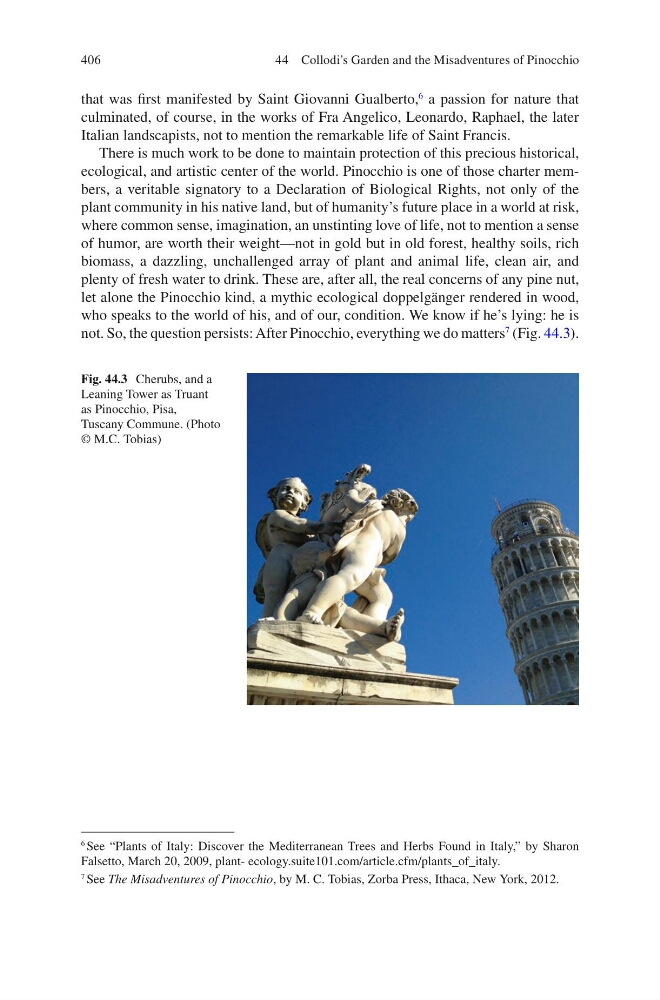
not. So, the question persists: After Pinocchio, everything we do matters
7
(Fig. 44.3).
6 See “Plants of Italy: Discover the Mediterranean Trees and Herbs Found in Italy,” by Sharon
Falsetto, March 20, 2009, plant- ecology.suite101.com/article.cfm/plants_of_italy.
7 See The Misadventures of Pinocchio, by M. C. Tobias, Zorba Press, Ithaca, New York, 2012.
Fig. 44.3 Cherubs, and a
Leaning Tower as Truant
as Pinocchio, Pisa,
Tuscany Commune. (Photo
© M.C. Tobias)
44 Collodi’s Garden and the Misadventures of Pinocchio
that was first manifested by Saint Giovanni Gualberto,
6
a passion for nature that
culminated, of course, in the works of Fra Angelico, Leonardo, Raphael, the later
Italian landscapists, not to mention the remarkable life of Saint Francis.
There is much work to be done to maintain protection of this precious historical,
ecological, and artistic center of the world. Pinocchio is one of those charter members, a veritable signatory to a Declaration of Biological Rights, not only of the
plant community in his native land, but of humanity’s future place in a world at risk,
where common sense, imagination, an unstinting love of life, not to mention a sense
of humor, are worth their weight—not in gold but in old forest, healthy soils, rich
biomass, a dazzling, unchallenged array of plant and animal life, clean air, and
plenty of fresh water to drink. These are, after all, the real concerns of any pine nut,
let alone the Pinocchio kind, a mythic ecological doppelgänger rendered in wood,
who speaks to the world of his, and of our, condition. We know if he’s lying: he is
not. So, the question persists: After Pinocchio, everything we do matters
7
(Fig. 44.3).
6 See “Plants of Italy: Discover the Mediterranean Trees and Herbs Found in Italy,” by Sharon
Falsetto, March 20, 2009, plant- ecology.suite101.com/article.cfm/plants_of_italy.
7 See The Misadventures of Pinocchio, by M. C. Tobias, Zorba Press, Ithaca, New York, 2012.
Fig. 44.3 Cherubs, and a
Leaning Tower as Truant
as Pinocchio, Pisa,
Tuscany Commune. (Photo
© M.C. Tobias)
44 Collodi’s Garden and the Misadventures of Pinocchio