

370
large majority are endemic to the Nilgiris, as Dr. Chhabra and colleagues have been
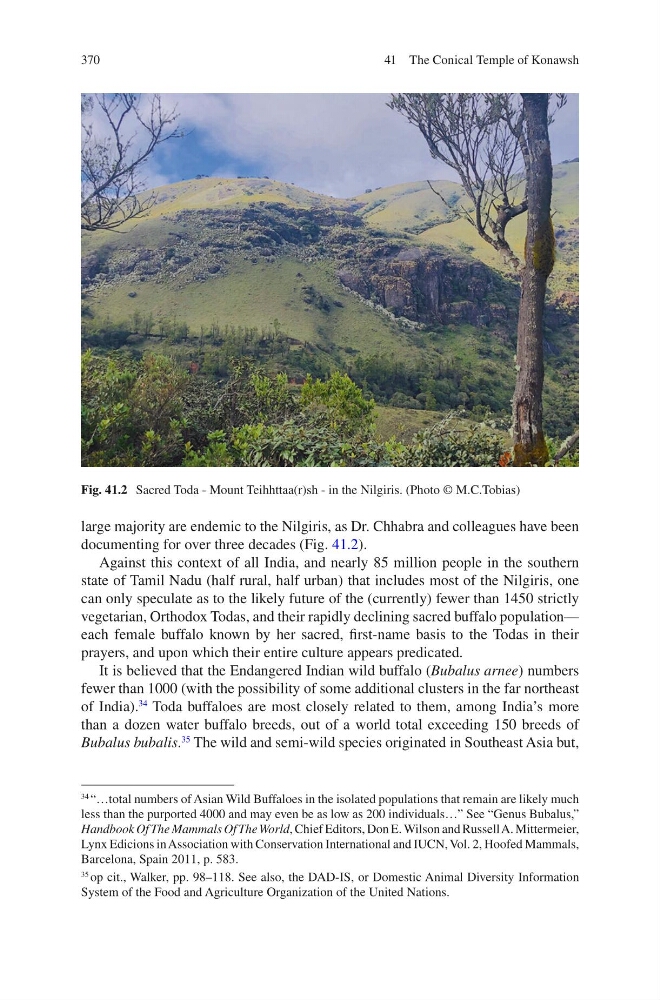
documenting for over three decades (Fig. 41.2).
Against this context of all India, and nearly 85 million people in the southern
state of Tamil Nadu (half rural, half urban) that includes most of the Nilgiris, one
can only speculate as to the likely future of the (currently) fewer than 1450 strictly
vegetarian, Orthodox Todas, and their rapidly declining sacred buffalo population—
each female buffalo known by her sacred, first-name basis to the Todas in their
prayers, and upon which their entire culture appears predicated.
It is believed that the Endangered Indian wild buffalo (Bubalus arnee) numbers
fewer than 1000 (with the possibility of some additional clusters in the far northeast
of India).
34
Toda buffaloes are most closely related to them, among India’s more
than a dozen water buffalo breeds, out of a world total exceeding 150 breeds of
Bubalus bubalis.
35
The wild and semi-wild species originated in Southeast Asia but,
34 “…total numbers of Asian Wild Buffaloes in the isolated populations that remain are likely much
less than the purported 4000 and may even be as low as 200 individuals…” See “Genus Bubalus,”
Handbook Of The Mammals Of The World, Chief Editors, Don E. Wilson and Russell A. Mittermeier,
Lynx Edicions in Association with Conservation International and IUCN, Vol. 2, Hoofed Mammals,
Barcelona, Spain 2011, p. 583.
35 op cit., Walker, pp. 98–118. See also, the DAD-IS, or Domestic Animal Diversity Information
System of the Food and Agriculture Organization of the United Nations.
Fig. 41.2 Sacred Toda - Mount Teihhttaa(r)sh - in the Nilgiris. (Photo © M.C.Tobias)
41 The Conical Temple of Konawsh
large majority are endemic to the Nilgiris, as Dr. Chhabra and colleagues have been
documenting for over three decades (Fig. 41.2).
Against this context of all India, and nearly 85 million people in the southern
state of Tamil Nadu (half rural, half urban) that includes most of the Nilgiris, one
can only speculate as to the likely future of the (currently) fewer than 1450 strictly
vegetarian, Orthodox Todas, and their rapidly declining sacred buffalo population—
each female buffalo known by her sacred, first-name basis to the Todas in their
prayers, and upon which their entire culture appears predicated.
It is believed that the Endangered Indian wild buffalo (Bubalus arnee) numbers
fewer than 1000 (with the possibility of some additional clusters in the far northeast
of India).
34
Toda buffaloes are most closely related to them, among India’s more
than a dozen water buffalo breeds, out of a world total exceeding 150 breeds of
Bubalus bubalis.
35
The wild and semi-wild species originated in Southeast Asia but,
34 “…total numbers of Asian Wild Buffaloes in the isolated populations that remain are likely much
less than the purported 4000 and may even be as low as 200 individuals…” See “Genus Bubalus,”
Handbook Of The Mammals Of The World, Chief Editors, Don E. Wilson and Russell A. Mittermeier,
Lynx Edicions in Association with Conservation International and IUCN, Vol. 2, Hoofed Mammals,
Barcelona, Spain 2011, p. 583.
35 op cit., Walker, pp. 98–118. See also, the DAD-IS, or Domestic Animal Diversity Information
System of the Food and Agriculture Organization of the United Nations.
Fig. 41.2 Sacred Toda - Mount Teihhttaa(r)sh - in the Nilgiris. (Photo © M.C.Tobias)
41 The Conical Temple of Konawsh