

357
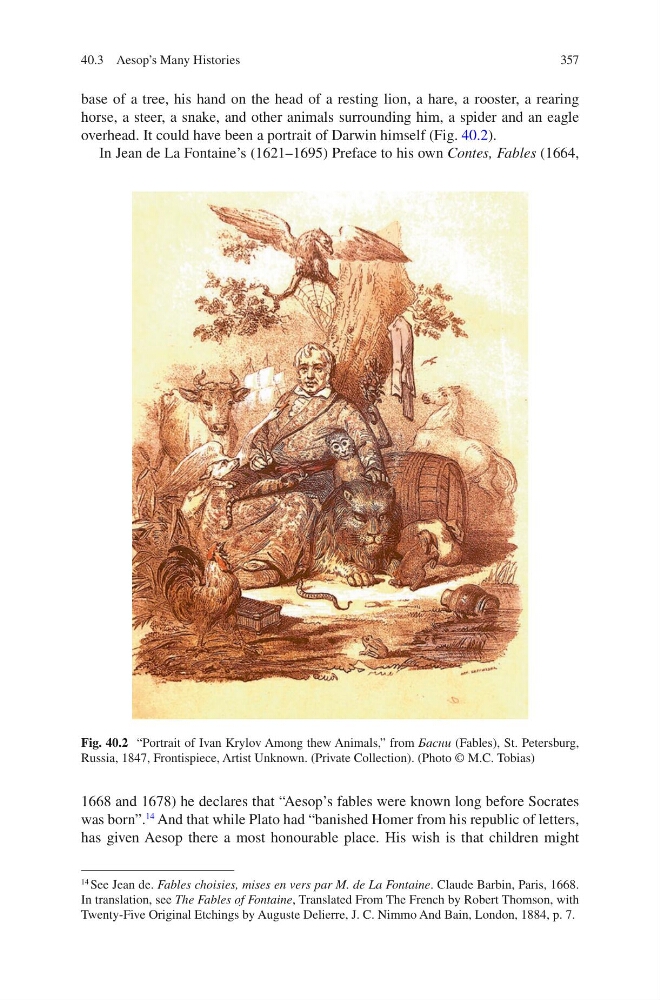
base of a tree, his hand on the head of a resting lion, a hare, a rooster, a rearing
horse, a steer, a snake, and other animals surrounding him, a spider and an eagle
overhead. It could have been a portrait of Darwin himself (Fig. 40.2).
In Jean de La Fontaine’s (1621–1695) Preface to his own Contes, Fables (1664,
1668 and 1678) he declares that “Aesop’s fables were known long before Socrates
was born”.
14
And that while Plato had “banished Homer from his republic of letters,
has given Aesop there a most honourable place. His wish is that children might
14 See Jean de. Fables choisies, mises en vers par M. de La Fontaine. Claude Barbin, Paris, 1668.
In translation, see The Fables of Fontaine, Translated From The French by Robert Thomson, with
Twenty-Five Original Etchings by Auguste Delierre, J. C. Nimmo And Bain, London, 1884, p. 7.
Fig. 40.2 “Portrait of Ivan Krylov Among thew Animals,” from Басни (Fables), St. Petersburg,
Russia, 1847, Frontispiece, Artist Unknown. (Private Collection). (Photo © M.C. Tobias)
40.3 Aesop’s Many Histories
base of a tree, his hand on the head of a resting lion, a hare, a rooster, a rearing
horse, a steer, a snake, and other animals surrounding him, a spider and an eagle
overhead. It could have been a portrait of Darwin himself (Fig. 40.2).
In Jean de La Fontaine’s (1621–1695) Preface to his own Contes, Fables (1664,
1668 and 1678) he declares that “Aesop’s fables were known long before Socrates
was born”.
14
And that while Plato had “banished Homer from his republic of letters,
has given Aesop there a most honourable place. His wish is that children might
14 See Jean de. Fables choisies, mises en vers par M. de La Fontaine. Claude Barbin, Paris, 1668.
In translation, see The Fables of Fontaine, Translated From The French by Robert Thomson, with
Twenty-Five Original Etchings by Auguste Delierre, J. C. Nimmo And Bain, London, 1884, p. 7.
Fig. 40.2 “Portrait of Ivan Krylov Among thew Animals,” from Басни (Fables), St. Petersburg,
Russia, 1847, Frontispiece, Artist Unknown. (Private Collection). (Photo © M.C. Tobias)
40.3 Aesop’s Many Histories