

353
translation of Aesop; the anthos or yellow wagtail; and aigithios or long-tailed tit in
Aristotle.
2
40.2 A Paradoxical Morality Play
In every case paradox presses in on the morality play, the begging for mercy between
animals, that is, a mouse and a lion. The lion is persuaded the mouse is an unsuitable
prey species in the scheme of things, agrees not to harm the mouse and is, in turn,
2
“Memories of Childhood: Aesop’s Fables Are as Relevant Today as They Were 2,600 Years Ago,”
Ancient Origins, by Aleksa Vuckovic, July 26, 2019. See also, Clayton, E. “Aesop, Aristotle, and
Animals: The Role of Fables in Human Life.” Humanitas, Nos. 1 and 2, Vol. XXI, 2008, pp. 179–
2008. Discussed for their picking of insects off some animals and nest-disturbance call that sounds
like “the whinnying of horses,” as analyzed by Tua Korhonen in “A Question of Life and Death:
The Aesopic Animal Fables on Why Not to Kill,” Humanities, MDPI, May 13, 2017, p. 11, taken
from Geoffrey Arnott, Birds in the Ancient World from A to Z, Routledge, London, 2007, pp.14–
15; file:///Users/michaeltobias/Downloads/humanities-06-00029-v2.pdf. The original reference
derives from Aristotle’s 8th book of his Study of Animals (8.609a4-610a36) but he also wrote of
these matters throughout his Politics.
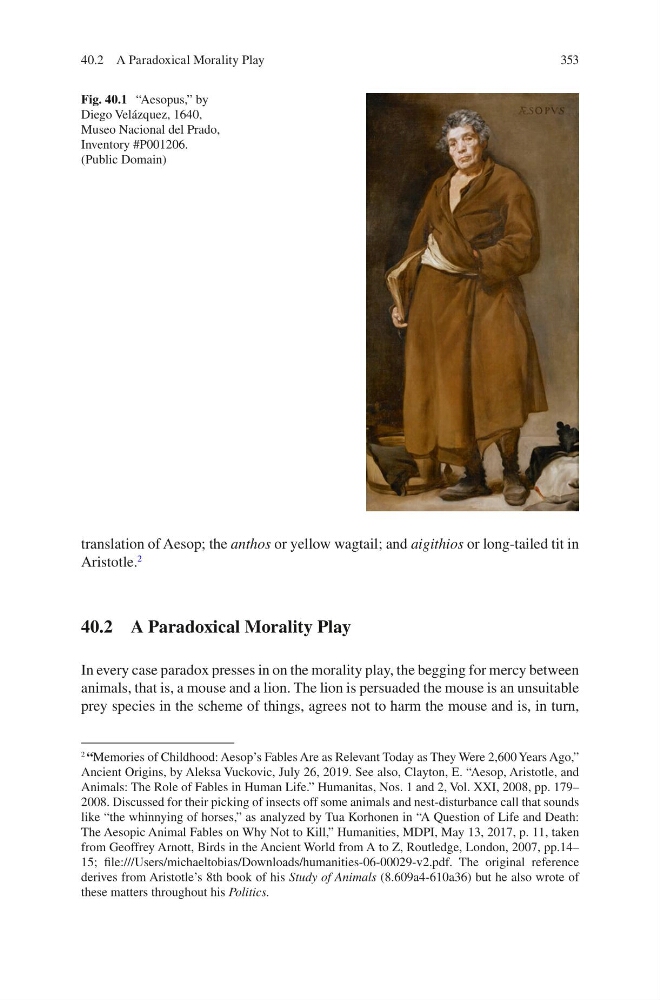
Fig. 40.1 “Aesopus,” by
Diego Velázquez, 1640,
Museo Nacional del Prado,
Inventory #P001206.
(Public Domain)
40.2 A Paradoxical Morality Play
translation of Aesop; the anthos or yellow wagtail; and aigithios or long-tailed tit in
Aristotle.
2
40.2 A Paradoxical Morality Play
In every case paradox presses in on the morality play, the begging for mercy between
animals, that is, a mouse and a lion. The lion is persuaded the mouse is an unsuitable
prey species in the scheme of things, agrees not to harm the mouse and is, in turn,
2
“Memories of Childhood: Aesop’s Fables Are as Relevant Today as They Were 2,600 Years Ago,”
Ancient Origins, by Aleksa Vuckovic, July 26, 2019. See also, Clayton, E. “Aesop, Aristotle, and
Animals: The Role of Fables in Human Life.” Humanitas, Nos. 1 and 2, Vol. XXI, 2008, pp. 179–
2008. Discussed for their picking of insects off some animals and nest-disturbance call that sounds
like “the whinnying of horses,” as analyzed by Tua Korhonen in “A Question of Life and Death:
The Aesopic Animal Fables on Why Not to Kill,” Humanities, MDPI, May 13, 2017, p. 11, taken
from Geoffrey Arnott, Birds in the Ancient World from A to Z, Routledge, London, 2007, pp.14–
15; file:///Users/michaeltobias/Downloads/humanities-06-00029-v2.pdf. The original reference
derives from Aristotle’s 8th book of his Study of Animals (8.609a4-610a36) but he also wrote of
these matters throughout his Politics.
Fig. 40.1 “Aesopus,” by
Diego Velázquez, 1640,
Museo Nacional del Prado,
Inventory #P001206.
(Public Domain)
40.2 A Paradoxical Morality Play