

345
in the Quarterly Review, Monthly Review, Gentleman’s Magazine, New London
Magazine, Edinburgh Review, and Blackwood’s Magazine. He read, it would seem,
nearly everything pertaining to “nature” literature that he could obtain: novels,
poetry, and adventure stories by Robert Southey, Wordsworth, James Thompson,
Chateaubriand, James Beattie, Mrs. Ann Radcliffe, Charles Brocken Brown, and
others. And his linguistic skills—Greek, Latin, French, Italian, and German—aided
him in his multiple translations as his great odyssey, lasting the final, third decade
of his life, commenced, a journey most acutely chronicled by biographer Richard
Holmes.
3
3 Shelley – The Pursuit, E.P.Dutton, New York, 1975. See also, James Rieger, The Mutiny Within:
The Heresies of Percy Bysshe Shelley, George Braziller, New York, 1967; Earl R. Wasserman,
Shelley: A Critical Reading, The Johns Hopkins University Press, 1971; On Shelley, ed. By
Edmund Blunden, et al., Oxford University Press, New York, 1938; B. M. Stafford, “Rude Sublime:
The Taste for Nature’s Colossi During The Late 18th and Early 19th Centuries, Gazette des Beaux
Arts 87, April 1976; and Ronald Ree’s “The Scenery Cult: Changing Landscape Tastes over Three
Centuries,” Landscape 19, no. 3, May 1975. See also, The Letters of Mary Wollstonecraft Shelley,
Volume 1, “A part of the Elect”, Edited by Betty T. Bennett, The Johns Hopkins University Press,
Baltimore and London, 1980; Ariel- The Life Of Shelley, By André Maurois, Translated by Ella
D’Arcy, D. Appleton And Company, New York, 1924; Shelley- The Man And The Poet, Thomas
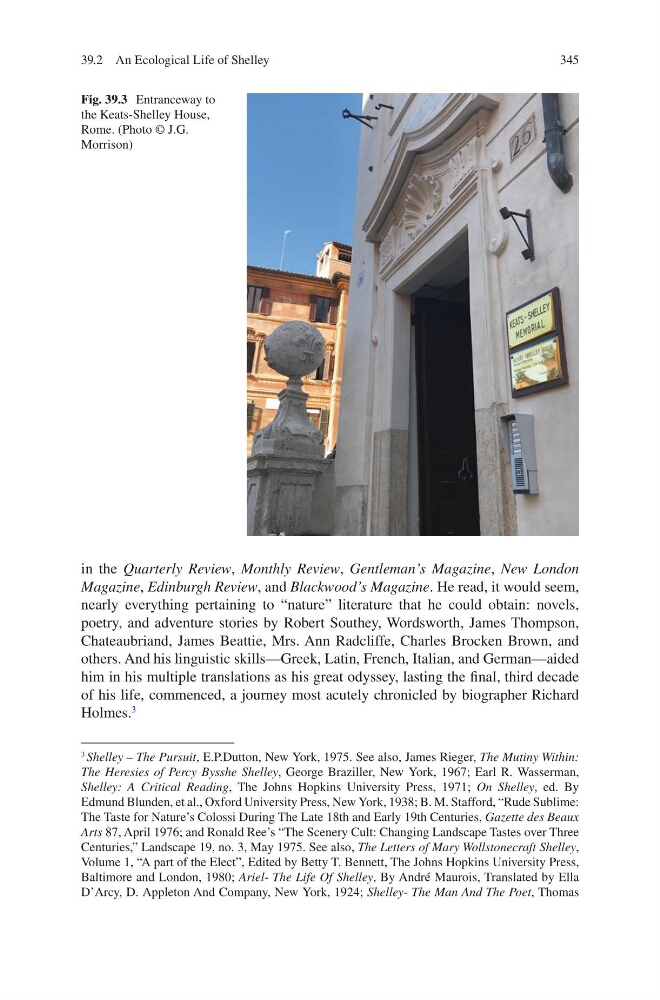
Fig. 39.3 Entranceway to
the Keats-Shelley House,
Rome. (Photo © J.G.
Morrison)
39.2 An Ecological Life of Shelley
in the Quarterly Review, Monthly Review, Gentleman’s Magazine, New London
Magazine, Edinburgh Review, and Blackwood’s Magazine. He read, it would seem,
nearly everything pertaining to “nature” literature that he could obtain: novels,
poetry, and adventure stories by Robert Southey, Wordsworth, James Thompson,
Chateaubriand, James Beattie, Mrs. Ann Radcliffe, Charles Brocken Brown, and
others. And his linguistic skills—Greek, Latin, French, Italian, and German—aided
him in his multiple translations as his great odyssey, lasting the final, third decade
of his life, commenced, a journey most acutely chronicled by biographer Richard
Holmes.
3
3 Shelley – The Pursuit, E.P.Dutton, New York, 1975. See also, James Rieger, The Mutiny Within:
The Heresies of Percy Bysshe Shelley, George Braziller, New York, 1967; Earl R. Wasserman,
Shelley: A Critical Reading, The Johns Hopkins University Press, 1971; On Shelley, ed. By
Edmund Blunden, et al., Oxford University Press, New York, 1938; B. M. Stafford, “Rude Sublime:
The Taste for Nature’s Colossi During The Late 18th and Early 19th Centuries, Gazette des Beaux
Arts 87, April 1976; and Ronald Ree’s “The Scenery Cult: Changing Landscape Tastes over Three
Centuries,” Landscape 19, no. 3, May 1975. See also, The Letters of Mary Wollstonecraft Shelley,
Volume 1, “A part of the Elect”, Edited by Betty T. Bennett, The Johns Hopkins University Press,
Baltimore and London, 1980; Ariel- The Life Of Shelley, By André Maurois, Translated by Ella
D’Arcy, D. Appleton And Company, New York, 1924; Shelley- The Man And The Poet, Thomas
Fig. 39.3 Entranceway to
the Keats-Shelley House,
Rome. (Photo © J.G.
Morrison)
39.2 An Ecological Life of Shelley