

316
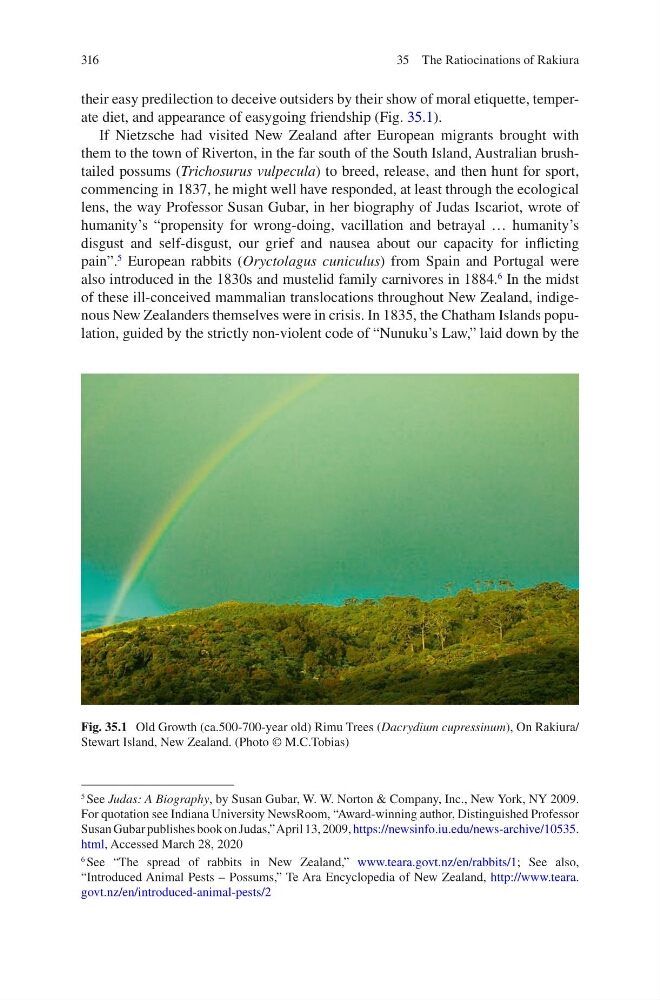
their easy predilection to deceive outsiders by their show of moral etiquette, temperate diet, and appearance of easygoing friendship (Fig. 35.1).
If Nietzsche had visited New Zealand after European migrants brought with
them to the town of Riverton, in the far south of the South Island, Australian brushtailed possums (Trichosurus vulpecula) to breed, release, and then hunt for sport,
commencing in 1837, he might well have responded, at least through the ecological
lens, the way Professor Susan Gubar, in her biography of Judas Iscariot, wrote of
humanity’s “propensity for wrong-doing, vacillation and betrayal … humanity’s
disgust and self-disgust, our grief and nausea about our capacity for inflicting
pain”.
5
European rabbits (Oryctolagus cuniculus) from Spain and Portugal were
also introduced in the 1830s and mustelid family carnivores in 1884.
6
In the midst
of these ill-conceived mammalian translocations throughout New Zealand, indigenous New Zealanders themselves were in crisis. In 1835, the Chatham Islands population, guided by the strictly non-violent code of “Nunuku’s Law,” laid down by the
5 See Judas: A Biography, by Susan Gubar, W. W. Norton & Company, Inc., New York, NY 2009.
For quotation see Indiana University NewsRoom, “Award-winning author, Distinguished Professor
Susan Gubar publishes book on Judas,” April 13, 2009, https://newsinfo.iu.edu/news-archive/10535.
html, Accessed March 28, 2020
6 See “The spread of rabbits in New Zealand,” www.teara.govt.nz/en/rabbits/1; See also,
“Introduced Animal Pests – Possums,” Te Ara Encyclopedia of New Zealand, http://www.teara.
govt.nz/en/introduced-animal-pests/2
Fig. 35.1 Old Growth (ca.500-700-year old) Rimu Trees (Dacrydium cupressinum), On Rakiura/
Stewart Island, New Zealand. (Photo © M.C.Tobias)
35 The Ratiocinations of Rakiura
their easy predilection to deceive outsiders by their show of moral etiquette, temperate diet, and appearance of easygoing friendship (Fig. 35.1).
If Nietzsche had visited New Zealand after European migrants brought with
them to the town of Riverton, in the far south of the South Island, Australian brushtailed possums (Trichosurus vulpecula) to breed, release, and then hunt for sport,
commencing in 1837, he might well have responded, at least through the ecological
lens, the way Professor Susan Gubar, in her biography of Judas Iscariot, wrote of
humanity’s “propensity for wrong-doing, vacillation and betrayal … humanity’s
disgust and self-disgust, our grief and nausea about our capacity for inflicting
pain”.
5
European rabbits (Oryctolagus cuniculus) from Spain and Portugal were
also introduced in the 1830s and mustelid family carnivores in 1884.
6
In the midst
of these ill-conceived mammalian translocations throughout New Zealand, indigenous New Zealanders themselves were in crisis. In 1835, the Chatham Islands population, guided by the strictly non-violent code of “Nunuku’s Law,” laid down by the
5 See Judas: A Biography, by Susan Gubar, W. W. Norton & Company, Inc., New York, NY 2009.
For quotation see Indiana University NewsRoom, “Award-winning author, Distinguished Professor
Susan Gubar publishes book on Judas,” April 13, 2009, https://newsinfo.iu.edu/news-archive/10535.
html, Accessed March 28, 2020
6 See “The spread of rabbits in New Zealand,” www.teara.govt.nz/en/rabbits/1; See also,
“Introduced Animal Pests – Possums,” Te Ara Encyclopedia of New Zealand, http://www.teara.
govt.nz/en/introduced-animal-pests/2
Fig. 35.1 Old Growth (ca.500-700-year old) Rimu Trees (Dacrydium cupressinum), On Rakiura/
Stewart Island, New Zealand. (Photo © M.C.Tobias)
35 The Ratiocinations of Rakiura