

314
must “dream the impossible dream” is evidence enough to render a formal commentary. Our motives are mixed, as Shakespeare most probingly delved. But it can
easily be argued that our compulsion to rectify and ameliorate; to save and be saved;
and to restrain, exert tenderness, speak of compassion, formulate town halls, vote,
assist, and engage in all those actions of kindness with which our myriad prophets
and saints have been absorbed dates most recently to the quixotic in human nature.
If it is the requisite response (and every sociobiologist, ecopsychologist, neurologist, molecular biologist, and every other -ist will endlessly debate its evolutionary
fineries), the outcome of a train of logic will be the same. Cervantes has enshrined
the ecological paradox by bringing the dreamer to life; sorting out good and evil;
and traversing the landscapes of paradise and hell, with his soft-hearted, evergullible comrade, Sancho, in a dual effort to save the world from themselves. If this
is the thematic origin of the novel, then it can be assumed that giraffes and butterflies have no need of novels, although non-fiction is something else entirely.
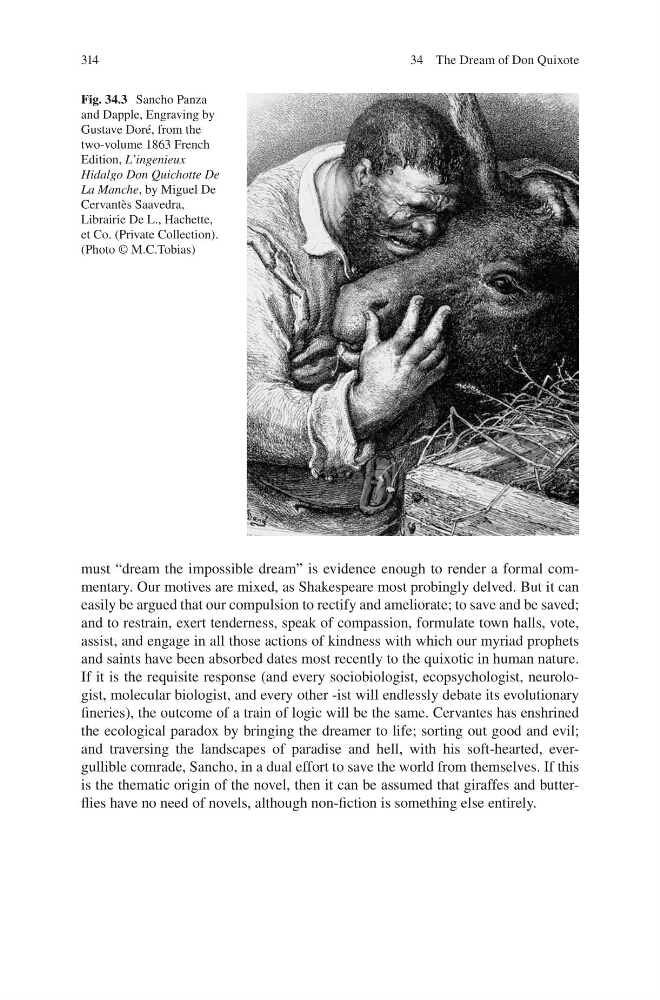
Fig. 34.3 Sancho Panza
and Dapple, Engraving by
Gustave Doré, from the
two-volume 1863 French
Edition, L’ingenieux
Hidalgo Don Quichotte De
La Manche, by Miguel De
Cervantès Saavedra,
Librairie De L., Hachette,
et Co. (Private Collection).
(Photo © M.C.Tobias)
34 The Dream of Don Quixote
must “dream the impossible dream” is evidence enough to render a formal commentary. Our motives are mixed, as Shakespeare most probingly delved. But it can
easily be argued that our compulsion to rectify and ameliorate; to save and be saved;
and to restrain, exert tenderness, speak of compassion, formulate town halls, vote,
assist, and engage in all those actions of kindness with which our myriad prophets
and saints have been absorbed dates most recently to the quixotic in human nature.
If it is the requisite response (and every sociobiologist, ecopsychologist, neurologist, molecular biologist, and every other -ist will endlessly debate its evolutionary
fineries), the outcome of a train of logic will be the same. Cervantes has enshrined
the ecological paradox by bringing the dreamer to life; sorting out good and evil;
and traversing the landscapes of paradise and hell, with his soft-hearted, evergullible comrade, Sancho, in a dual effort to save the world from themselves. If this
is the thematic origin of the novel, then it can be assumed that giraffes and butterflies have no need of novels, although non-fiction is something else entirely.
Fig. 34.3 Sancho Panza
and Dapple, Engraving by
Gustave Doré, from the
two-volume 1863 French
Edition, L’ingenieux
Hidalgo Don Quichotte De
La Manche, by Miguel De
Cervantès Saavedra,
Librairie De L., Hachette,
et Co. (Private Collection).
(Photo © M.C.Tobias)
34 The Dream of Don Quixote