

307
Attempting to defy all evolutionary odds, touting such mind-numbing conjurations as cheerful realism, guarded optimism, and the like, it is and has always been
clear that we are, quite simply, lost in a colloquy that declares “war” on such novel
organisms with the same aggressive mandate and neutrality of morals as appears to
have inspired the novel coronavirus-19 itself. Or so our economic modeling, social
chaos (a restless, economically stretched public forcing states to compromise on
social distancing and the like), and the politics of an American presidential race
would indicate. The human social contracts, like the United States or India, are
simply too large and internally fragmented to succeed ecologically.
But from a strictly biological perspective, here is the planet working out another
tactic to reduce the size of the human population—to do things we cannot begin to
imagine. With human quarantine arose some of the best air quality San Francisco
had ever documented; a reprieve for wildlife in national parks, currently mostly
empty; and towns and cities quiet for the first time in a generation. Far more birds
were singing and more nocturnal creatures emboldened to move with a sense of
impunity across highways and urban landscapes. It may strike of zero consolation
to those who are most horribly suffering. But from an orthodox conservation biology vantage, the chaos and systematic detection and mitigation endeavors unleashed
by such opportunistic new species like the Covid virus must compel our grudging
respect, at least. Even the most pacifist doctrines within various ethical traditions
(Jain, Buddhist, etc.) do not advocate self-destruction in its wake, but the compromise bearing upon a survival stratagem.
At the same time we realize that our response is desperately limited to killing it,
a fact that can only further undermine and complicate our response and sense of
moral duty, in times of panic toward all other species, who—even during calmer
periods of human history—have never exactly benefitted from our being here. To
them, we are the novel virus and no philosophical chicanery can see us in any other
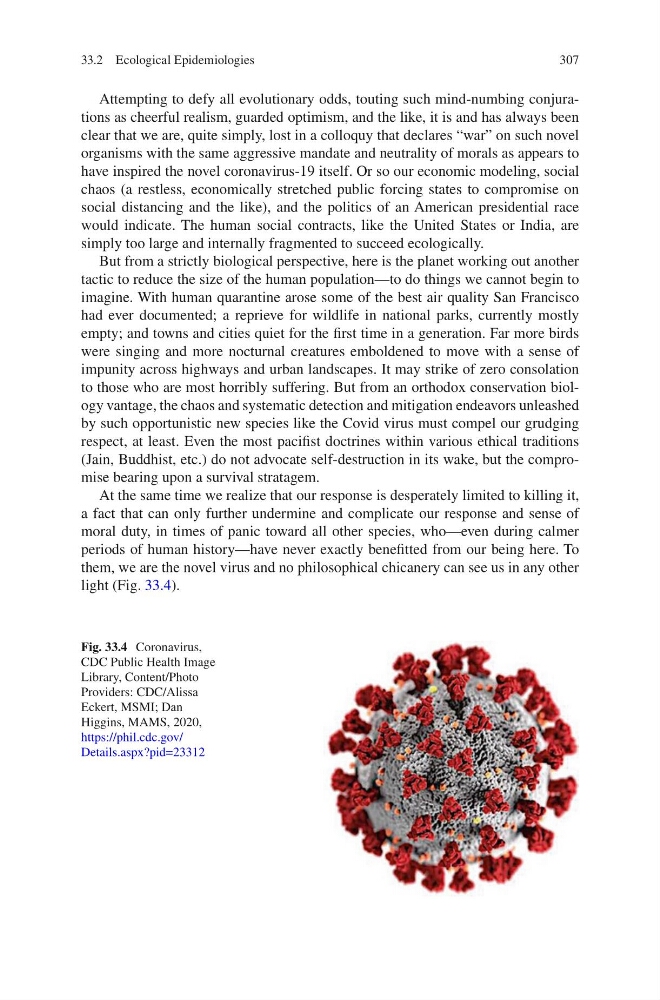
light (Fig. 33.4).
Fig. 33.4 Coronavirus,
CDC Public Health Image
Library, Content/Photo
Providers: CDC/Alissa
Eckert, MSMI; Dan
Higgins, MAMS, 2020,
https://phil.cdc.gov/
Details.aspx?pid=23312
33.2 Ecological Epidemiologies
Attempting to defy all evolutionary odds, touting such mind-numbing conjurations as cheerful realism, guarded optimism, and the like, it is and has always been
clear that we are, quite simply, lost in a colloquy that declares “war” on such novel
organisms with the same aggressive mandate and neutrality of morals as appears to
have inspired the novel coronavirus-19 itself. Or so our economic modeling, social
chaos (a restless, economically stretched public forcing states to compromise on
social distancing and the like), and the politics of an American presidential race
would indicate. The human social contracts, like the United States or India, are
simply too large and internally fragmented to succeed ecologically.
But from a strictly biological perspective, here is the planet working out another
tactic to reduce the size of the human population—to do things we cannot begin to
imagine. With human quarantine arose some of the best air quality San Francisco
had ever documented; a reprieve for wildlife in national parks, currently mostly
empty; and towns and cities quiet for the first time in a generation. Far more birds
were singing and more nocturnal creatures emboldened to move with a sense of
impunity across highways and urban landscapes. It may strike of zero consolation
to those who are most horribly suffering. But from an orthodox conservation biology vantage, the chaos and systematic detection and mitigation endeavors unleashed
by such opportunistic new species like the Covid virus must compel our grudging
respect, at least. Even the most pacifist doctrines within various ethical traditions
(Jain, Buddhist, etc.) do not advocate self-destruction in its wake, but the compromise bearing upon a survival stratagem.
At the same time we realize that our response is desperately limited to killing it,
a fact that can only further undermine and complicate our response and sense of
moral duty, in times of panic toward all other species, who—even during calmer
periods of human history—have never exactly benefitted from our being here. To
them, we are the novel virus and no philosophical chicanery can see us in any other
light (Fig. 33.4).
Fig. 33.4 Coronavirus,
CDC Public Health Image
Library, Content/Photo
Providers: CDC/Alissa
Eckert, MSMI; Dan
Higgins, MAMS, 2020,
https://phil.cdc.gov/
Details.aspx?pid=23312
33.2 Ecological Epidemiologies