

283
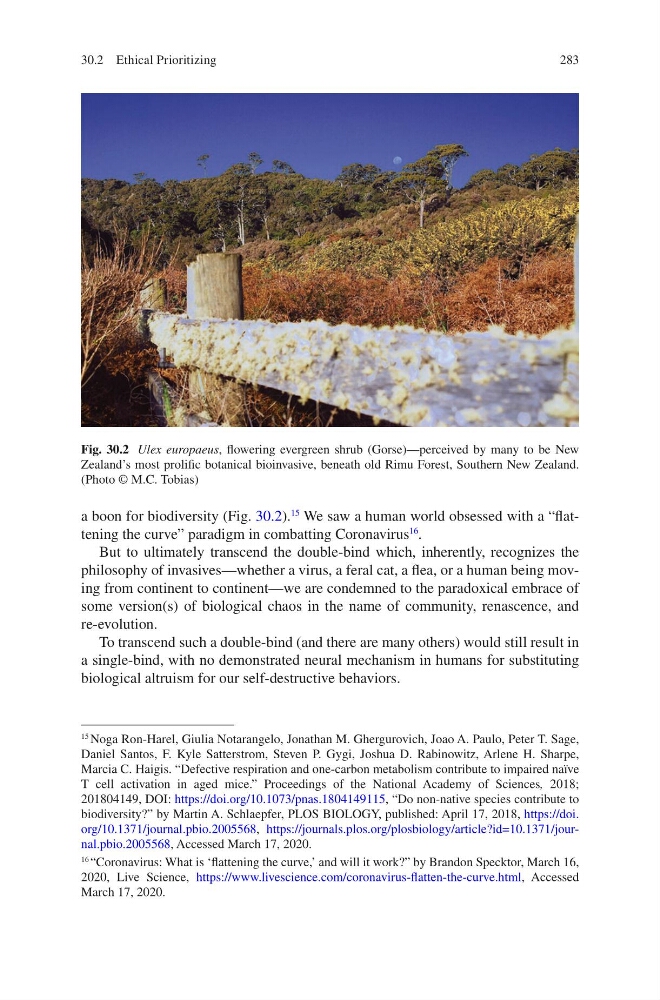
a boon for biodiversity (Fig. 30.2).
15
We saw a human world obsessed with a “flattening the curve” paradigm in combatting Coronavirus
16
.
But to ultimately transcend the double-bind which, inherently, recognizes the
philosophy of invasives—whether a virus, a feral cat, a flea, or a human being moving from continent to continent—we are condemned to the paradoxical embrace of
some version(s) of biological chaos in the name of community, renascence, and
re-evolution.
To transcend such a double-bind (and there are many others) would still result in
a single-bind, with no demonstrated neural mechanism in humans for substituting
biological altruism for our self-destructive behaviors.
15 Noga Ron-Harel, Giulia Notarangelo, Jonathan M. Ghergurovich, Joao A. Paulo, Peter T. Sage,
Daniel Santos, F. Kyle Satterstrom, Steven P. Gygi, Joshua D. Rabinowitz, Arlene H. Sharpe,
Marcia C. Haigis. “Defective respiration and one-carbon metabolism contribute to impaired naïve
T cell activation in aged mice.” Proceedings of the National Academy of Sciences, 2018;
201804149, DOI: https://doi.org/10.1073/pnas.1804149115, “Do non-native species contribute to
biodiversity?” by Martin A. Schlaepfer, PLOS BIOLOGY, published: April 17, 2018, https://doi.
org/10.1371/journal.pbio.2005568, https://journals.plos.org/plosbiology/article?id=10.1371/journal.pbio.2005568, Accessed March 17, 2020.
16 “Coronavirus: What is ‘flattening the curve,’ and will it work?” by Brandon Specktor, March 16,
2020, Live Science, https://www.livescience.com/coronavirus-flatten-the-curve.html, Accessed
March 17, 2020.
Fig. 30.2 Ulex europaeus, flowering evergreen shrub (Gorse)—perceived by many to be New
Zealand’s most prolific botanical bioinvasive, beneath old Rimu Forest, Southern New Zealand.
(Photo © M.C. Tobias)
30.2 Ethical Prioritizing
a boon for biodiversity (Fig. 30.2).
15
We saw a human world obsessed with a “flattening the curve” paradigm in combatting Coronavirus
16
.
But to ultimately transcend the double-bind which, inherently, recognizes the
philosophy of invasives—whether a virus, a feral cat, a flea, or a human being moving from continent to continent—we are condemned to the paradoxical embrace of
some version(s) of biological chaos in the name of community, renascence, and
re-evolution.
To transcend such a double-bind (and there are many others) would still result in
a single-bind, with no demonstrated neural mechanism in humans for substituting
biological altruism for our self-destructive behaviors.
15 Noga Ron-Harel, Giulia Notarangelo, Jonathan M. Ghergurovich, Joao A. Paulo, Peter T. Sage,
Daniel Santos, F. Kyle Satterstrom, Steven P. Gygi, Joshua D. Rabinowitz, Arlene H. Sharpe,
Marcia C. Haigis. “Defective respiration and one-carbon metabolism contribute to impaired naïve
T cell activation in aged mice.” Proceedings of the National Academy of Sciences, 2018;
201804149, DOI: https://doi.org/10.1073/pnas.1804149115, “Do non-native species contribute to
biodiversity?” by Martin A. Schlaepfer, PLOS BIOLOGY, published: April 17, 2018, https://doi.
org/10.1371/journal.pbio.2005568, https://journals.plos.org/plosbiology/article?id=10.1371/journal.pbio.2005568, Accessed March 17, 2020.
16 “Coronavirus: What is ‘flattening the curve,’ and will it work?” by Brandon Specktor, March 16,
2020, Live Science, https://www.livescience.com/coronavirus-flatten-the-curve.html, Accessed
March 17, 2020.
Fig. 30.2 Ulex europaeus, flowering evergreen shrub (Gorse)—perceived by many to be New
Zealand’s most prolific botanical bioinvasive, beneath old Rimu Forest, Southern New Zealand.
(Photo © M.C. Tobias)
30.2 Ethical Prioritizing