

280
case, evolution would ensure the fly’s starvation. Alice is astonished but reminded
by the Gnat that “It always happens.”
3
Or, as John Gay (1685–1732) wrote in his
Fables, “…Tis vanity that swells thy mind. What, heav’n and earth for thee design’d!
For thee! Made only for our need; That more important Fleas might feed.”
4
A sentiment most prolifically illustrated in Ivan Krylov’s own Fables (1815). Krylov
(1769–1844) was most likely the pictorial and philosophical link between Aesop,
Jean de La Fontaine, and Lewis Carroll (1832–1898). And not surprisingly, there is
significant evidence linking Charles Darwin’s theories to the philosophical disposition of Lewis Carroll in his fiction.
5
So contradictory is the evidence in evolution for anything actually working out
as it should that French philosopher François de La Rochefoucauld (1630–1680)
wrote, “There are some who never would have loved if they never had heard it
3 See Lewis Carroll, Through The Looking-Glass and What Alice Found There: With Fifty
Illustrations by John Tenniel, Macmillan And Co., London, 1898, pp. 58–59.
4 Fables, John Gay, J. and R. Tonson and J. Watts, London, 1753, Volume 1, p. 189.
5 See “What are You? The influence of Charles Darwin’s evolutionary theory in Lewis Carroll’s
Alice’s Adventures in Wonderland and Through the Looking-Glass,” by Michelle W. H. Smit,
Leiden University, September 30, 2019, https://openaccess.leidenuniv.nl/handle/1887/79963
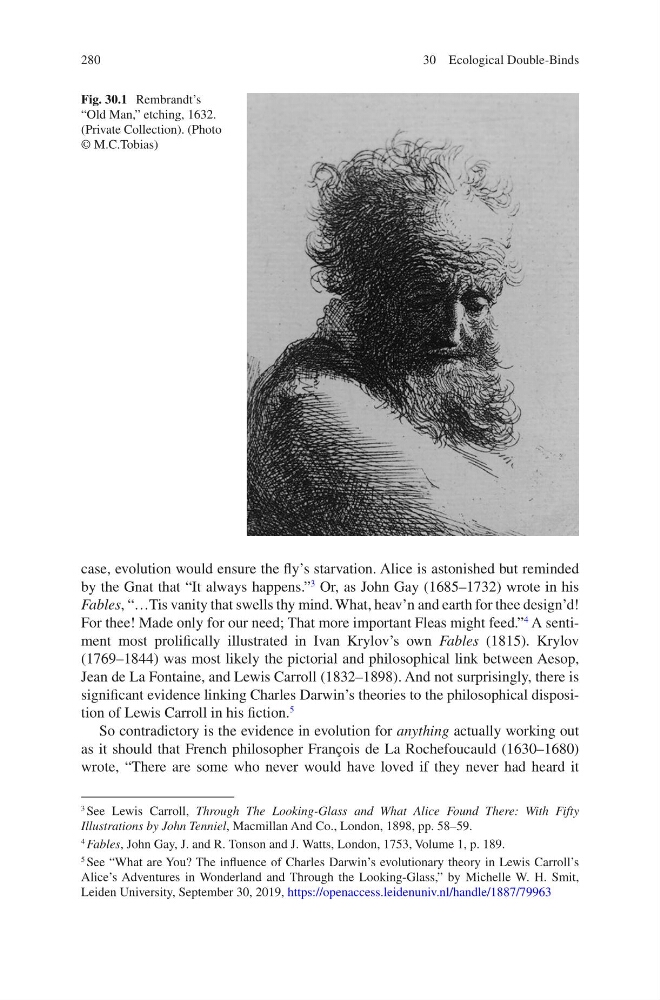
Fig. 30.1 Rembrandt’s
“Old Man,” etching, 1632.
(Private Collection). (Photo
© M.C.Tobias)
30 Ecological Double-Binds
case, evolution would ensure the fly’s starvation. Alice is astonished but reminded
by the Gnat that “It always happens.”
3
Or, as John Gay (1685–1732) wrote in his
Fables, “…Tis vanity that swells thy mind. What, heav’n and earth for thee design’d!
For thee! Made only for our need; That more important Fleas might feed.”
4
A sentiment most prolifically illustrated in Ivan Krylov’s own Fables (1815). Krylov
(1769–1844) was most likely the pictorial and philosophical link between Aesop,
Jean de La Fontaine, and Lewis Carroll (1832–1898). And not surprisingly, there is
significant evidence linking Charles Darwin’s theories to the philosophical disposition of Lewis Carroll in his fiction.
5
So contradictory is the evidence in evolution for anything actually working out
as it should that French philosopher François de La Rochefoucauld (1630–1680)
wrote, “There are some who never would have loved if they never had heard it
3 See Lewis Carroll, Through The Looking-Glass and What Alice Found There: With Fifty
Illustrations by John Tenniel, Macmillan And Co., London, 1898, pp. 58–59.
4 Fables, John Gay, J. and R. Tonson and J. Watts, London, 1753, Volume 1, p. 189.
5 See “What are You? The influence of Charles Darwin’s evolutionary theory in Lewis Carroll’s
Alice’s Adventures in Wonderland and Through the Looking-Glass,” by Michelle W. H. Smit,
Leiden University, September 30, 2019, https://openaccess.leidenuniv.nl/handle/1887/79963
Fig. 30.1 Rembrandt’s
“Old Man,” etching, 1632.
(Private Collection). (Photo
© M.C.Tobias)
30 Ecological Double-Binds