

260
transcendent wish that wishes away hours, combing the multitiered disparities and
discontent of an age—all ages—of devout anxiety, desperation resulting in some
great, albeit illusory, dream of exile.
Christopher Cardozo has told us that when Native Americans visit exhibitions of
Edward Curtis, which Cardozo has been brilliantly championing for much of his
life, they inevitably discern deceased members of their families. The continuity,
Christopher says, choking up with excitement, is like a family tree, lost ancestors,
future destiny, come to light, in the epiphanies of photographic moments. This was
what both Aristotle and Kant were more than hinting at. How our imagination might
be fully enlivened by the encounter with an image; the same field of excited electrons that catapults electrical impulses into our receptor visual cells within the
occipital lobes, laying bare the ecological implications of who and what we are; of
that which we can do to align our brief lifespans with the visual mapping in which
our brains are forever engaged—those who can see, or imagine such scenes, reconnoiter other sights ecstatic, or gracefully bow out, leaving so many places alone
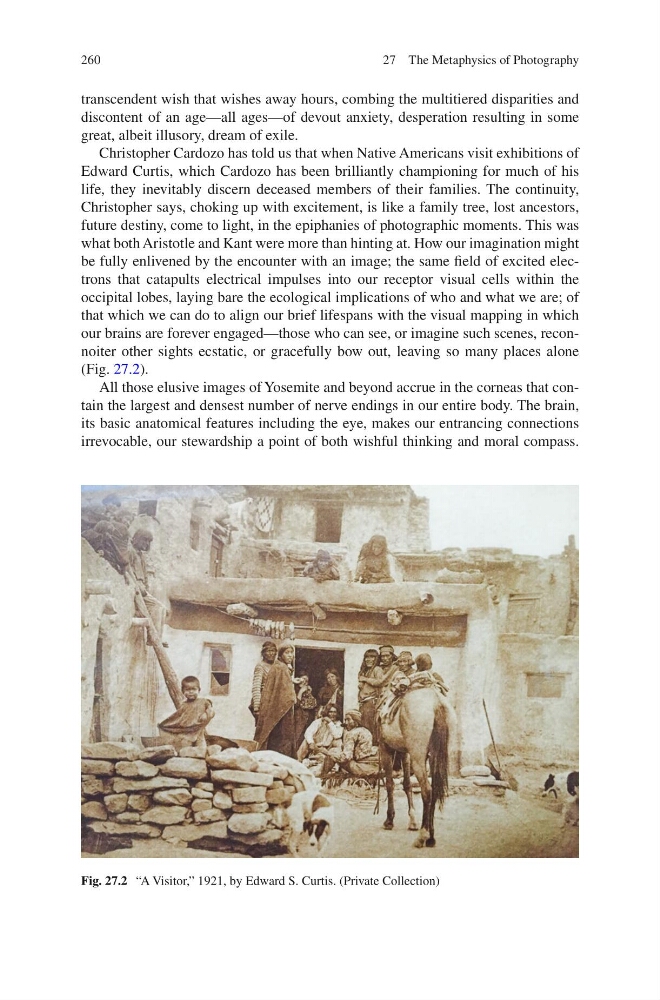
(Fig. 27.2).
All those elusive images of Yosemite and beyond accrue in the corneas that contain the largest and densest number of nerve endings in our entire body. The brain,
its basic anatomical features including the eye, makes our entrancing connections
irrevocable, our stewardship a point of both wishful thinking and moral compass.
Fig. 27.2 “A Visitor,” 1921, by Edward S. Curtis. (Private Collection)
27 The Metaphysics of Photography
transcendent wish that wishes away hours, combing the multitiered disparities and
discontent of an age—all ages—of devout anxiety, desperation resulting in some
great, albeit illusory, dream of exile.
Christopher Cardozo has told us that when Native Americans visit exhibitions of
Edward Curtis, which Cardozo has been brilliantly championing for much of his
life, they inevitably discern deceased members of their families. The continuity,
Christopher says, choking up with excitement, is like a family tree, lost ancestors,
future destiny, come to light, in the epiphanies of photographic moments. This was
what both Aristotle and Kant were more than hinting at. How our imagination might
be fully enlivened by the encounter with an image; the same field of excited electrons that catapults electrical impulses into our receptor visual cells within the
occipital lobes, laying bare the ecological implications of who and what we are; of
that which we can do to align our brief lifespans with the visual mapping in which
our brains are forever engaged—those who can see, or imagine such scenes, reconnoiter other sights ecstatic, or gracefully bow out, leaving so many places alone
(Fig. 27.2).
All those elusive images of Yosemite and beyond accrue in the corneas that contain the largest and densest number of nerve endings in our entire body. The brain,
its basic anatomical features including the eye, makes our entrancing connections
irrevocable, our stewardship a point of both wishful thinking and moral compass.
Fig. 27.2 “A Visitor,” 1921, by Edward S. Curtis. (Private Collection)
27 The Metaphysics of Photography