

242
dependent upon subjective criteria and the conservatism, or not, of policy
perceptions.
Multiply such impressions by internal mechanisms of impact (where blame is
easily cast on race, industry, point of origin, even gender) and we find the current
pre-conditions for listing or not listing species as Threatened or Endangered ripe
with human folly. Folly × folly does not equal good science, and even worse public
policy. Neither domain can quite account for the gaps in human nature, which, ultimately, come down to two fundamental realities: human hunger and the availability
of plants; and the senses, which appreciate, reject (as in the case of allergenic
plants), or exhibit tone deafness. But the basic scientific debates according to threat
levels to plants (where science also confuses bioinvasives, e.g., weeds, with reality)
tracks along linguistic lines, and Linnaeus and his predecessors across Europe have
much to do with the gaps, fueled by almost perverse obsessions with the sexual
nature of plant proliferation, that a Maeterlink assayed (and quite brilliantly) to
improve upon.
As for Colorado, the state is ranked number 8 in the nation for at-risk plant species, with 16 species-level taxa federally listed as Threatened or Endangered. And
of 117 plant species found in the state that happen to be “globally imperiled and
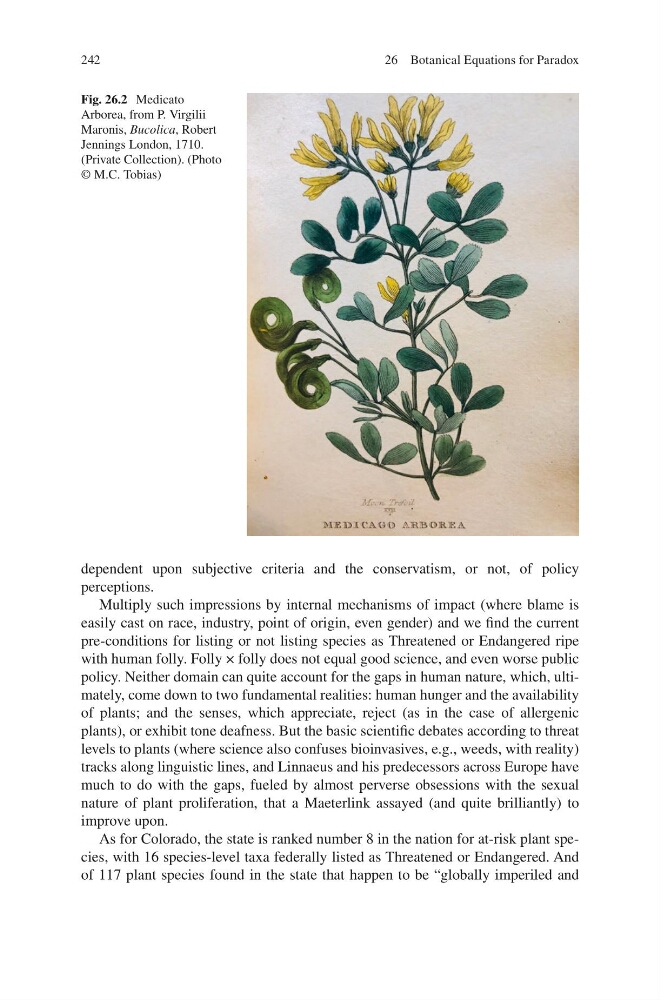
Fig. 26.2 Medicato
Arborea, from P. Virgilii
Maronis, Bucolica, Robert
Jennings London, 1710.
(Private Collection). (Photo
© M.C. Tobias)
26 Botanical Equations for Paradox
dependent upon subjective criteria and the conservatism, or not, of policy
perceptions.
Multiply such impressions by internal mechanisms of impact (where blame is
easily cast on race, industry, point of origin, even gender) and we find the current
pre-conditions for listing or not listing species as Threatened or Endangered ripe
with human folly. Folly × folly does not equal good science, and even worse public
policy. Neither domain can quite account for the gaps in human nature, which, ultimately, come down to two fundamental realities: human hunger and the availability
of plants; and the senses, which appreciate, reject (as in the case of allergenic
plants), or exhibit tone deafness. But the basic scientific debates according to threat
levels to plants (where science also confuses bioinvasives, e.g., weeds, with reality)
tracks along linguistic lines, and Linnaeus and his predecessors across Europe have
much to do with the gaps, fueled by almost perverse obsessions with the sexual
nature of plant proliferation, that a Maeterlink assayed (and quite brilliantly) to
improve upon.
As for Colorado, the state is ranked number 8 in the nation for at-risk plant species, with 16 species-level taxa federally listed as Threatened or Endangered. And
of 117 plant species found in the state that happen to be “globally imperiled and
Fig. 26.2 Medicato
Arborea, from P. Virgilii
Maronis, Bucolica, Robert
Jennings London, 1710.
(Private Collection). (Photo
© M.C. Tobias)
26 Botanical Equations for Paradox