

237
The original lamb, as painted in the central panel of this, arguably the most emotional, provocative, and influential painting in the history of Western Civilization, is
a lamb of great sorrow. His destiny has not been altered, despite the superficial
efforts to destroy, remove, or steal his look away. In the end, the magnificent incarnation of his spirit by the van Eyck brothers endures. Indeed, while the lamb carried
primary symbolism to the heart of the Middle Ages worshippers, it is a very different substantiation carried out by the van Eycks. As Sir Martin Conway wrote of it,
“It does not look like a symbol, it looks like a sheep; and instead of at once suggesting a mystic thought, it shocks the eye by its sturdy realism….”
16
And while a small and devoted contingent of vegans attempt to rewrite the history of Ghent surrounding the Altarpiece, a world of Christians and Jews, of
Muslims and people of every other conceivable faith, or lack of faith, continue to
slaughter sheep and, as per the use of the young singular in Exodus 12:3–8, the
Reaktion Books, Ltd., London, 1991; and Van Eyck, by Ludwig Baldass, Phaidon Press, London,
1952.
16 See Early Flemish Artists and their Predecessors on the Lower Rhine, by William Martin
Conway, Seeley & Co., London 1887, p. 138.
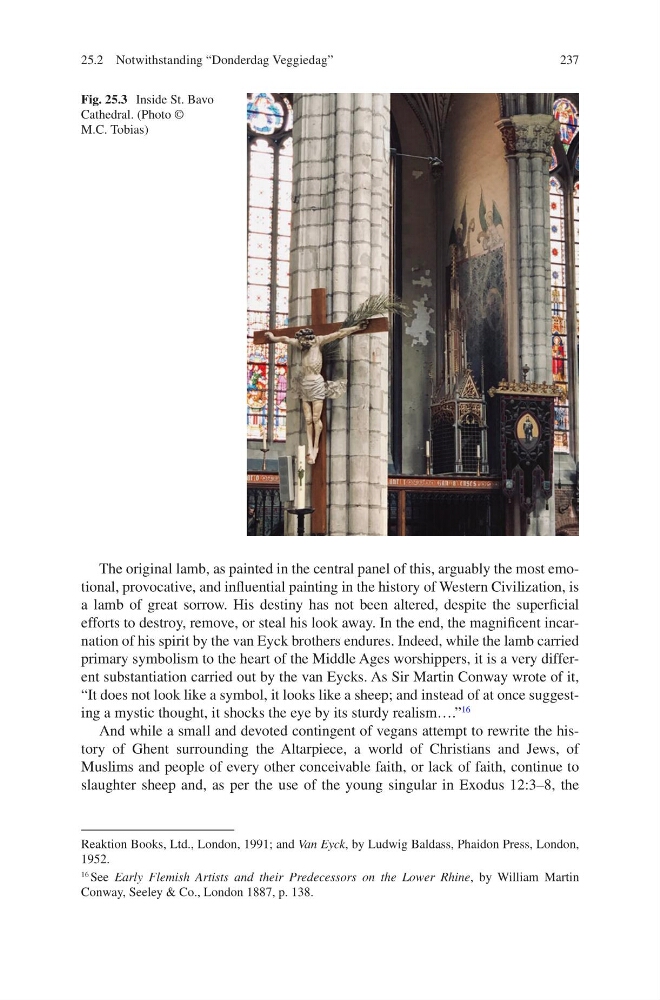
Fig. 25.3 Inside St. Bavo
Cathedral. (Photo ©
M.C. Tobias)
25.2 Notwithstanding “Donderdag Veggiedag”
The original lamb, as painted in the central panel of this, arguably the most emotional, provocative, and influential painting in the history of Western Civilization, is
a lamb of great sorrow. His destiny has not been altered, despite the superficial
efforts to destroy, remove, or steal his look away. In the end, the magnificent incarnation of his spirit by the van Eyck brothers endures. Indeed, while the lamb carried
primary symbolism to the heart of the Middle Ages worshippers, it is a very different substantiation carried out by the van Eycks. As Sir Martin Conway wrote of it,
“It does not look like a symbol, it looks like a sheep; and instead of at once suggesting a mystic thought, it shocks the eye by its sturdy realism….”
16
And while a small and devoted contingent of vegans attempt to rewrite the history of Ghent surrounding the Altarpiece, a world of Christians and Jews, of
Muslims and people of every other conceivable faith, or lack of faith, continue to
slaughter sheep and, as per the use of the young singular in Exodus 12:3–8, the
Reaktion Books, Ltd., London, 1991; and Van Eyck, by Ludwig Baldass, Phaidon Press, London,
1952.
16 See Early Flemish Artists and their Predecessors on the Lower Rhine, by William Martin
Conway, Seeley & Co., London 1887, p. 138.
Fig. 25.3 Inside St. Bavo
Cathedral. (Photo ©
M.C. Tobias)
25.2 Notwithstanding “Donderdag Veggiedag”