

217
excavations at the Clark Quarry near Brunswick, Georgia.
13
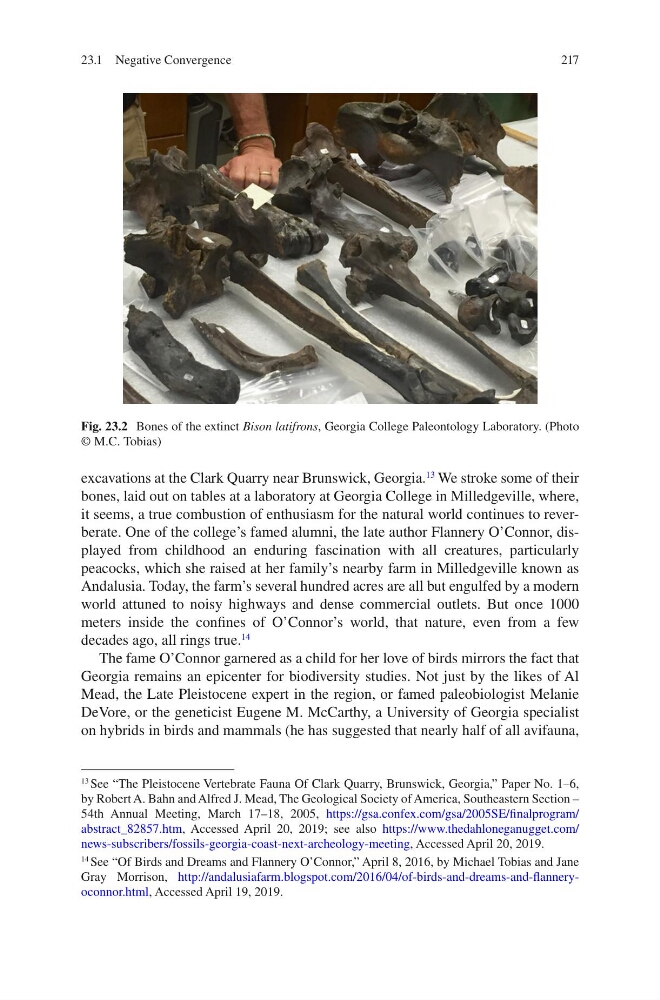
We stroke some of their
bones, laid out on tables at a laboratory at Georgia College in Milledgeville, where,
it seems, a true combustion of enthusiasm for the natural world continues to reverberate. One of the college’s famed alumni, the late author Flannery O’Connor, displayed from childhood an enduring fascination with all creatures, particularly
peacocks, which she raised at her family’s nearby farm in Milledgeville known as
Andalusia. Today, the farm’s several hundred acres are all but engulfed by a modern
world attuned to noisy highways and dense commercial outlets. But once 1000
meters inside the confines of O’Connor’s world, that nature, even from a few
decades ago, all rings true.
14
The fame O’Connor garnered as a child for her love of birds mirrors the fact that
Georgia remains an epicenter for biodiversity studies. Not just by the likes of Al
Mead, the Late Pleistocene expert in the region, or famed paleobiologist Melanie
DeVore, or the geneticist Eugene M. McCarthy, a University of Georgia specialist
on hybrids in birds and mammals (he has suggested that nearly half of all avifauna,
13 See “The Pleistocene Vertebrate Fauna Of Clark Quarry, Brunswick, Georgia,” Paper No. 1–6,
by Robert A. Bahn and Alfred J. Mead, The Geological Society of America, Southeastern Section –
54th Annual Meeting, March 17–18, 2005, https://gsa.confex.com/gsa/2005SE/finalprogram/
abstract_82857.htm, Accessed April 20, 2019; see also https://www.thedahloneganugget.com/
news-subscribers/fossils-georgia-coast-next-archeology-meeting, Accessed April 20, 2019.
14 See “Of Birds and Dreams and Flannery O’Connor,” April 8, 2016, by Michael Tobias and Jane
Gray Morrison, http://andalusiafarm.blogspot.com/2016/04/of-birds-and-dreams-and-flanneryoconnor.html, Accessed April 19, 2019.
Fig. 23.2 Bones of the extinct Bison latifrons, Georgia College Paleontology Laboratory. (Photo
© M.C. Tobias)
23.1 Negative Convergence
excavations at the Clark Quarry near Brunswick, Georgia.
13
We stroke some of their
bones, laid out on tables at a laboratory at Georgia College in Milledgeville, where,
it seems, a true combustion of enthusiasm for the natural world continues to reverberate. One of the college’s famed alumni, the late author Flannery O’Connor, displayed from childhood an enduring fascination with all creatures, particularly
peacocks, which she raised at her family’s nearby farm in Milledgeville known as
Andalusia. Today, the farm’s several hundred acres are all but engulfed by a modern
world attuned to noisy highways and dense commercial outlets. But once 1000
meters inside the confines of O’Connor’s world, that nature, even from a few
decades ago, all rings true.
14
The fame O’Connor garnered as a child for her love of birds mirrors the fact that
Georgia remains an epicenter for biodiversity studies. Not just by the likes of Al
Mead, the Late Pleistocene expert in the region, or famed paleobiologist Melanie
DeVore, or the geneticist Eugene M. McCarthy, a University of Georgia specialist
on hybrids in birds and mammals (he has suggested that nearly half of all avifauna,
13 See “The Pleistocene Vertebrate Fauna Of Clark Quarry, Brunswick, Georgia,” Paper No. 1–6,
by Robert A. Bahn and Alfred J. Mead, The Geological Society of America, Southeastern Section –
54th Annual Meeting, March 17–18, 2005, https://gsa.confex.com/gsa/2005SE/finalprogram/
abstract_82857.htm, Accessed April 20, 2019; see also https://www.thedahloneganugget.com/
news-subscribers/fossils-georgia-coast-next-archeology-meeting, Accessed April 20, 2019.
14 See “Of Birds and Dreams and Flannery O’Connor,” April 8, 2016, by Michael Tobias and Jane
Gray Morrison, http://andalusiafarm.blogspot.com/2016/04/of-birds-and-dreams-and-flanneryoconnor.html, Accessed April 19, 2019.
Fig. 23.2 Bones of the extinct Bison latifrons, Georgia College Paleontology Laboratory. (Photo
© M.C. Tobias)
23.1 Negative Convergence