

200
a morbid loathing teetering around the madness in others, those who would ignore
the all-enduring labors of a planet throughout the tens of millions of years of her
biological experiments to produce a Capped Heron (Pilherodius pileatus) or the
genus morpho, with its 176 species and sub-species of unforgettable iconic, metallic
blue butterflies—the iridescence occurring in the nanostructures (lamellae layering,
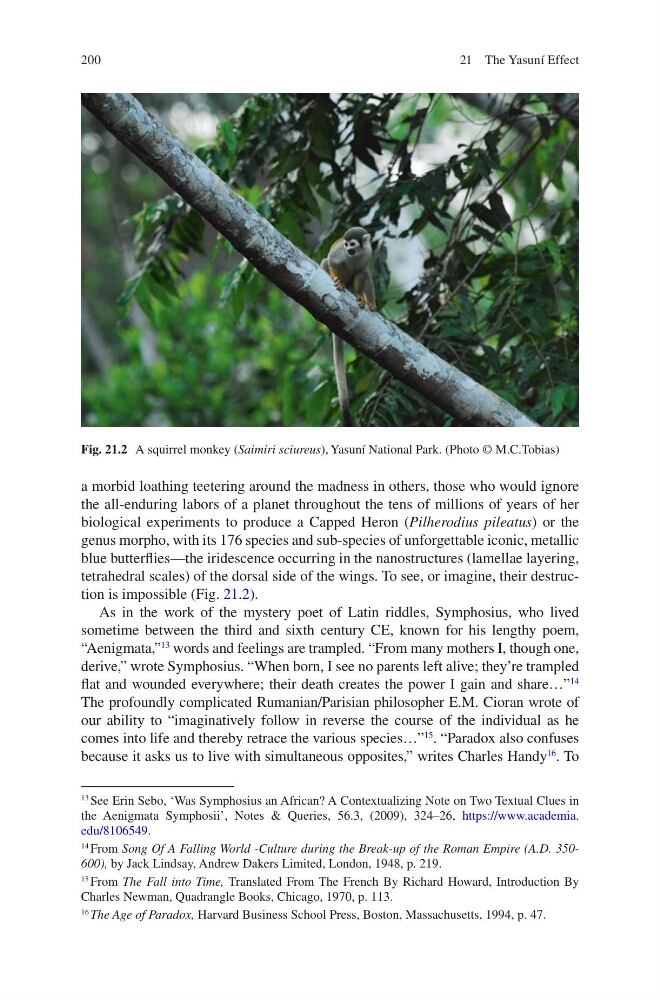
tetrahedral scales) of the dorsal side of the wings. To see, or imagine, their destruction is impossible (Fig. 21.2).
As in the work of the mystery poet of Latin riddles, Symphosius, who lived
sometime between the third and sixth century CE, known for his lengthy poem,
“Aenigmata,”
13
words and feelings are trampled. “From many mothers I, though one,
derive,” wrote Symphosius. “When born, I see no parents left alive; they’re trampled
flat and wounded everywhere; their death creates the power I gain and share…”
14
The profoundly complicated Rumanian/Parisian philosopher E.M. Cioran wrote of
our ability to “imaginatively follow in reverse the course of the individual as he
comes into life and thereby retrace the various species…”
15
. “Paradox also confuses
because it asks us to live with simultaneous opposites,” writes Charles Handy
16
. To
13 See Erin Sebo, ‘Was Symphosius an African? A Contextualizing Note on Two Textual Clues in
the Aenigmata Symphosii’, Notes & Queries, 56.3, (2009), 324–26, https://www.academia.
edu/8106549.
14 From Song Of A Falling World -Culture during the Break-up of the Roman Empire (A.D. 350600), by Jack Lindsay, Andrew Dakers Limited, London, 1948, p. 219.
15 From The Fall into Time, Translated From The French By Richard Howard, Introduction By
Charles Newman, Quadrangle Books, Chicago, 1970, p. 113.
16 The Age of Paradox, Harvard Business School Press, Boston, Massachusetts, 1994, p. 47.
Fig. 21.2 A squirrel monkey (Saimiri sciureus), Yasuní National Park. (Photo © M.C.Tobias)
21 The Yasuní Effect
a morbid loathing teetering around the madness in others, those who would ignore
the all-enduring labors of a planet throughout the tens of millions of years of her
biological experiments to produce a Capped Heron (Pilherodius pileatus) or the
genus morpho, with its 176 species and sub-species of unforgettable iconic, metallic
blue butterflies—the iridescence occurring in the nanostructures (lamellae layering,
tetrahedral scales) of the dorsal side of the wings. To see, or imagine, their destruction is impossible (Fig. 21.2).
As in the work of the mystery poet of Latin riddles, Symphosius, who lived
sometime between the third and sixth century CE, known for his lengthy poem,
“Aenigmata,”
13
words and feelings are trampled. “From many mothers I, though one,
derive,” wrote Symphosius. “When born, I see no parents left alive; they’re trampled
flat and wounded everywhere; their death creates the power I gain and share…”
14
The profoundly complicated Rumanian/Parisian philosopher E.M. Cioran wrote of
our ability to “imaginatively follow in reverse the course of the individual as he
comes into life and thereby retrace the various species…”
15
. “Paradox also confuses
because it asks us to live with simultaneous opposites,” writes Charles Handy
16
. To
13 See Erin Sebo, ‘Was Symphosius an African? A Contextualizing Note on Two Textual Clues in
the Aenigmata Symphosii’, Notes & Queries, 56.3, (2009), 324–26, https://www.academia.
edu/8106549.
14 From Song Of A Falling World -Culture during the Break-up of the Roman Empire (A.D. 350600), by Jack Lindsay, Andrew Dakers Limited, London, 1948, p. 219.
15 From The Fall into Time, Translated From The French By Richard Howard, Introduction By
Charles Newman, Quadrangle Books, Chicago, 1970, p. 113.
16 The Age of Paradox, Harvard Business School Press, Boston, Massachusetts, 1994, p. 47.
Fig. 21.2 A squirrel monkey (Saimiri sciureus), Yasuní National Park. (Photo © M.C.Tobias)
21 The Yasuní Effect