

196
so merciless a world of slimes, saps, thorns, micros and macros, blisters and bites.
Fifty-five million-year-old threats to bipedal movement; menaces masked delicately, swiftly, colorfully, or unseen. But at maximal cost. The burdens accumulate
in a mental maelstrom, comminations without respite. Mostly, it is the idea of the
Amazon that prompts both terror and her rewards.
Such rainforest, if anything, precludes all obvious awareness and intrusion,
instantaneously drowning out consciousness that would ask, pathetically, for the
least, confused exceptionalism. Rainforests are, by primordial definition, the purest
forms of self-maintenance in absence of governance. This dense forest cover
eschews political etiquette. Standouts like ourselves are insulting. Any physical
manifestation that does not reign in ego, self-absorbing within a biological ethic
instituted tens of millions of years ago, is either a random mutation with virtually no
success in store, or simply the momentary bulk of debris that has accumulated from
flood waters, a fire, or some other natural disturbance. Acoustics, light, shade,
movement through an unharnessing by the second of all that refuses to be touched,
performs the perfect cosmological set of non-equations, indeterminacies and subterfuge, the very obverse of an astrogeophysical black hole.
Lyanda Lynn Haupt writes of Charles Darwin’s diaries during his years on the
Beagle, and specifically in concert with some of his early solitary walks into the
Brazilian tropics, “He touched, lightly, everything that didn’t look like it could bite,
he smiled just a little, and finally he reached for his pocket notebook, wanting to
capture something of this strange, soft elation ‘Twiners entwining twiners—tresses
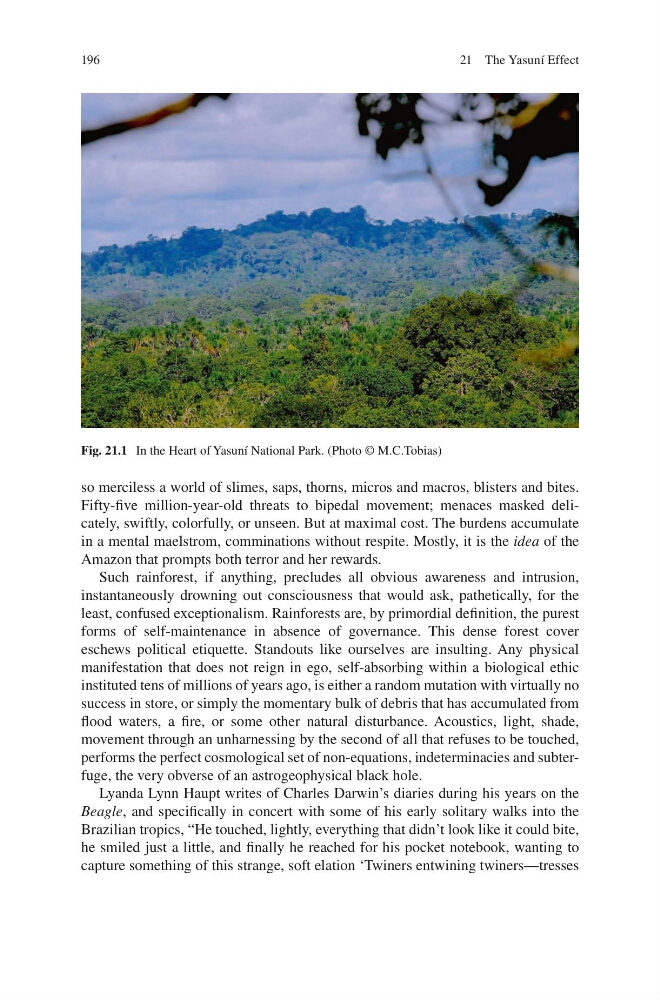
Fig. 21.1 In the Heart of Yasuní National Park. (Photo © M.C.Tobias)
21 The Yasuní Effect
so merciless a world of slimes, saps, thorns, micros and macros, blisters and bites.
Fifty-five million-year-old threats to bipedal movement; menaces masked delicately, swiftly, colorfully, or unseen. But at maximal cost. The burdens accumulate
in a mental maelstrom, comminations without respite. Mostly, it is the idea of the
Amazon that prompts both terror and her rewards.
Such rainforest, if anything, precludes all obvious awareness and intrusion,
instantaneously drowning out consciousness that would ask, pathetically, for the
least, confused exceptionalism. Rainforests are, by primordial definition, the purest
forms of self-maintenance in absence of governance. This dense forest cover
eschews political etiquette. Standouts like ourselves are insulting. Any physical
manifestation that does not reign in ego, self-absorbing within a biological ethic
instituted tens of millions of years ago, is either a random mutation with virtually no
success in store, or simply the momentary bulk of debris that has accumulated from
flood waters, a fire, or some other natural disturbance. Acoustics, light, shade,
movement through an unharnessing by the second of all that refuses to be touched,
performs the perfect cosmological set of non-equations, indeterminacies and subterfuge, the very obverse of an astrogeophysical black hole.
Lyanda Lynn Haupt writes of Charles Darwin’s diaries during his years on the
Beagle, and specifically in concert with some of his early solitary walks into the
Brazilian tropics, “He touched, lightly, everything that didn’t look like it could bite,
he smiled just a little, and finally he reached for his pocket notebook, wanting to
capture something of this strange, soft elation ‘Twiners entwining twiners—tresses
Fig. 21.1 In the Heart of Yasuní National Park. (Photo © M.C.Tobias)
21 The Yasuní Effect