

177
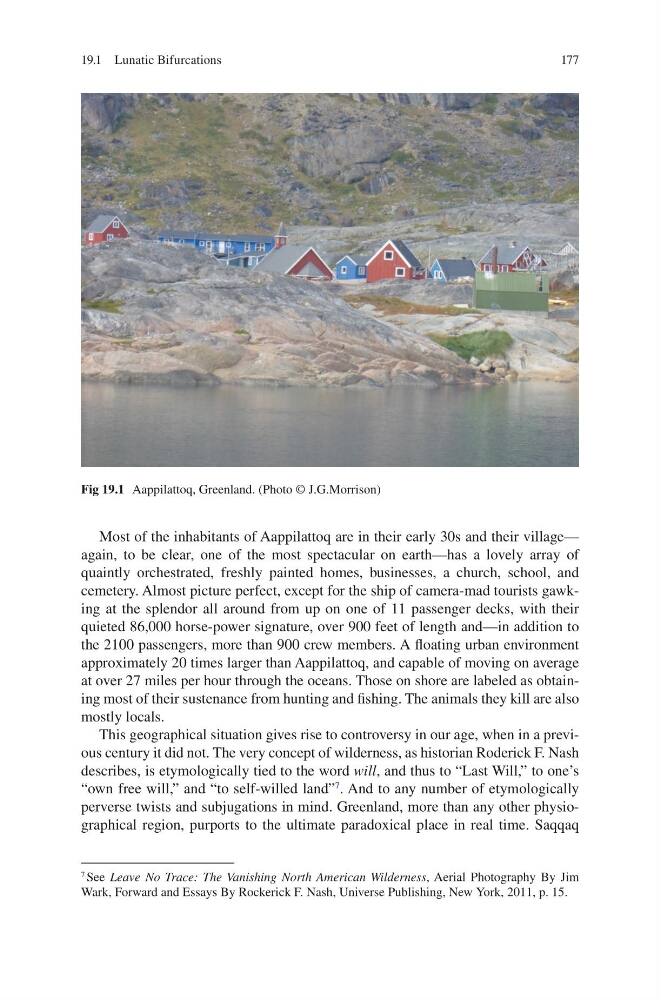
Most of the inhabitants of Aappilattoq are in their early 30s and their village—
again, to be clear, one of the most spectacular on earth—has a lovely array of
quaintly orchestrated, freshly painted homes, businesses, a church, school, and
cemetery. Almost picture perfect, except for the ship of camera-mad tourists gawking at the splendor all around from up on one of 11 passenger decks, with their
quieted 86,000 horse-power signature, over 900 feet of length and—in addition to
the 2100 passengers, more than 900 crew members. A floating urban environment
approximately 20 times larger than Aappilattoq, and capable of moving on average
at over 27 miles per hour through the oceans. Those on shore are labeled as obtaining most of their sustenance from hunting and fishing. The animals they kill are also
mostly locals.
This geographical situation gives rise to controversy in our age, when in a previous century it did not. The very concept of wilderness, as historian Roderick F. Nash
describes, is etymologically tied to the word will, and thus to “Last Will,” to one’s
“own free will,” and “to self-willed land”
7
. And to any number of etymologically
perverse twists and subjugations in mind. Greenland, more than any other physiographical region, purports to the ultimate paradoxical place in real time. Saqqaq
7 See Leave No Trace: The Vanishing North American Wilderness, Aerial Photography By Jim
Wark, Forward and Essays By Rockerick F. Nash, Universe Publishing, New York, 2011, p. 15.
Fig 19.1 Aappilattoq, Greenland. (Photo © J.G.Morrison)
19.1 Lunatic Bifurcations
Most of the inhabitants of Aappilattoq are in their early 30s and their village—
again, to be clear, one of the most spectacular on earth—has a lovely array of
quaintly orchestrated, freshly painted homes, businesses, a church, school, and
cemetery. Almost picture perfect, except for the ship of camera-mad tourists gawking at the splendor all around from up on one of 11 passenger decks, with their
quieted 86,000 horse-power signature, over 900 feet of length and—in addition to
the 2100 passengers, more than 900 crew members. A floating urban environment
approximately 20 times larger than Aappilattoq, and capable of moving on average
at over 27 miles per hour through the oceans. Those on shore are labeled as obtaining most of their sustenance from hunting and fishing. The animals they kill are also
mostly locals.
This geographical situation gives rise to controversy in our age, when in a previous century it did not. The very concept of wilderness, as historian Roderick F. Nash
describes, is etymologically tied to the word will, and thus to “Last Will,” to one’s
“own free will,” and “to self-willed land”
7
. And to any number of etymologically
perverse twists and subjugations in mind. Greenland, more than any other physiographical region, purports to the ultimate paradoxical place in real time. Saqqaq
7 See Leave No Trace: The Vanishing North American Wilderness, Aerial Photography By Jim
Wark, Forward and Essays By Rockerick F. Nash, Universe Publishing, New York, 2011, p. 15.
Fig 19.1 Aappilattoq, Greenland. (Photo © J.G.Morrison)
19.1 Lunatic Bifurcations