

126
have been inhabited during centuries past by any number of famed ascetics-turnedsaints. The cool lambent nights were thick with the gorgeous communal howls of
Egyptian jackals, taxa placed genetically within the “grey wolf species complex” as
of 2011.
36
The hot mornings emerged slowly to the lovely cooing of the Sinai doves.
All in retrospect so many years later couches memory in that enigmatic bundle
which was the Codex Sinaiticus itself: 188 lines in four columns, on average, per
leaf, until, some halfway through, turning to two much thicker columns. A mesmerizing tale told with uncials of Alexandrian text-type. Each of the quaternions comprising four conjugate leaves is signed in red ink by a scribe, of which there were
probably four or five, as well as three groups of so-called “correctors.” Nothing
quite prepares the reader for the intensity of the manuscript, the density of its importunate style, and the obscurity of its provenance.
36 See standard comparisons, see https://www.biblestudytools.com/micah/1-1-compare.html,
Accessed March 13, 2019.
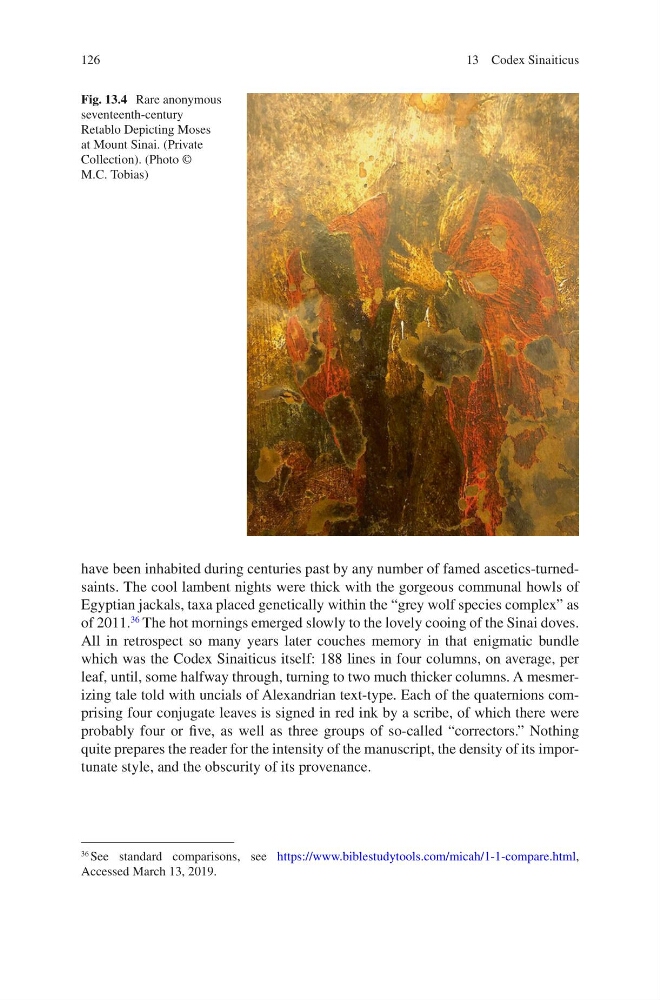
Fig. 13.4 Rare anonymous
seventeenth-century
Retablo Depicting Moses
at Mount Sinai. (Private
Collection). (Photo ©
M.C. Tobias)
13 Codex Sinaiticus
have been inhabited during centuries past by any number of famed ascetics-turnedsaints. The cool lambent nights were thick with the gorgeous communal howls of
Egyptian jackals, taxa placed genetically within the “grey wolf species complex” as
of 2011.
36
The hot mornings emerged slowly to the lovely cooing of the Sinai doves.
All in retrospect so many years later couches memory in that enigmatic bundle
which was the Codex Sinaiticus itself: 188 lines in four columns, on average, per
leaf, until, some halfway through, turning to two much thicker columns. A mesmerizing tale told with uncials of Alexandrian text-type. Each of the quaternions comprising four conjugate leaves is signed in red ink by a scribe, of which there were
probably four or five, as well as three groups of so-called “correctors.” Nothing
quite prepares the reader for the intensity of the manuscript, the density of its importunate style, and the obscurity of its provenance.
36 See standard comparisons, see https://www.biblestudytools.com/micah/1-1-compare.html,
Accessed March 13, 2019.
Fig. 13.4 Rare anonymous
seventeenth-century
Retablo Depicting Moses
at Mount Sinai. (Private
Collection). (Photo ©
M.C. Tobias)
13 Codex Sinaiticus