

120
prior to the mouth of Wady Lejâ, Elijah’s Chapel, the “Spring of Moses,” Wady
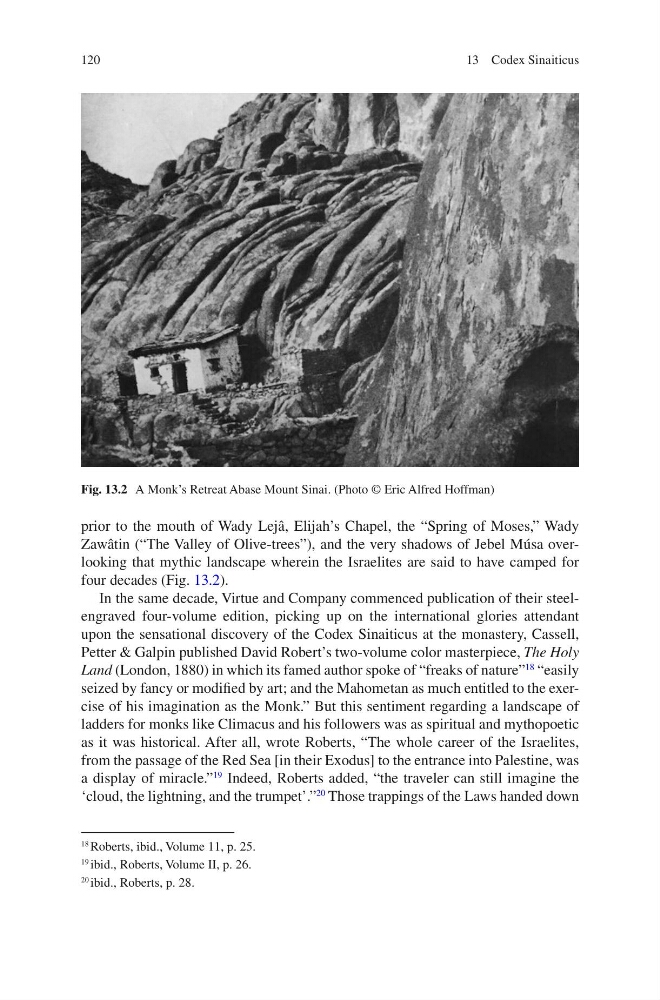
Zawâtin (“The Valley of Olive-trees”), and the very shadows of Jebel Músa overlooking that mythic landscape wherein the Israelites are said to have camped for
four decades (Fig. 13.2).
In the same decade, Virtue and Company commenced publication of their steelengraved four-volume edition, picking up on the international glories attendant
upon the sensational discovery of the Codex Sinaiticus at the monastery, Cassell,
Petter & Galpin published David Robert’s two-volume color masterpiece, The Holy
Land (London, 1880) in which its famed author spoke of “freaks of nature”
18
“easily
seized by fancy or modified by art; and the Mahometan as much entitled to the exercise of his imagination as the Monk.” But this sentiment regarding a landscape of
ladders for monks like Climacus and his followers was as spiritual and mythopoetic
as it was historical. After all, wrote Roberts, “The whole career of the Israelites,
from the passage of the Red Sea [in their Exodus] to the entrance into Palestine, was
a display of miracle.”
19
Indeed, Roberts added, “the traveler can still imagine the
‘cloud, the lightning, and the trumpet’.”
20
Those trappings of the Laws handed down
18 Roberts, ibid., Volume 11, p. 25.
19 ibid., Roberts, Volume II, p. 26.
20 ibid., Roberts, p. 28.
Fig. 13.2 A Monk’s Retreat Abase Mount Sinai. (Photo © Eric Alfred Hoffman)
13 Codex Sinaiticus
prior to the mouth of Wady Lejâ, Elijah’s Chapel, the “Spring of Moses,” Wady
Zawâtin (“The Valley of Olive-trees”), and the very shadows of Jebel Músa overlooking that mythic landscape wherein the Israelites are said to have camped for
four decades (Fig. 13.2).
In the same decade, Virtue and Company commenced publication of their steelengraved four-volume edition, picking up on the international glories attendant
upon the sensational discovery of the Codex Sinaiticus at the monastery, Cassell,
Petter & Galpin published David Robert’s two-volume color masterpiece, The Holy
Land (London, 1880) in which its famed author spoke of “freaks of nature”
18
“easily
seized by fancy or modified by art; and the Mahometan as much entitled to the exercise of his imagination as the Monk.” But this sentiment regarding a landscape of
ladders for monks like Climacus and his followers was as spiritual and mythopoetic
as it was historical. After all, wrote Roberts, “The whole career of the Israelites,
from the passage of the Red Sea [in their Exodus] to the entrance into Palestine, was
a display of miracle.”
19
Indeed, Roberts added, “the traveler can still imagine the
‘cloud, the lightning, and the trumpet’.”
20
Those trappings of the Laws handed down
18 Roberts, ibid., Volume 11, p. 25.
19 ibid., Roberts, Volume II, p. 26.
20 ibid., Roberts, p. 28.
Fig. 13.2 A Monk’s Retreat Abase Mount Sinai. (Photo © Eric Alfred Hoffman)
13 Codex Sinaiticus